
Writing first-class nursing assignments
Structure, evidence and academic writing for UK nursing students, from brief to final draft.
Not sure where to start? Talk to our support team live.

Nursing & Dissertations
A nursing dissertation is the largest piece of academic work most UK nursing students undertake. This roadmap shows how to build a first-class one — from a focused research question and aligned chapters to a synthesised literature review, justified method, and critical discussion — using short teaching examples, not ready-made chapters.
The short version
A first-class nursing dissertation depends less on length than on alignment: a focused research question, chapters that clearly connect, appropriate evidence and method, and critical analysis and synthesis rather than description. It reads as one coherent argument, links its findings to the nursing context, and is refined through disciplined drafting and review.
On this page
The standard
A nursing dissertation is the largest piece of academic writing most UK students undertake, and getting the structure and methodology right early makes everything that follows easier. The mark rarely comes down to word count — it comes down to whether the whole thing holds together as a single, evidence-based argument. First-class work is defined by alignment (every chapter serves the research question), evidence quality, a justified method, sound reasoning, coherence, and clear nursing relevance.
The clearest way to see the standard is the shift from describing, to analysing, to synthesising:
From pass to first-class
The test If a reader can follow one clear argument from your research question all the way to your conclusion, you are writing at first-class level. If chapters read as separate mini-essays, alignment is the first thing to fix.
Start here
Everything in the dissertation hangs off the research question, so time spent narrowing it is never wasted. A strong question is specific enough to answer within your word count and timeframe, and broad enough to have a literature behind it. Pressure-test any question against these:
Most students start too broad. The trick is to move from a topic to a question by adding a population, a focus and an outcome. A structured framework makes this concrete: PICO (Population, Intervention, Comparison, Outcome) suits intervention questions, while SPIDER (Sample, Phenomenon of Interest, Design, Evaluation, Research type) suits qualitative or experience-based questions. They are tools, not requirements — use whichever fits your topic.
Topic to question Broad topic: “pressure ulcers.” Focused question (PICO): “In adult inpatients at risk of pressure ulcers, how does more frequent repositioning, compared with standard repositioning, affect pressure-ulcer incidence?” Illustrative only — your question must be your own and grounded in the literature you can actually find.
Agree the final question with your supervisor before you build chapters around it. A question that shifts halfway through is one of the most expensive mistakes you can make, because every chapter has to move with it.
Plan against the rubric
Planning does not start with writing; it starts with reading. Before drafting, gather and re-read your assignment brief, the marking rubric, the learning outcomes, your university's dissertation requirements, and any supervisor guidance. These define what “first-class” means for your specific dissertation — the weighting of each chapter, the type of dissertation expected, and the criteria you will be marked against.
Reading the criteria closely is the single highest-value hour of the whole project — it defines the target everything else has to hit. If any part of the brief is ambiguous, your supervisor can confirm what the brief leaves open before you commit to a plan.
Start with the brief
Brief Decoder helps you turn a dense dissertation brief and marking rubric into concrete, prioritised requirements — so your research question and every chapter are built around what is actually being assessed. You stay in control of the work; it simply clarifies the task.
The shape
Structure varies by university and by dissertation type, but most nursing dissertations follow a recognisable shape. Use this as a map, then adjust to your own brief. Each chapter should visibly serve the research question.
First, know which type you are writing, because it changes the middle chapters:
Confirm your type with your supervisor early — a “findings” chapter means something different for an empirical study than for a literature review.
Typical chapter map
Referencing: nursing programmes use different styles — often Harvard, APA or Vancouver — so confirm which your school requires and apply it consistently from your very first note. For what belongs in appendices versus the main body, see our thesis appendix guide.
How long is it?
UK nursing dissertations vary widely — commonly somewhere between 8,000 and 15,000 words at undergraduate level, though your own brief is the only number that counts. More important than the total is how you allocate it: weight the words towards the chapters that carry the marks, rather than spreading them evenly.
Tables, and often the reference list, usually sit outside the word count — but always check your own rubric, as the rules differ by university. Decide the split before you draft, and revisit it if one chapter starts crowding out the analysis.
The hardest chapter
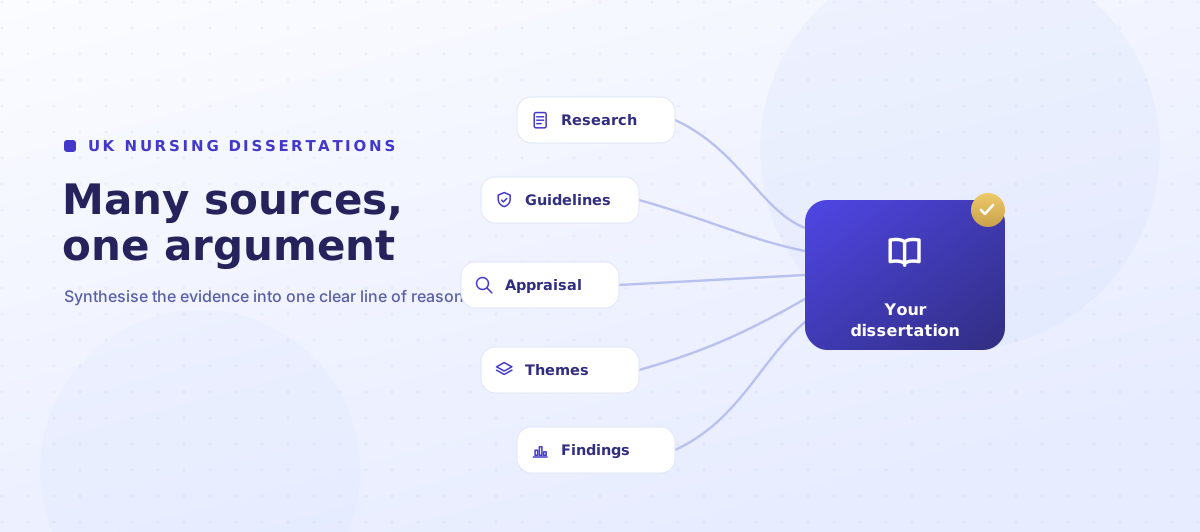
The literature review is where most marks are won or lost, and where most students slip into “Source A says… Source B says… Source C says…”. A first-class review does the opposite: it organises the evidence by theme, then compares, appraises and synthesises it into an argument that leads to your gap.
Before you can synthesise, you need a defensible search. Even for a non-systematic review, markers want to see that your evidence was found methodically, not cherry-picked:
Sources to synthesis
A synthesis matrix — a grid logging each study's theme, method, key finding and quality — makes the relationships visible and is the fastest route out of source-by-source writing (the free planner below includes one). Once themes are mapped, write to the theme, not the source: instead of a paragraph per study, write a paragraph per idea that draws several studies together.
Themes, not sources Rather than “Study A… Study B… Study C…”, a themed paragraph reads: “Several studies link X to Y; however, the two conducted in community settings report weaker effects, suggesting the setting matters.” That single move — comparing and explaining — is synthesis.
For each theme, say where studies agree, where they disagree and why — often differences in method, population or setting explain conflicting findings. The University of Southampton's guide to writing the dissertation literature review is a helpful reference, and our guide to why adding more sources is not always the answer explains why relevance and synthesis beat sheer volume.
How you found out
First, the distinction students most often blur: methodology is your overall approach and the reasoning behind it; methods are the specific techniques you used. Markers reward the justification — why this approach suits your question — far more than a description of what you did.
Crucially, not every nursing dissertation collects primary patient data. Many are literature-based (a structured review of existing research), which avoids primary data collection while still demanding rigour. Depending on your type, address the relevant items:
Two things lift a methodology chapter. First, how you will analyse the evidence: a qualitative study might use thematic analysis; a quantitative one, descriptive and — where appropriate — inferential statistics; a literature-based review, a structured thematic synthesis. Name the approach and say why it fits your question.
Second, rigour. Show you have thought about quality — reliability and validity in quantitative work, or credibility, transferability and dependability (trustworthiness) in qualitative work. Where relevant, add a note of reflexivity: how your own position might shape interpretation. If your study collects primary data, explain the ethical approval you obtained and how you protected participants — this is not optional, and it belongs here as well as in your ethics section.
Keep them separate
Blurring these two is one of the most common structural problems. Keep the jobs distinct: findings report what you found; the discussion explains what it means.
Present the results or the themes from your review clearly and neutrally — what the evidence shows, without interpretation.
Interpret the findings against existing research, weigh limitations, draw out nursing implications, and answer the research question.
A strong discussion moves through a clear chain for each key finding — from result to meaning to significance for practice:
A discussion move
In the findings chapter, present results or review themes clearly — use tables or clear sub-headings — and resist interpreting yet; save every “this suggests…” for the discussion. A full discussion then does more than interpret each finding: it also states honest limitations, draws out implications for practice, education or policy, and points to directions for future research — without overstating what one project can prove.
Our guide to interpreting your findings works through this shift from reporting to interpreting in more detail.
The differentiator
Descriptive writing is the single most common reason a technically complete dissertation misses a first. The fix is not more content — it is more judgement. After each piece of evidence, interrogate it:
Answering even a few of these turns a summary into analysis. For the sentence-level version of this shift, see our guide to description vs analysis, and for building analytical paragraphs, our guide to the PEEL method in nursing essays.
So what for nursing?
A nursing dissertation should show why its findings matter for care — but this is where students either say too little or over-claim. Discuss implications carefully: what the evidence suggests for practice, education or policy, framed by its strength and limitations. Avoid definitive clinical claims your evidence cannot support, and never imply your dissertation changes practice on its own.
Weight your implications by the strength of the evidence behind them. Broadly, systematic reviews and well-designed trials sit higher in the hierarchy of evidence than single small studies or expert opinion — so a recommendation resting on one small study should be phrased far more tentatively than one supported by several converging reviews. Making that calibration visible is itself a mark of critical thinking.
The same evidence-to-practice reasoning underpins a nursing care plan: an intervention is only as strong as the rationale behind it. Where relevant, anchor implications to professional standards such as the NMC Code rather than to opinion.
Do it properly
Even a literature-based dissertation has ethical dimensions — honest representation of sources, transparent method, and correct attribution. If your work involves any primary data or reference to practice, confidentiality is essential: anonymise people, places and identifying detail in line with the NMC Code.
If you collect any primary data, you will almost certainly need formal ethical approval before you start — never collect data first and seek approval afterwards. That usually means addressing informed consent, the right to withdraw, secure and data-protection-compliant handling of information, and safe storage and disposal. Approval can take weeks, so build it into your timeline rather than treating it as a formality.
Ethics requirements and approval processes differ by university and dissertation type, so follow your own institution's ethics guidance and your supervisor's direction — and keep the work firmly within your university's academic integrity expectations. The dissertation must be your own analysis, in your own words.
Pace yourself
A dissertation fails more often from poor pacing than from poor ability. Rather than fixed week numbers — which depend on your programme — think in stages, and protect time for revision, which students routinely underestimate:
The journey, stage by stage
Booking supervisor check-ins against these stages keeps the project moving. If you are weighing how long a longer research project realistically takes, our realistic thesis timeline guide is a useful comparison.
Avoid these
| Common mistake | How to fix it |
|---|---|
| Research question too broad | Narrow the focus, population or setting until it is answerable |
| Literature review becomes a source summary | Reorganise by theme; compare and synthesise, do not list |
| Weak alignment between chapters | Trace every chapter back to the research question |
| Too much background, not enough analysis | Trim context; give the space to critical discussion |
| Weak methodology justification | Explain why this approach suits the question, not just what you did |
| Findings and discussion blurred | Report first; interpret second — keep the jobs separate |
| Descriptive writing throughout | Add judgement: strength, limitation, comparison, implication |
| Unsupported clinical claims | Frame implications by the strength and limits of the evidence |
| Poor synthesis of evidence | Show how studies relate — agree, differ, and why |
| No clear search strategy | Record databases, terms and inclusion criteria so the review is reproducible |
| Inconsistent referencing | Apply one style from your first note and check every entry |
| Leaving editing to the end | Build in revision time; the final review is not a formality |
Most of these trace back to two things: alignment and analysis.
Land it
The conclusion is not a summary of everything you did — it is a direct answer to the research question, drawn from the argument you have already built. Synthesise your key points into a clear overall position, state the main implications and limitations, and suggest where research could go next. Crucially, introduce no new evidence here; the conclusion closes the argument rather than opening a new one.
Write the abstract last, once the conclusion is settled. In a short single paragraph (check your word limit) it should state the aim, your approach, the key findings and the main conclusion — a miniature of the whole dissertation, with no citations and nothing that is not in the main text. It is the first thing a marker reads, so make it clear and accurate.
Before you submit
Use this on your own draft — your marking criteria define exactly what each chapter must achieve.
Why us
My Perfect Writing helps UK nursing students plan, structure and review their own dissertation — while you stay responsible for your own research, analysis and words. We do not write assessed chapters.
Brief Decoder helps you turn the dissertation brief and rubric into concrete requirements.
Marker’s Eye reviews your own chapters and flags where description should become analysis, against UK marking expectations.
Guidance reflects how UK markers weigh alignment, evidence quality, synthesis and critical discussion.
Your research and writing remain yours. We do not write dissertations or invent studies or data.
Use the free blueprint to keep every chapter aligned to your research question before you draft.
You stay responsible for your own dissertation — our tools help you plan and review it, they do not write it for you.
Questions
Before you submit
Once your dissertation is drafted, review it against your brief and marking rubric — Marker’s Eye can check your own chapters for alignment, synthesis and critical depth before you submit. You make the changes; every word stays your own.
Guidance should support your learning, not replace your own work.