
Driscoll model of reflection
Turn a placement experience into critical, evidence-based reflection with What? So What? Now What?
Not sure where to start? Talk to our support team live.

Nursing & Academic Writing
Learn how to understand the brief, organise clinical evidence, link theory to practice and write critically while keeping every word your own.
The short version
To write a nursing assignment, answer the exact brief, then build a focused academic argument rather than a description. Use current evidence critically — compare and evaluate sources — and connect what they show to nursing practice. Follow professional standards and confidentiality requirements throughout, reference accurately, and keep every word your own.
On this page
The basics
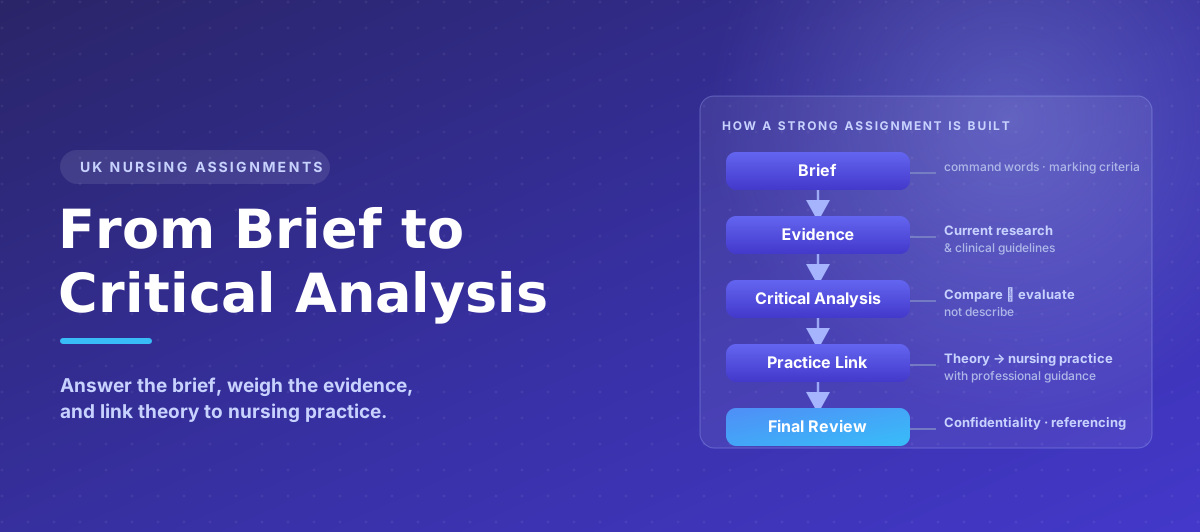
A strong nursing assignment does four things at once: it answers the exact question set, argues a clear position, supports that position with current evidence, and links the evidence to safe, person-centred nursing practice. Weak assignments describe a topic; strong ones analyse it — they weigh what the evidence shows and explain what it means for care.
UK markers assess a consistent set of qualities: task relevance, critical analysis, use of research and clinical evidence, structure, professional understanding, and referencing. Almost every mark you gain or lose maps back to one of these. This guide works through each in turn, with a worked example, a dedicated first-year section, and a planner you can use on your own draft.
Marker translation A pass answer explains what the evidence says. A strong answer explains what the evidence means for the question and for practice — and where the evidence is limited.
Step 1
Most lost marks start here — answering a question that was not set. Before you read a single article, read the assignment brief slowly and identify the command word: analyse, evaluate, discuss and critically appraise all ask for judgement, not just description, while describe or outline ask for less. Underline the topic, the scope, and any limits on word count or format.
Then read the learning outcomes and the marking criteria together. The learning outcomes tell you what the module must see you demonstrate; the marking rubric tells you how those are weighted. If most marks sit under "critical analysis" and "use of evidence", that is where most of your word count should go. If anything in the brief is genuinely unclear, ask your lecturer or module lead — a short email is far cheaper than a misdirected assignment.
A structured way to do this is to understand your nursing assignment brief command word by command word, so you can see exactly what the question is asking before you plan. For subject-specific guidance on what UK markers expect, our nursing assignment support page explains the same criteria in more depth.
Step 2
Once you understand the brief, decide on your answer — the position your assignment will argue. Even a "discuss" question benefits from a clear line: a one-sentence response that the whole piece supports. This is the difference between a report that lists facts and an assignment that makes a case.
Draft a working thesis in plain words: "This assignment argues that …, because the evidence shows …". You can refine it later, but having it early keeps every paragraph on task. If you cannot state your answer in one sentence, the question is still too broad — narrow it to a specific patient group, setting, or aspect of care you can actually support with evidence.
Step 3
Planning is where strong nursing academic writing is won. Map your main argument, then list the two or three supporting points that build it, and the counterpoint or limitation you will acknowledge. For each point, note the evidence you will use and how it connects to practice — before you write full paragraphs.
This is exactly what the free planner below is for: a one-page brief map, an evidence comparison matrix, and a paragraph planner so your reading is organised into an argument rather than a pile of quotes. Planning first also stops the most common structural problem — paragraphs that summarise a study but never say why it matters.
Step 4
| Section | Purpose | What strong writing does here |
|---|---|---|
| Introduction | Set up the question and your answer | States the topic, your position, and the scope — no long background |
| Body paragraphs | Build the argument | One claim per paragraph, evidenced, evaluated, and linked to practice |
| Evidence & analysis | Weigh the research | Compares studies and appraises reliability, rather than listing them |
| Practice link | Connect theory to care | Shows what the evidence means for safe, person-centred nursing |
| Conclusion | Answer the question | Synthesises the argument and responds directly to the brief — no new evidence |
| Reference list | Show your sources | Accurate, consistent, in your required style |
Structures vary by module and assignment type (essay, case study, care plan, reflection). Always check your brief and marking criteria first — this is a common default, not a fixed rule.
Step 5
Your introduction should answer the question in miniature: name the topic, state your position, and outline the scope in a few sentences. Resist a long history of the condition or a dictionary definition — markers want to see the argument start quickly.
For the body, give every paragraph a job. A reliable pattern for a nursing paragraph structure is: make a claim that advances your argument; give the evidence; explain what it shows; evaluate its strength or limitation; then link it to practice and back to the question. If a paragraph only reports what a study found, it is description — add the "so what for care?" and you have analysis. Signposting phrases from a resource such as the University of Manchester Academic Phrasebank can help you word comparison and evaluation without sounding formulaic.
Step 6
Evidence-based nursing means more than citing sources — it means judging them. Prefer current, relevant evidence and understand where it sits in the hierarchy of evidence: systematic reviews and well-conducted trials carry more weight than a single small study or expert opinion, though qualitative research is essential for understanding experience and person-centred care.
The skill markers reward is comparing studies rather than listing them: where do findings agree, where do they conflict, and why? Then appraise each source — its reliability, validity, sample, potential bias, and limitations. A structured tool such as the CASP critical appraisal checklists gives you a consistent way to do this. For clinical recommendations, cite authoritative UK sources such as NICE guidance rather than unverified websites. Never invent a finding or a statistic — if the evidence is thin, say so; acknowledging limitation is itself critical analysis.
If you find that comparing and evaluating evidence is exactly where you slow down, our guide on how to interpret findings and discuss evidence critically works through the same comparison-and-limitation skill in a science-writing context.
Worked example
Here is a short, anonymised academic example on a safe, generic topic — person-centred communication. No patient or setting is identified.
Descriptive Effective communication is important in nursing. Studies show that good communication improves patient satisfaction, so nurses should communicate well with patients.
Analytical Evidence associates person-centred communication with higher reported patient satisfaction, though much of it is self-reported and cross-sectional, which limits claims about cause. Even so, the pattern aligns with the professional expectation to treat people as partners in care, suggesting that structured communication training is a reasonable, if not fully proven, way to support person-centred practice.
Why the second is stronger It does not just report that communication "is important". It weighs the evidence, names a limitation (self-report, cross-sectional design), connects the finding to a professional expectation, and reaches a measured, defensible conclusion. That is the move from description to critical analysis.
Step 7
A nursing assignment is not an abstract essay — it should show what the evidence means for care. After you present and appraise evidence, add the practice link: how would this inform safe, person-centred, professionally accountable nursing? This is where theory, research and clinical judgement meet.
Use professional guidance appropriately to anchor those links. The NMC Code from the Nursing and Midwifery Council sets the standards you can reference when you explain why an evidence-based action supports patient safety or accountability. Cite it to support a point, not as decoration — and never state a professional requirement you have not checked. Keep the focus on academic argument about practice, not on giving patient-specific clinical instructions.
Step 8
If your assignment refers to placement experience, confidentiality is non-negotiable. Remove anything that could identify a patient, family member, colleague, or setting — names, dates, locations, and unusual clinical details. Use an approved pseudonym only where your brief allows it, and include only the detail the argument genuinely needs.
This protects real people and reflects the professional standard expected of you; it also keeps your work within your university’s academic integrity expectations. When in doubt about how much detail is acceptable, check your brief and your university’s confidentiality guidance before you submit.
Know the difference
Some nursing assignments ask for reflective writing rather than a standard academic essay. A reflection is written more personally and works through an experience to reach a learning point, often using a model. A standard essay argues a position using evidence in a more formal, third-person voice. Check your brief for which one is expected — the two are marked differently.
If your assignment is reflective, a structured model keeps it analytical rather than descriptive. Our guide on how to use Driscoll’s model for reflective writing shows the What? So What? Now What? approach with a worked nursing example.
Step 9
Your conclusion should answer the brief, not summarise the topic. Synthesise your argument — pull the threads together, state what the evidence supports overall, and respond directly to the question. Do not introduce new evidence or new claims here.
Then reference accurately. Check which style your school requires (often Harvard or APA in UK nursing, but confirm your own module guide), and cite as you write rather than at the end, when references drift out of sync. Consistent, complete referencing is a visible marker of academic care — and it protects your integrity by showing whose ideas are whose.
Apply it to your own draft
Marker’s Eye reviews your own nursing draft against UK marking criteria — task relevance, critical analysis, evidence use and links to practice — and flags where description should become analysis. You make the changes; every word stays yours.
For first-year students
If this is your first year, the honest answer is: you are not expected to write like an experienced clinician, and you should not try to. Markers know you are learning. What they want to see is that you can read a brief, use evidence carefully, and start building an academic argument. Focus on the foundations and the rest follows.
Reassuring but realistic: your first assignments are a skill you build, not a verdict on whether you will be a good nurse. Each one gets easier as these habits become automatic.
Avoid these
Before you submit
Use this checklist on your own draft before submission.
Why us
My Perfect Writing helps UK nursing students understand their brief and review their own drafts — while they stay responsible for their own reading, analysis and writing. We do not complete assignments or give clinical advice.
Brief Decoder helps you read a nursing assignment brief — the command words, scope and marking criteria — so you answer the question that was set.
Marker’s Eye reviews your own draft, flagging descriptive writing, thin analysis or missing evidence against UK marking expectations.
Guidance reflects what UK nursing markers assess — task relevance, critical analysis, evidence use, and links to practice — not a generic template.
The reading, analysis and writing remain yours. We do not write assignments, and we do not give clinical or patient-specific advice.
Explore the tools before deciding whether you need any further guidance.
You stay the author of your own work — our tools help you understand and improve it, they do not write it or give clinical advice.
Questions
Before you submit
Use this guide to understand what a strong nursing assignment does, then let Marker’s Eye review your own draft against UK marking criteria before you submit.
Guidance should support learning, not replace authorship.