

Dissertation & Thesis
Thesis Appendix: What to Include and How to Format It
Appendices are where your supporting evidence lives. Done well they strengthen a thesis; done badly they clutter it. This guide covers what to include, what to leave out, and how to label, format and reference appendices for UK dissertations and theses.
The short version
Quick answer
A thesis appendix holds supporting material — questionnaires, interview transcripts, raw data, statistical output, and ethics or consent forms — that would interrupt your main text. Include something only if you refer to it in the text and your thesis still makes complete sense without it. Appendices come after your reference list, each labelled Appendix A, B, C.
On this page
In this guide
The basics
What is a thesis or dissertation appendix?
An appendix is a section at the end of your thesis that holds supporting material — evidence that backs up your research but is too long or too detailed to sit in the main chapters. More than one is called appendices.
The test is simple: your thesis must make complete sense without the appendix. Essential information — the analysis a marker needs to follow your argument — belongs in the main text. Bulky supporting evidence — a full questionnaire, a long data table, an interview transcript — belongs in an appendix, where a reader can check it if they want to.
Rule of thumb If a marker must read it to follow your argument, it goes in the main text. If it only supports or evidences a point you have already made, it can go in an appendix.
Include vs leave out
What belongs in an appendix — and what does not
Include material that supports your work but would interrupt the flow of your chapters. Typical items in a UK dissertation or thesis are:
- Your research instruments — a blank questionnaire or survey, an interview schedule, or an observation sheet.
- Raw and processed data — full data tables, and statistical output such as SPSS results.
- Interview transcripts, suitably anonymised (see the ethics note below).
- Your coding framework or thematic analysis structure.
- Ethics documentation — your ethics approval letter and a blank consent form.
- Large supplementary tables or figures that would break up the results chapter.
Leave out anything a reader does not need and anything you never mention: as the Oxford Brookes University guidance on appendices puts it, you must refer to each appendix in the body of your work — if you do not, the reader will not know it is there, and it probably should not be included. Never use an appendix as a place to park material that is really part of your argument, or to pad the work out.
Quick decisions
What to include in your appendix
| Material | Include in appendix? | Why | How to label it |
|---|---|---|---|
| Blank questionnaire or survey | Yes | Shows your instrument without filling the results chapter | Appendix A — Participant questionnaire |
| Interview schedule | Yes | Documents the questions you asked | Appendix B — Interview schedule |
| Full interview transcript | Yes, anonymised | Too long for the main text; evidences your data | Appendix C — Interview transcript (anonymised) |
| Raw data / statistical output | Yes | Supports your results without cluttering them | Appendix D — SPSS output |
| Coding or thematic framework | Yes | Makes your analysis transparent | Appendix E — Coding framework |
| Ethics approval and blank consent form | Yes | Evidences research integrity | Appendix F — Ethics documentation |
| Large supplementary table or figure | Yes, if it interrupts the flow | Keeps the results chapter readable | Appendix G — Supplementary tables |
| Material essential to your argument | No | It belongs in the main text | — |
| Anything you never refer to | No | If you do not cite it, remove it | — |
Your university handbook and supervisor’s instructions always take priority over general guidance — check them before you finalise your appendices.
Placement
Where does the appendix go, and does it appear in the contents?
In most UK dissertations and theses, appendices come after your reference list or bibliography, at the very end of the document. Each appendix is normally listed in your table of contents so a reader can find it, and each usually starts on a new page.
There is some variation: a minority of departments ask for appendices before the references, and a doctoral thesis with very large appendices may bind them in a separate volume. Generating a clean contents list and consistent numbering is easiest with your university’s thesis template — the University of Hull’s thesis formatting guidance shows how the table of contents, numbering and appendices fit together.
Check first Placement, contents-page listing and page numbering are the details examiners notice. Your handbook is the final word — follow it over any general rule here.
Labelling
How to label and format appendices
Label each appendix clearly and consistently:
- Name them in order. Use Appendix A, Appendix B, Appendix C, in the order they are first mentioned in your text, and give each a short descriptive title (“Appendix A — Participant questionnaire”).
- Restart numbering inside each appendix. If Appendix A has two tables and Appendix B has one, the table in Appendix B is “Table B1” (or “Table 1”), not “Table 3”.
- Match your thesis formatting. Use the same font, spacing and margins as the rest of the document, and keep page numbering continuous through the appendices.
Consistent labels make cross-referencing easy and signal a carefully finished piece of work.
Cross-referencing
How to refer to an appendix in the main text
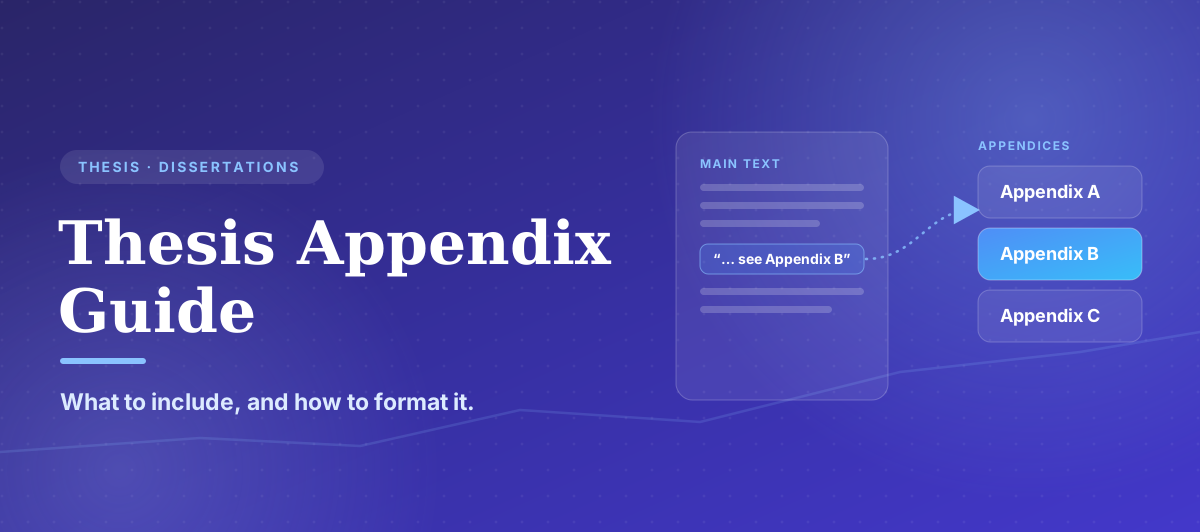
Every appendix must be referred to at least once in the main text — that is what justifies its place in the thesis. Point to it with a short phrase at the moment it becomes relevant:
- “The full questionnaire is provided in Appendix A.”
- “As shown in Table C2 (Appendix C), responses clustered around three themes.”
If you reproduce someone else’s work in an appendix — a published scale, a figure, a data extract — cite it as normal, with an in-text citation next to the item and a full entry in your reference list. Material in an appendix is not exempt from referencing.
Word count & ethics
Do appendices count toward the word count, and how do I handle confidential data?
Word count: appendices usually do not count toward your word limit — but this varies by university and course, so confirm it in your handbook. Whatever the rule, never move parts of your actual argument into an appendix to slip under the limit; markers assess what is in the main text.
Confidential data: anything involving people must protect their identity. Anonymise transcripts and remove names, places and other identifying details before they go anywhere near an appendix, include a blank consent form rather than completed ones, and never include material that could identify a participant. The UK Data Service guidance on anonymising research data explains how to do this properly, and it is part of working within academic integrity.
UK context
What UK universities expect from an appendix
There is no single UK-wide rule for appendices — expectations sit in your university handbook and your supervisor’s instructions, and those take priority over any general guide. What is fairly consistent is how appendices scale with the level of study:
- Undergraduate dissertation: usually one or two appendices — often a questionnaire or interview schedule and some supporting data.
- Master’s thesis: more supporting material is normal — instruments, transcripts, coding frameworks and ethics documentation.
- Doctoral thesis: appendices can be extensive, sometimes bound as a separate volume, and may include published papers where your regulations allow it.
If you are unsure what a UK marker expects from your dissertation as a whole — scope, evidence, structure and presentation — our thesis and dissertation guidance explains what those expectations look like in practice.
See it applied
Example appendix structure
Here is how the appendices of a typical UK dissertation using interviews and a survey might be organised — each item labelled in the order it is first mentioned, and each referred to from the main text:
Appendix A Participant questionnaire (blank)
Appendix B Interview schedule
Appendix C Interview transcripts (anonymised)
Appendix D Supplementary tables and statistical output
Review your own draft
Not sure your appendices are right?
Marker’s Eye reviews your own thesis or dissertation draft against UK marking criteria — including whether your appendices are referenced, labelled and placed correctly — and shows you what to fix. Every word stays yours.
Before you submit
Appendix checklist
- Does your thesis still make sense if the appendices are removed?
- Is every appendix referred to at least once in the main text?
- Is each one labelled in order (Appendix A, B, C) with a descriptive title?
- Are transcripts and data anonymised, with only a blank consent form included?
- Are the appendices placed and listed the way your handbook specifies?
- Is any borrowed material in an appendix cited and in your reference list?
If you can tick all six, your appendices are ready — supporting your argument, not padding it.
Why us
Why UK students use My Perfect Writing alongside this guide
My Perfect Writing helps UK students understand what their university expects and review their own thesis draft — including how appendices are referenced and structured — without taking authorship of the work away from them.
Your thesis stays yours
We help you understand requirements and review your own draft. We do not write, complete or replace your thesis or its appendices.
Built around UK academic expectations
Guidance reflects what UK markers and supervisors look for in structure, presentation and how supporting material is used.
Reviews your own draft
Marker’s Eye checks your own thesis draft against UK marking criteria — including whether appendices are referenced, labelled and placed sensibly.
Ethical academic support
We support your own research and writing, in line with academic integrity — never outsourcing your thesis.
Start with a free preview
Explore Marker’s Eye before deciding whether you need any further guidance.
You stay the author of your thesis — Marker’s Eye reviews your own draft, it does not write it for you.
Questions
Frequently asked questions
What should be included in a thesis appendix?
Does an appendix count toward the word count?
Does the appendix go before or after the references?
Should an appendix appear in the table of contents?
Can interview transcripts go in an appendix?
How do I refer to an appendix in the main text?
Before you submit
Check your appendices in your own draft
Use this guide to build clear, well-labelled appendices, then let Marker’s Eye review your own draft — appendix cross-references, structure and formatting included — against UK marking criteria before you submit.
Guidance should support your work, not replace your authorship.