
How markers assess reflective essays
Map your actual criteria to evidence of interpretation, self-awareness and learning.
Not sure where to start? Talk to our support team live.

Nursing & Reflective Practice
The Driscoll model turns a placement experience into critical reflection through three questions. This guide shows UK nursing students how to use each stage, with a worked example and a checklist for your own draft.
The short version
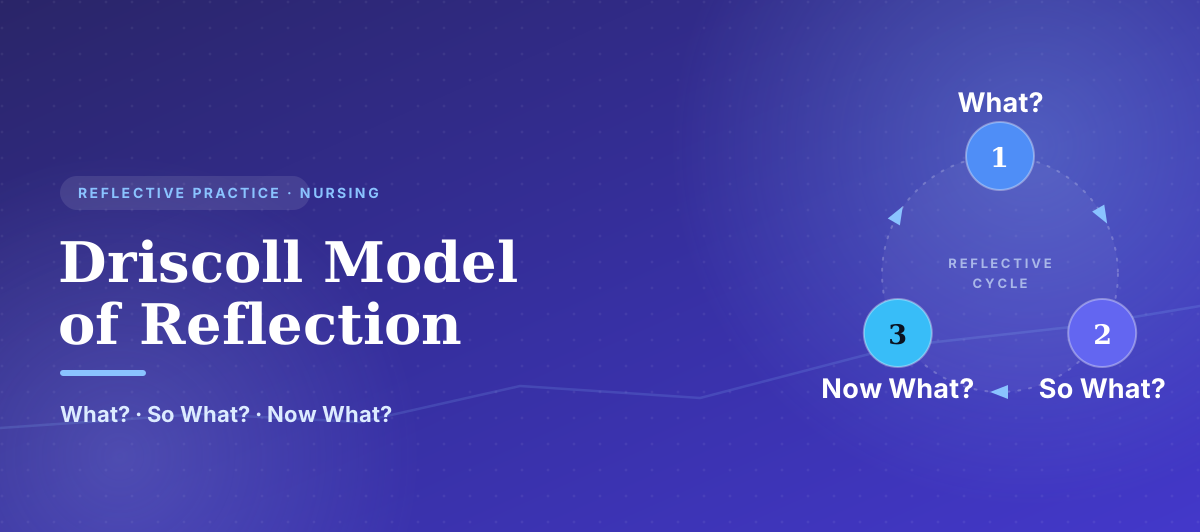
The Driscoll model of reflection is a three-stage cycle — What? (describe the event), So What? (analyse what it means), and Now What? (plan future action). UK nursing students use it to turn a placement experience into critical, evidence-based reflection that shows learning rather than description.
On this page
The basics
The Driscoll model of reflection is a structured way to learn from clinical experience. Developed by John Driscoll, it strips reflective practice down to three plain questions, which makes it quick to remember on a busy placement and easy to apply to a nursing assignment.
The model is cyclical: it moves from describing what happened, to analysing why it mattered, to deciding what you will do differently next time. That final step is what turns a diary entry into reflection — the shift from description to analysis that UK markers reward.
Marker translation A pass reflection describes the event. A strong reflection uses each stage to reach a specific, evidenced learning point.
The framework
Each stage answers one question. Work through them in order and give the last two stages as much space as the first.
Apply it to your own draft
Marker’s Eye reviews your own reflective draft against UK marking criteria — reflection depth, critical analysis, evidence use, NMC Code application, and confidentiality — and flags where description should become analysis. You make the changes; every word stays yours.
See it applied
Here is a short, anonymised example of the three stages applied to a placement moment. Names and identifying details are removed.
What? During a medication round on placement, I noticed a prescribed dose looked unusually high for the patient. I paused the round and checked with my mentor before administering.
So What? The pause mattered because safe medicines management is a core professional responsibility, and speaking up prevented a possible error. It showed me that clinical confidence is not about acting quickly — it is about knowing when to stop and verify. Evidence on medication safety supports checking when something does not fit the clinical picture.
Now What? I will revise the trust's medicines policy and dose-calculation guidance before my next placement, and continue to raise concerns early rather than assume a prescription is correct. My learning point is specific: verify, then administer.
Notice that the “So What?” and “Now What?” stages carry the analysis and the learning — the “What?” is kept short on purpose.
Quick self-check · 30 seconds
Use these three questions to check whether your draft is moving beyond description into reflection.
Want to plan all three stages before writing or revising your draft?
Use the Free Driscoll Reflection WorksheetChoosing a model
| Consideration | Driscoll (What / So What / Now What) | Gibbs (six stages) |
|---|---|---|
| Number of stages | Three | Six |
| Best for | Quick, focused reflection on a single event | Deeper reflection that separates feelings and evaluation |
| Learning curve | Fast to remember and apply | More detailed, more structured |
| Common use | Short reflective accounts and placement logs | Longer reflective essays |
There is no single required model — check your brief first. If your module specifies one, use it. Gibbs’ reflective cycle is a longer, six-stage alternative for when you need more depth.
Before you submit
Use this checklist on your own draft before submission.
Avoid these
A reflective account is your own account of practice — keep it authentic and within your university’s academic integrity expectations. For help understanding what your brief expects before you write, see our nursing assignment help page.
Why us
My Perfect Writing helps UK students understand their brief, review their own drafts and identify clear next steps without taking control of their work away from them.
We provide structured guidance and feedback on your own work. We do not write submission-ready assignments or replace student authorship.
Our tools focus on the areas UK markers assess, including task relevance, critical analysis, evidence, structure and academic integrity.
Instead of vague comments, students receive focused guidance showing what needs attention and what they can improve themselves.
Students can use focused tools such as Marker’s Eye and can also contact a human representative when they need additional guidance.
Students can explore the relevant report or tool before deciding whether they need further support.
You stay responsible for your own work — Marker’s Eye guides and reviews your draft, it does not write it for you.
Questions
Before you submit
Use this guide to understand what each stage should do, then let Marker’s Eye review your own reflective draft against UK marking criteria before you submit.
Guidance should support learning, not replace authorship.