
How to write a critical reflection essay
Continue exploring this topic with a related practical guide.
Not sure where to start? Talk to our support team live.

Reflective Writing
A reflection can follow every stage and still say too little. Find the missing reasoning between what happened, what it means and what you will change.
The short version
Reflective essays stay descriptive when they recount events without examining assumptions, evidence or alternative explanations. Keep only the context a reader needs, explain why your response mattered, question your interpretation and turn the learning into a specific action. Use the model and assessment criteria required by your module.
On this page
Practical guidance
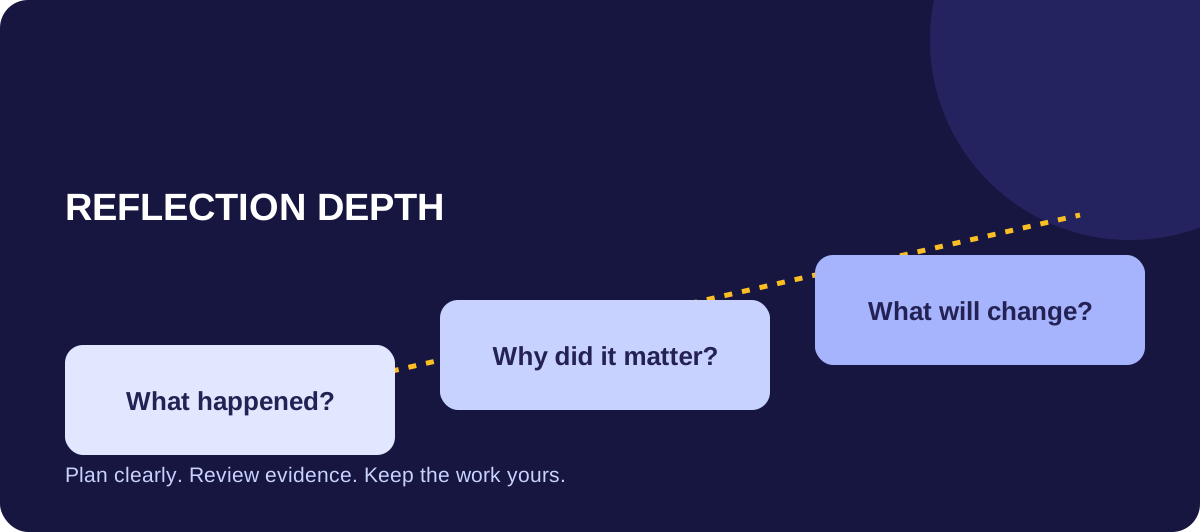
A reflective essay can follow every stage yet still only recount events. The missing step is explaining why a decision mattered and what changed in your understanding. For placement writing, My Perfect Writing’s nursing assignment support helps you interpret expectations while your experience and writing remain yours.
Read a paragraph without its heading. Does it explain a cause, an assumption or a learning point? If it only says what happened next, use the checks below alongside our critical reflection guide.
At a glance
| Mistake | What the reader cannot see | Repair |
|---|---|---|
| Long event chronology | Why this moment deserves attention | Keep the relevant incident and explain its significance. |
| Feelings with no explanation | How emotions affected a decision | Identify the assumption or response behind the feeling. |
| Theory added at the end | What the evidence explains | Apply a specific idea and examine its limits. |
| Only blaming yourself or others | Alternative explanations | Consider constraints and another participant’s perspective. |
| A vague action plan | How learning will change practice | Specify an action, opportunity and review method. |
There is no universal description-to-analysis percentage. Use your own rubric.
Practical guidance
Gibbs, Driscoll and Kolb organise reflection; headings alone do not create analysis. Keep the model your brief requires. If you can choose, compare Gibbs and Driscoll before drafting.
The University of Edinburgh’s guidance recommends enough context to make the learning understandable. Keep a detail when removing it would weaken the explanation; cut it when it merely extends the chronology.
Apply the guide
Use the tool to identify review priorities, then check them against your brief and evidence. You remain the author.
Practical guidance
Descriptive: “I did not ask for help with our group presentation. I felt nervous and the slides were unfinished. Next time I will communicate better.”
More analytical: “I assumed asking for help would show poor preparation, so I hid a delay. A teammate’s feedback suggested an early update would have let us redistribute the work. I have only one teammate’s account, so my interpretation is limited. At the next checkpoint, I will report progress and blockers and ask whether our plan needs adjusting.”
This invented example connects an assumption, consequence, feedback, limitation and action. Use that reasoning pattern with your own incident; do not submit the example as personal experience.
Practical guidance
Use evidence to test a claim. If unclear roles affected communication, explain how a relevant concept helps interpret that problem, then consider alternatives such as time pressure. A citation that only defines teamwork adds little analysis.
Separate observation from interpretation: “feedback arrived late” does not establish that the tutor undervalued your work. Feedback Decoder can help organise tutor comments into revision priorities; check the interpretation against the original feedback.
Practical guidance
“Be more confident” is vague. “Prepare two clarification questions for the next meeting, then record whether they resolved my uncertainty” is reviewable. Connect the action to the learning and choose an outcome you can realistically influence.
For placement reflections, remove names and identifying combinations of dates, locations or unusual details. Follow your institution’s confidentiality rules and check any professional standard your brief requires.
Before submission
Use the free depth checker to review one paragraph at a time.
Questions
Your next step
My Perfect Writing supports understanding, planning and draft review. Keep your decisions, evidence and final wording your own.
Follow your module brief and academic-integrity requirements.