
The Driscoll model
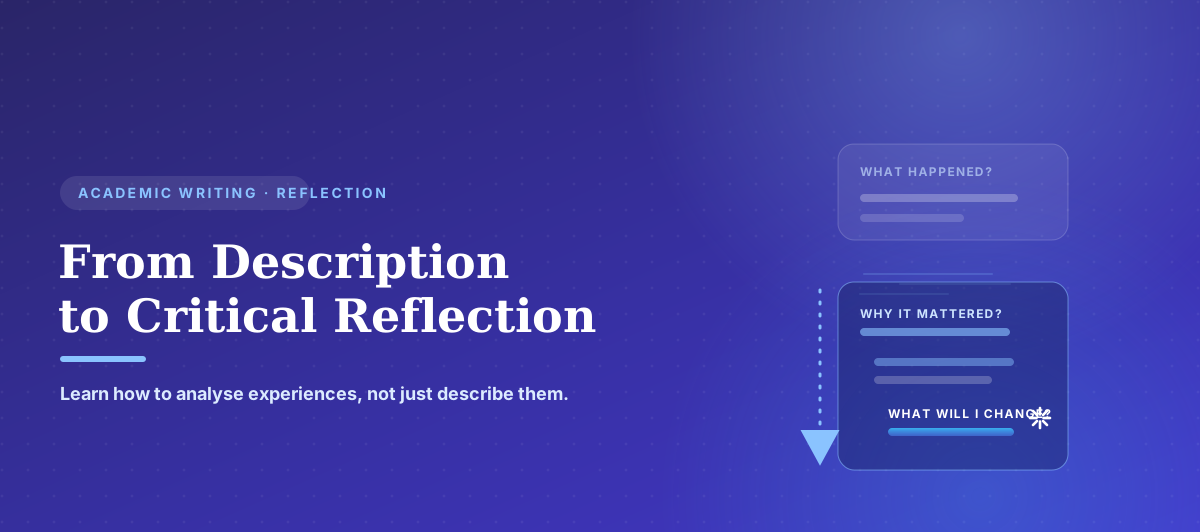
The three-stage What? So what? Now what? cycle — a simple framework to structure your reflection.
Not sure where to start? Talk to our support team live.

Reflective Writing
Most reflective essays lose marks for describing what happened instead of reflecting on it. This guide shows what makes reflection critical, how to structure a reflection essay, how much first person to use, and how to turn description into analysis — with a worked example.
The short version
A critical reflection essay analyses an experience rather than just describing it: you explain what happened, why it mattered, what you learned, and what you would do differently. Unlike descriptive writing, critical reflection links your experience to evidence or theory and shows a genuine change in your thinking.
On this page
Start here
A critical reflection essay asks you to look back on an experience — a placement, a group project, a piece of feedback, a practical — and work out what it means, not just what happened. The description is only the starting point; the marks come from the analysis: why the experience mattered, what it taught you, and what you would do differently next time. This is what tutors mean by reflective practice.
It trips students up because it feels personal, yet it is still academic writing. You are expected to be honest about your own experience while staying analytical and, where relevant, linking what happened to evidence or theory. Reflection is common in nursing, education, social work and many practice-based subjects, so getting the balance right matters across a lot of courses. If a reflective assignment for a health or nursing module is proving hard to pitch, My Perfect Writing’s nursing assignment help can show you what strong reflection looks like in your field — the aim is always to help you write your own, not to write it for you.
Integrity first A reflection essay is about your genuine experience and your own thinking. Plan it, structure it and review it — but the reflection has to be honestly yours, not invented to fit a model.
The core skill
The single biggest reason reflective essays lose marks is that they stay descriptive — they report what happened without ever explaining what it means. Critical reflection takes each observation one step further: it interprets, evaluates and draws a lesson. The table below shows the same moments written both ways.
See the difference
| Descriptive (what happened) | Critical reflection (what it means) |
|---|---|
| The patient became distressed during the procedure. | The patient became distressed, which made me realise I had not explained the procedure clearly beforehand; next time I will check understanding before starting. |
| I found the group project difficult. | I found the group project difficult because we had not agreed roles early on, and I now see that setting expectations at the start prevents later conflict. |
| The experiment did not work as expected. | The unexpected result prompted me to question my method, and comparing it with the module reading showed where my technique had likely introduced error. |
Notice the pattern: each critical version adds why it happened, what it means, and what changes next.
Apply it to your own draft
Marker’s Eye reviews your own reflective draft against UK marking criteria — reflection depth, critical analysis and evidence use — and flags where description should become analysis, so you can improve it before you submit. You make the changes; every word stays yours.
Pick a framework
Most reflective essays are built on a model that gives your thinking a shape. You usually do not need to explain the model at length — you use it to structure your reflection. The two you will meet most often are Gibbs and Driscoll:
Pick one model and follow it consistently rather than mixing several. The University of Edinburgh Reflectors’ Toolkit is a useful, non-commercial overview if you want to compare frameworks before you decide.
Build the essay
Whichever model you choose, a critical reflection essay usually moves through the same five steps:
Keep each paragraph focused on one point and make sure it moves beyond description. If paragraph structure is where you struggle, the PEEL method used in nursing essays adapts well to reflective paragraphs too.
Get the voice right
Yes — you can and usually should use the first person in a reflection essay. Because it is about your own experience, “I noticed” and “I realised” are appropriate and expected, unlike in a standard essay. Always check your brief, as a few modules still ask for a more detached voice.
First person does not mean informal, though. Keep the tone academic: write in full sentences, stay measured rather than emotional, and back up claims about your learning with specifics. A reflective essay can be personal and rigorous at the same time — that balance is exactly what markers reward.
See it applied
Here is a short reflection on receiving critical feedback, with each sentence labelled by the move it performs.
Description (what) After submitting my first essay, my tutor commented that my argument was “descriptive rather than analytical”.
Analysis (so what) At first I was discouraged, but re-reading my work I saw that I had summarised sources without ever evaluating them — I had explained what each author said, not what it meant for my question.
Learning (now what) I now understand that analysis means weighing evidence and drawing my own conclusion, not reporting it, and in my next essay I will end each paragraph by stating what the evidence shows.
Notice that the reflection does not just record the feedback — it interprets it and turns it into a change in approach. If you want to go deeper on that exact skill, see description vs analysis: what markers want.
What earns the marks
Markers are not looking for a dramatic story or a “perfect” outcome — they are looking for depth of reflection. A higher band typically shows honest analysis, a clear sense of what changed in your thinking, appropriate links to evidence or theory, and a realistic action plan. A lower band usually stays at description, or lists feelings without interpreting them.
The hardest part to judge in your own work is whether you have actually crossed from description into analysis — it always feels analytical while you are writing it. This is where Marker’s Eye helps: it reviews your own reflective draft against UK marking criteria and flags the sentences that are still only describing, so you can lift them before you submit.
Avoid these
Free resource
Not sure whether your draft has crossed from description into genuine reflection? Our Critical Reflection Depth Checker gives you a description → analysis → learning ladder, paragraph-by-paragraph prompts, and a checklist of what markers expect — so you can test your own draft before you hand it in.
Grab the checker Use the free resource card on this page to get the Critical Reflection Depth Checker sent to you — it’s built to sit next to your draft as you review it.
Before you submit
Run this on your own draft before submission — or let Marker’s Eye check it against UK marking criteria first.
Why us
My Perfect Writing helps UK students understand their brief, review their own drafts and identify clear next steps without taking control of their work away from them.
We provide structured guidance and feedback on your own work. We do not write submission-ready assignments or replace student authorship.
Our tools focus on the areas UK markers assess, including task relevance, critical analysis, evidence, structure and academic integrity.
Instead of vague comments, students receive focused guidance showing what needs attention and what they can improve themselves.
Students can use focused tools such as Marker’s Eye and can also contact a human representative when they need additional guidance.
Students can explore the relevant report or tool before deciding whether they need further support.
You stay responsible for your own work — Marker’s Eye guides and reviews your draft, it does not write it for you.
Questions
Before you submit
Use this guide to plan your reflection, then let Marker’s Eye review your own draft against UK marking criteria before you submit — so description-level writing gets caught early.
Guidance should support learning, not replace authorship.