
The Driscoll model of reflection
The shorter three-question alternative to Gibbs — What? So What? Now What? — with a worked example and checklist.
Not sure where to start? Talk to our support team live.

Reflective Writing
“Too descriptive” is the most common comment on reflective work. This practical guide shows UK students how to apply Gibbs’ Reflective Cycle — working through all six stages, deepening the analysis, using evidence well, and building an action plan you can actually act on.
The short version
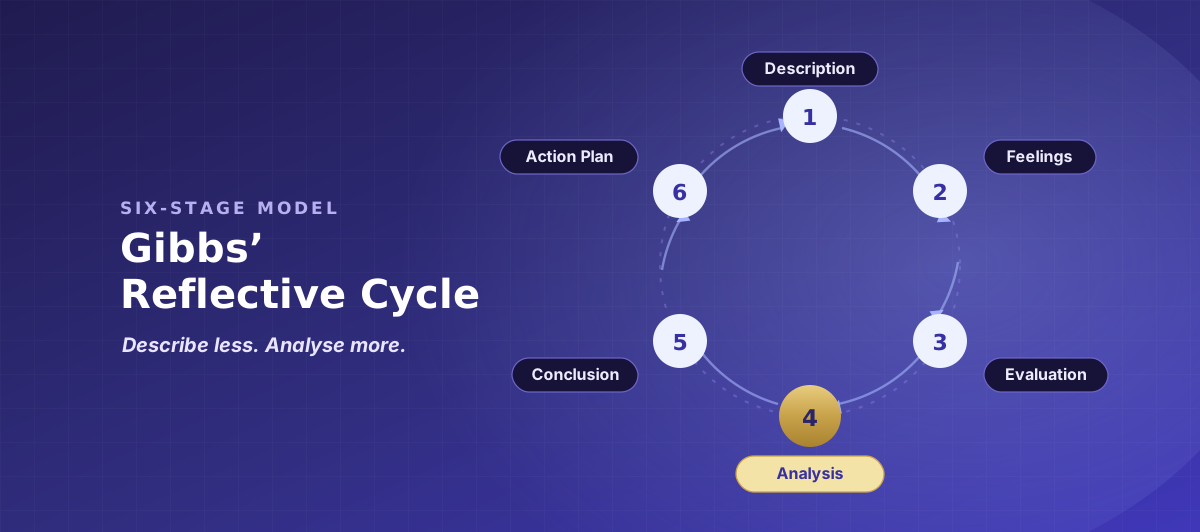
Gibbs’ Reflective Cycle is a six-stage model for structured reflection: Description, Feelings, Evaluation, Analysis, Conclusion and Action Plan. UK students use it to turn an experience into critical, evidence-informed learning — moving beyond describing what happened to analysing why it mattered and planning what they will do differently next time.
On this page
The basics
Gibbs’ Reflective Cycle is a structured way to learn from experience. Developed by Graham Gibbs in 1988, it breaks reflection into six stages that take you from describing what happened to planning what you will do next time. Reflection is structured for a reason: without a framework, most people simply retell the event and stop before the thinking that earns marks.
You will meet Gibbs across many UK courses — it is especially common in nursing and health, education, social work, business and any module with a placement, practical, or group-work component. If your subject sits in one of those areas, our nursing assignment help page shows how the same reflective skills apply to evidence-based writing.
One warning before you start: the stages are a scaffold, not a checklist to tick. Writing a paragraph under each heading is not the same as reflecting. The marks live in why the experience mattered and what you genuinely learned — not in mechanically completing all six boxes.
The six stages, in order
Marker translation A pass reflection describes the event and lists feelings. A strong reflection uses the middle stages — Evaluation and Analysis — to reach a specific, evidenced learning point.
The framework
Here is what each stage is for, the questions to ask yourself, what good reflection should achieve, and the mistake to avoid. The short examples show the thinking only — they are not paragraphs to copy into your own work.
Thinking example “During a group presentation, I was responsible for the data section, but our slides overran and I had to cut mine short.” — one or two sentences is plenty.
Thinking example Evaluation says the slides overran. Analysis asks why — we never rehearsed to time, and I had not agreed a cut-down version in advance; time-management research on group tasks would predict exactly this.
Keep your own reflection authentic and within your university’s academic integrity expectations — it should be your genuine account, in your own words.
Join the stages up
The stages are a chain, not six isolated headings. Each one feeds the next: an honest Evaluation gives your Analysis something to explain, and a sharp Analysis makes your Conclusion and Action Plan almost write themselves. When a reflection feels flat, it is usually because two stages were written separately and never connected.
The workflow, end to end
A practical order of work: draft a short Description, jot honest Feelings, then spend most of your effort on Evaluation and Analysis. Write the Conclusion and Action Plan last, so they follow directly from the analysis rather than from the event. Because Gibbs is a cycle, your Action Plan should point forward — it becomes the starting point the next time a similar situation comes around.
The most important shift
The single biggest reason reflections lose marks is staying descriptive — retelling what happened without ever explaining why it mattered. Description answers what, who and when; analysis answers why, so what and what next. You need some description to set the scene, but the majority of your effort should go into analysis.
What happened, who was involved, the sequence of events, and what was said — reported in order, then left there.
Why it happened, why it mattered, what influenced the outcome, what theory or evidence suggests, other possible readings — and what you learned.
If “too descriptive” keeps appearing on your feedback, our guide to description vs analysis: what markers actually want breaks the shift down sentence by sentence, and our guide to understanding UK tutor feedback translates the comments themselves into concrete actions.
Apply it to your own reflection
Marker’s Eye reviews your own reflective draft against UK marking expectations — flagging where you describe instead of analyse, and where your reasoning needs more depth or evidence — so you can develop it yourself. You make the changes; every word stays your own. It supports your tutor’s guidance, it does not replace it, and it cannot know your final grade.
Use it where it fits
Reflection is personal, but at degree level it usually needs to connect to something beyond your own opinion — academic literature, a professional code or guideline, a theory or module concept, or research evidence. This most often belongs in the Analysis stage, where you explain why things happened, and sometimes in Evaluation or the Action Plan, where evidence supports what you plan to change.
Two cautions. First, references should support your reasoning, not decorate it — a citation with no explanation adds nothing. Second, do not force a source into every stage; your Description and Feelings rarely need one. How much evidence you need depends entirely on your brief, module and tutor guidance, so read the marking criteria before you decide. If you are unsure exactly what your task is asking for, our Brief Decoder can help you pin down the requirements first.
Go deeper here
Analysis is where most marks are won or lost, so give it more space than any other stage. The key point: Analysis is not another version of Evaluation. Evaluation judges what was good and bad; Analysis explains why it turned out that way and what it means. To push a reflection from description into genuine analysis, work through questions like these:
You do not need to answer all ten — choose the ones that genuinely open up your experience. For phrasing that signals critical thinking rather than summary, the University of Manchester’s Academic Phrasebank: Being Critical is a reliable free reference. The analysis itself, though, must be your own.
Make it specific
A weak Action Plan is the quiet mark-loser at the end of many reflections. It sounds fine but says nothing you could act on.
Too vague “Next time I will communicate better.” — Better at what? How? When? Nobody, including you, could tell whether you had done it.
Turn a vague intention into a plan by answering five questions:
Now it is specific “Before the week-8 group assessment, I will run one timed rehearsal and prepare a two-minute backup version of the data section, so my part fits the slot without being cut.”
Choosing a model
| Consideration | Gibbs (six stages) | Driscoll (What / So What / Now What) |
|---|---|---|
| Number of stages | Six | Three |
| Structure | Detailed — separates evaluation, analysis, conclusion and action | Simpler three-question framework |
| Best for | Longer reflective essays that need depth | Quick, focused reflection on a single event |
| Learning curve | More to hold in mind, but more guidance | Fast to remember and apply |
Neither model is universally better — follow your assignment brief, module instructions and tutor guidance. If your module specifies a model, use it. For the shorter alternative, see our guide to the Driscoll model of reflection.
Avoid these
| Common mistake | Quick fix |
|---|---|
| Spending too much word count on Description | Cut it to a few sentences; move the space to Analysis |
| Treating Feelings as the whole reflection | Name feelings briefly, then connect them to what happened |
| Confusing Evaluation with Analysis | Evaluation judges good/bad; Analysis explains why |
| Reporting evidence without explaining it | After each source, say what it means for your experience |
| Forcing citations into every stage | Use evidence where it supports reasoning, mainly in Analysis |
| Using theory but not linking it to the event | Tie the theory directly to what actually happened to you |
| A vague action plan | Make it specific: what, how, when, and how you will know |
| Ignoring the marking criteria | Read the rubric first and reflect against what it rewards |
| Following the six stages mechanically | Let each stage feed the next, not sit in its own box |
| Never saying what you actually learned | End with one clear, specific lesson from the experience |
Most of these come back to the same fix: less describing, more analysing.
Before you submit
Use this on your own draft — your marking criteria define exactly what each stage should achieve for your task.
Why us
My Perfect Writing helps UK students understand their brief and review their own reflective drafts — while you stay responsible for your own reflection and words. We do not write your assessed work.
Brief Decoder helps you read the reflective brief so your reflection answers what the module actually asks.
Marker’s Eye reviews your own reflection and flags where description should become analysis, against UK marking expectations.
Guidance reflects how UK markers weigh description against critical analysis, evidence and a specific action plan.
Your reflection and writing remain yours. We do not write reflective assignments or invent placement experiences.
Use the free depth planner to deepen your own reflection before deciding whether you need any further guidance.
You stay responsible for your own reflection — our tools help you plan and review it, they do not do it for you.
Questions
Before you submit
Use this guide to understand what each Gibbs stage should do, then review your own reflective draft against your assignment brief and rubric — Marker’s Eye can help you check it before you submit.
Guidance should support your learning, not replace your own work.