
Description vs analysis
What “too descriptive” means and how to turn factual summary into critical analysis.
Not sure where to start? Talk to our support team live.

International Students
UK tutor feedback is often indirect and assumes conventions that are new if you studied elsewhere. This guide explains how UK feedback works, what common phrases really mean, how to turn comments into concrete changes, and where to get help — so feedback becomes useful rather than confusing.
The short version
UK tutor feedback is usually criteria-based and often politely indirect, which can confuse international students. Phrases like “too descriptive”, “develop this” or “unsubstantiated” are not personal criticism — each points to a specific improvement. The key is to decode the comment, link it to the marking criteria, and make one concrete change before your next submission.
On this page
How it works
UK feedback is usually tied to marking criteria or a rubric, and it comes in two forms: formative feedback (guidance on drafts or earlier work, meant to help you improve) and summative feedback (the comments that explain a final grade). Most comments are trying to move your work up against those criteria — so the fastest way to understand a comment is to read it next to the rubric it refers to.
UK academic culture also expects a lot of independent learning: tutors point you toward an improvement and expect you to work out the detail, rather than rewriting it for you. That is a difference in convention, not a lack of support. This guide is general study-skills guidance; your own tutor and university services always come first.
The translation key
| Phrase | What it usually means | What to do |
|---|---|---|
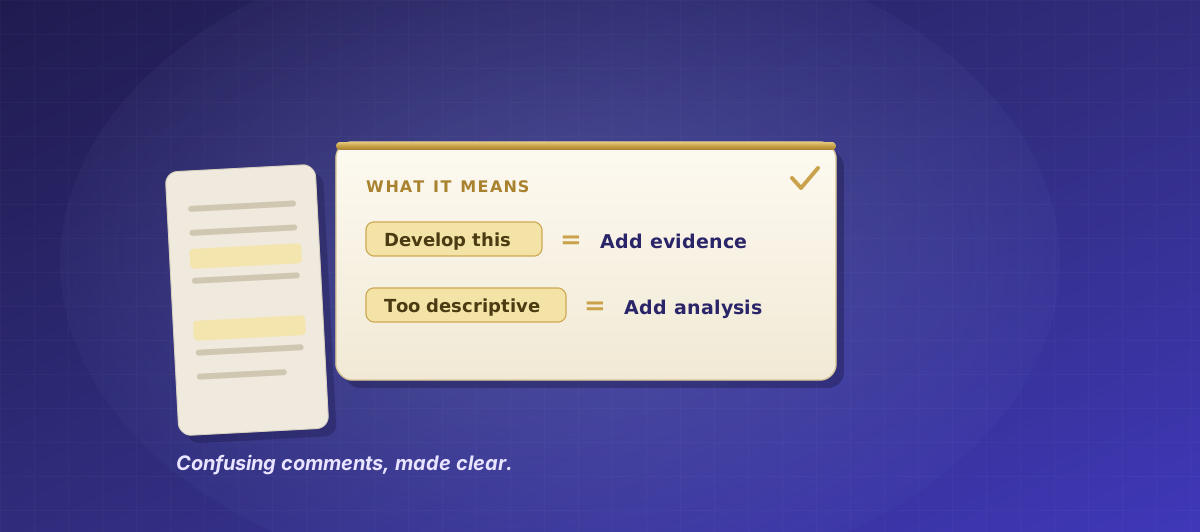
| Too descriptive | You summarise instead of analysing | Add why each point matters to the question |
| Develop this point | The idea is good but undercooked | Expand it with evidence and explanation |
| Unsubstantiated / needs evidence | A claim has no support | Add a cited source or example |
| Not critical enough | You accept sources at face value | Weigh strengths, limits and other views |
| Signposting | The reader gets lost | Guide them with clear topic sentences and links |
| Clarify / unclear | The meaning is hard to follow | Rephrase in simpler, more precise wording |
| Reference / proofread | Referencing or errors need work | Fix citations and check the text carefully |
Meanings are typical, not universal — always confirm against your tutor’s intent and your marking criteria.
Why it feels hard
Several things combine. UK markers often phrase criticism indirectly and politely — “you might consider…” can mean “you must change this”. Feedback also assumes shared conventions (what “critical”, “argument” or “analysis” mean here) that may differ from the academic culture you studied in. And because so much is left to independent learning, a comment can feel like a hint rather than an instruction.
None of this means your work is bad or that you are being judged personally. A phrase such as “too descriptive” is a shorthand for a specific, fixable gap. If a comment is about analysis in particular, our guide to description vs analysis shows exactly how to close it.
The method
Turn every comment into an action with the same four steps: decode the phrase, find the criterion it relates to, decide the one change it asks for, and then apply that change across the whole piece, not just where it was marked. Feedback on one paragraph almost always applies elsewhere too.
A short example. A tutor writes “develop this” beside a paragraph. Decode: the point is underdeveloped. Criterion: use of evidence and analysis. Change: add a cited example and explain what it shows. Apply: check every paragraph for thin points and do the same. Then look across all your feedback for the one pattern that recurs — fixing that usually moves your work up the most. Reviewing the next draft against the criteria is where our Marker’s Eye can help.
Get support
You do not have to decode feedback alone. The best first step is to ask the tutor who wrote it — most welcome a short, specific question such as “when you wrote ‘develop this’, did you mean more evidence or more analysis?”. Your university’s academic skills or study advice service and its English language support can also help you read feedback and act on it, and your students’ union can point you to the right service.
For wider support as an international student — from academic life to practical issues — the UK Council for International Student Affairs (UKCISA) is an authoritative independent source, and the University of Manchester’s Academic Phrasebank helps with the academic phrasing UK feedback expects.
Avoid these
These slow students down the most:
Apply it to your own feedback
Feedback Decoder turns tutor comments such as “too descriptive” or “develop this” into clear, specific next steps — so you know exactly what to change before your next submission. You do the work; every word stays your own.
After you get feedback
Use this after each piece of feedback — your tutor and university services are your best guide to what a comment means.
Why us
My Perfect Writing helps you understand tutor feedback and review your own next draft — while you stay responsible for your own work. We do not write your assignments.
Feedback Decoder helps turn tutor comments into clear, specific next steps you can act on.
Marker’s Eye reviews your own draft against UK marking expectations so you can see if you have addressed the feedback.
Guidance reflects UK marking conventions and the phrasing UK tutors use.
The reading, thinking and writing remain yours. We do not complete assessments.
Use the free translation sheet to turn your own feedback into actions before deciding whether you need more help.
You stay responsible for your own work — our tools help you understand feedback and review your draft, they do not do it for you.
Questions
Before your next submission
Use this guide to turn UK tutor feedback into concrete changes, then let Marker’s Eye review your own next draft against UK marking expectations before you submit.
Guidance should support your learning, not replace your own work.