
Writing first-class nursing assignments
Structure, evidence and academic writing for UK nursing students, from brief to final draft.
Not sure where to start? Talk to our support team live.

Nursing & Academic Writing
Followed PEEL but your nursing paragraph still reads as descriptive? This guide shows UK nursing students how to use Point, Evidence, Explanation and Link to build genuinely analytical paragraphs — interpreting evidence, synthesising sources and connecting everything to the assignment question, with short teaching examples only.
The short version
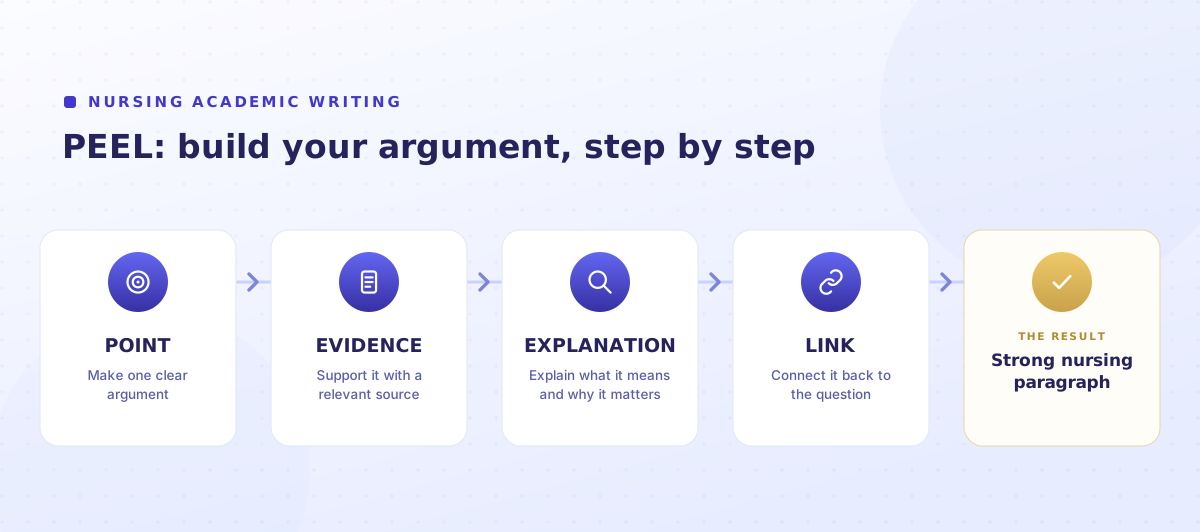
PEEL (Point, Evidence, Explanation, Link) gives a nursing paragraph its structure: make one clear point, support it with credible evidence, explain what that evidence means, and link back to the question. But structure alone is not analysis — critical depth comes from how you interpret, compare, evaluate and connect the evidence to your argument.
On this page
The basics
PEEL is a paragraph framework used across UK academic writing, and it is especially useful for nursing assignments, where every claim needs to be backed by evidence and analysis. It stands for Point, Evidence, Explanation, Link, and it gives each paragraph a predictable shape so a reader can follow your reasoning. Many UK universities teach it as a starting structure — the University of Staffordshire’s academic writing guide even adds a “C” for a critical point once the basics are in place.
Paragraph anatomy — each layer strengthens the argument
The honest version PEEL gives the paragraph a skeleton. Critical thinking gives it depth. A paragraph can contain all four letters and still earn a low mark if the Explanation never really analyses anything.
P — the claim
A strong Point does four things: it answers part of the question, makes one clear claim, sets up the purpose of the paragraph, and is arguable rather than simply factual. The most common problem is a Point that tries to cover several ideas at once, so the paragraph never settles on anything to prove.
Weaker Point “Communication is important in nursing.” — True, but not arguable, and far too broad to build one paragraph around.
Stronger Point “Structured handover tools can reduce communication errors during shift changes, supporting patient safety.” — One clear, arguable claim the rest of the paragraph can evidence and analyse.
Notice the stronger Point is specific and tied to a nursing outcome (patient safety). If you are unsure whether your Points actually answer the task, our guide to writing first-class nursing assignments covers reading the question before you write.
E — the support
Evidence is not simply writing “According to Smith (2022)…”. Before a source earns its place, interrogate it. Ask yourself:
In nursing, the strongest arguments usually blend research evidence with professional and policy context — for example, connecting a study to the NMC Code or national guidance. This is the same evidence-to-rationale logic used in a nursing care plan: the source is only as useful as your reason for choosing it.
E — the depth
This is the stage that separates a strong paragraph from an average one — and the stage most students rush. Many insert a citation and move straight to the next one, leaving the reader to guess why it mattered. Instead, make your Explanation work through a chain of questions:
Turn evidence into analysis
For phrasing that signals interpretation rather than summary, the University of Manchester’s Academic Phrasebank: Being Critical is a reliable free reference — but the analysis itself must be your own.
The real problem
Here is the honest answer to the question most students are really asking: a paragraph can contain a Point, Evidence, an Explanation and a Link and still be descriptive. That happens when the “Explanation” only restates what the source said instead of judging it. The difference is not the structure — it is the thinking inside the third stage.
Reports what the source said: “This study found that structured handovers reduced errors.” Then moves on to the next citation.
Weighs it: why it matters, how strong the evidence is, any limitation, whether other studies agree, and what it implies for safe practice and your argument.
A critical explanation asks: why does it matter, how strong is the evidence, what limitation exists, is there conflicting evidence, does context change the conclusion, and how does this move the argument forward? Our guide to description vs analysis breaks that shift down sentence by sentence.
Apply it to your own draft
Marker’s Eye reviews your own nursing paragraphs against UK marking expectations — flagging where an Explanation only describes, where evidence needs weighing, and where a point is not linked to the argument — so you can develop it yourself. You make the changes; every word stays your own. It supports your tutor’s feedback and cannot know your final grade.
From structure to analysis
One practical way to stop paragraphs staying flat is to build in an explicit evaluation move. Think of it as PEEL + Depth — not an official acronym, just a reminder that stronger university paragraphs usually pause to compare and evaluate before they link:
The paragraph, with depth built in
PEEL gives the structure; analysis, evaluation and synthesis create the depth. You do not need to add the step to every paragraph — use it where a claim genuinely deserves weighing.
More than one voice
A common misconception is that one PEEL paragraph means one source. It does not. Some of the strongest paragraphs bring two or three sources into conversation, then draw a reasoned conclusion. A useful pattern:
That is synthesis: using sources to build a position, rather than reporting them one after another. It is also where recency and relevance matter — more sources are not automatically better, as our guide to why adding more sources is not always the answer explains.
Avoid this
| Citation dumping (stacking) | Synthesis (analysis) |
|---|---|
| “Source A says X. Source B says Y. Source C says Z.” | Shows how A, B and C relate — agree, differ or add nuance |
| Each source gets its own sentence and no comment | Sources are weighed against each other |
| No judgement about quality or relevance | Notes which evidence is stronger, and why |
| Ignores that studies may examine different settings | Accounts for setting, population and context |
| Ends with a list | Ends with a reasoned conclusion you can defend |
The fix is one question: what can I reasonably conclude from these sources together? Do not stack sources — synthesise them.
L — the connection
A Link should not be a bolted-on sentence like “This links back to the question.” A good Link does real work: it reinforces how the paragraph answers the question, shows the paragraph’s contribution to your overall argument, draws out the nursing implication, or transitions naturally into the next issue.
Rather than reaching for the same formula every time, ask what this particular paragraph has just proved, and say why that matters for the assignment. Understanding exactly what the question is asking makes natural linking far easier — our Brief Decoder can help you pin the requirements down first.
Put it together
When you are drafting, work from the question outwards rather than from a source inwards. This keeps every paragraph earning its place in the argument:
From question to finished paragraph
Once you have a draft, the fastest way to improve is to review your own paragraphs against this flow — checking that each one interprets and evaluates, rather than just reporting what a source said.
Avoid these
| Common mistake | How to fix it |
|---|---|
| Point is too broad | Narrow it to one specific, arguable claim |
| Several unrelated points in one paragraph | One point per paragraph; split the rest out |
| Evidence added with no analysis | After each source, say what it means and why |
| Explanation just repeats the evidence | Judge it — significance, strength, limitation |
| Too many citations stacked together | Synthesise: show how the sources relate |
| Source quality not considered | Weigh credibility, type and recency |
| Paragraph stays descriptive | Add the “so what for nursing?” step |
| Nursing relevance mentioned but not explained | Spell out the implication for practice or safety |
| Link is mechanical or formulaic | Say what the paragraph proved and why it matters |
| Every paragraph uses the same pattern | Vary sentence openings; let content lead |
| Treating PEEL as a marking formula | Use it as a scaffold, then add critical thinking |
Most fixes come down to the same move: less reporting, more judgement.
Before you submit
Use this on your own draft — your marking criteria define exactly what “analysis” means for your task.
Why us
My Perfect Writing helps UK nursing students understand their brief and review their own writing — while you stay responsible for your own analysis and words. We do not write your assessed work.
Brief Decoder helps you read the question so each paragraph answers what is actually being assessed.
Marker’s Eye reviews your own paragraphs and flags where description should become analysis, against UK marking expectations.
Guidance reflects how UK markers weigh point, evidence, critical analysis and synthesis.
Your paragraphs and analysis remain yours. We do not write assessed nursing work or invent evidence.
Use the free PEEL planner to strengthen your own paragraphs before deciding whether you need further guidance.
You stay responsible for your own writing — our tools help you plan and review it, they do not do it for you.
Questions
Before you submit
Use this guide to turn structured paragraphs into analytical ones, then review your own draft against your assignment brief and marking criteria — Marker’s Eye can help you check it before you submit.
Guidance should support your learning, not replace your own work.