
Writing first-class nursing assignments
A step-by-step guide to structure, evidence and academic writing for UK nursing students.
Not sure where to start? Talk to our support team live.

Nursing & Care Planning
A nursing care plan links clinical assessment to real patient outcomes. This guide shows UK nursing students how to build and critically discuss one — from assessing needs and setting goals to evidence-based interventions, documentation and evaluation — with short teaching examples, not a ready-made plan to copy.
The short version
A nursing care plan is a structured, evidence-based document that guides a patient’s care from assessment through to evaluation. It sets out the patient’s needs, prioritised problems, clear goals, planned interventions with a rationale, and how outcomes will be reviewed — so care stays individual, safe, coordinated and accountable across the whole team.
On this page
The basics
A nursing care plan is a structured record of how a patient’s care will be assessed, planned, delivered and reviewed. It turns what you notice about a patient into prioritised problems, clear goals, and specific interventions with a reason behind each one — then checks whether those interventions worked. Done well, it keeps care individual, safe, coordinated and accountable, and gives every member of the team the same up-to-date picture.
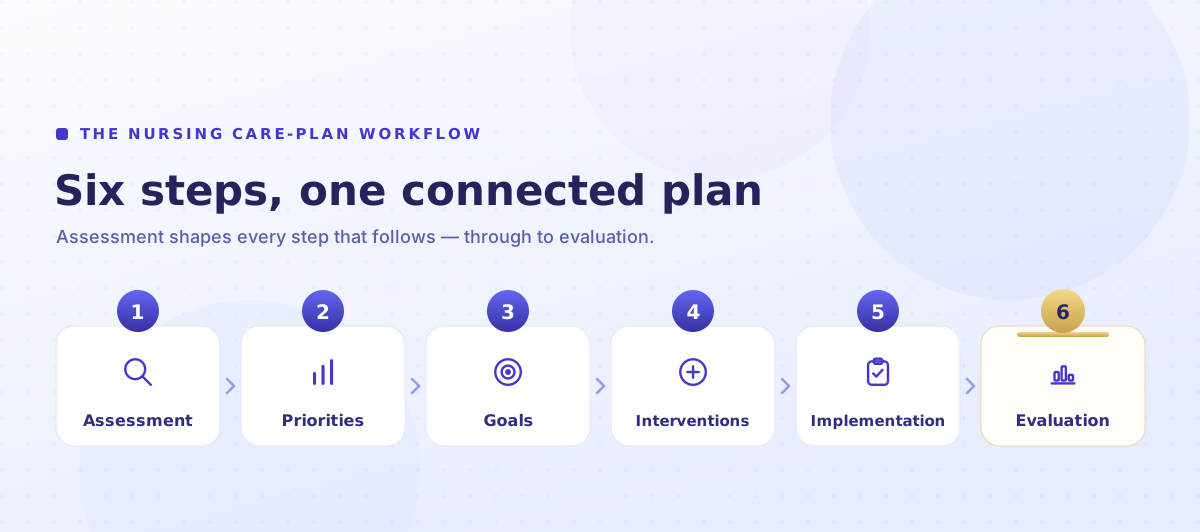
Most UK plans follow a recognised process, often summarised as assess, plan, implement and evaluate (you may see it as APIE or ADPIE, where the D is nursing diagnosis). The exact framework and paperwork vary by placement, trust and university, but the logic below is the same everywhere.
The care-plan process
In your assignment Markers rarely reward a plan that just fills in a template. They reward the reasoning that connects assessment to priorities, priorities to goals, and interventions to evidence — and an honest evaluation of what happened.
Step 1
Assessment is where the plan is won or lost — everything after it depends on what you gather here. Good assessment is holistic: it looks beyond the presenting problem to the person. Many UK programmes use a structured framework, such as an activities-of-daily-living model or an A–E approach, so that nothing important is missed.
Collect information from more than one source and more than one type:
The skill is not just gathering data but interpreting it — distinguishing a genuine need from an incidental finding, and noticing what the numbers mean for this particular person. That interpretation is what later turns a descriptive plan into a critical one.
Step 2
You will almost always identify more needs than can be tackled at once, so the next step is to prioritise. A patient with many problems still has a most urgent one. Prioritisation is a clinical judgement, and it is one of the clearest places to show critical thinking in an assignment.
Frameworks such as an ABCDE approach or a recognised hierarchy of needs can help you justify the order. In your writing, always say why a problem is the priority, not just that it is.
Step 3
A goal states what success looks like for a prioritised problem. Vague goals cannot be evaluated, so aim for specific, measurable, achievable, relevant and time-bound (SMART) outcomes, agreed with the patient wherever possible. The difference between a weak and a stronger goal is usually the difference between a pass and a strong mark.
“Patient will mobilise better.” — Better by how much, doing what, and by when? Nobody could measure whether it was met.
“Within 3 days, the patient will walk 10 metres with a frame and one nurse, reporting pain of 3/10 or less.” — Specific, measurable and time-bound.
Distinguish short-term goals (the next shift or few days) from longer-term outcomes (by discharge). Both should trace back to something you found in the assessment.
Apply it to your own draft
Marker’s Eye reviews your own care-plan draft against UK marking expectations — flagging where goals are vague, where interventions lack a rationale, and where you describe instead of discuss — so you can develop it yourself. You make the changes; every word stays your own. It supports your tutor’s guidance and cannot know your final grade.
Step 4
Interventions are the specific nursing actions planned to meet each goal — repositioning to protect skin, a fluid-balance chart, structured pain review, education, referral. What lifts an assignment from descriptive to critical is the rationale: the evidence or guideline explaining why that intervention is appropriate for this patient. An intervention without a rationale is just a task; an intervention with one is a clinical decision.
Wherever possible, connect interventions to recognised sources — national clinical guidance such as NICE, local trust policy, and the professional standards in the NMC Code — and explain how the evidence applies here rather than just citing it.
How to link it up
Teaching example Risk score shows high pressure-ulcer risk (evidence) → reposition two-hourly and use a pressure-relieving mattress (intervention) → repositioning redistributes pressure and reduces tissue damage, in line with pressure-area guidance (rationale) → skin stays intact at review (outcome).
Step 5
Implementation is delivering the planned care and recording it. Documentation is not an afterthought — in UK practice, clear and contemporaneous records are a professional requirement and the main evidence that care was given. Notes should be accurate, timely, objective and legible, and should show any changes in the patient’s condition and how the team responded.
In an academic care plan, this is also where confidentiality matters most. You must anonymise the patient and any identifying details — no real names, dates of birth, addresses, or anything that could identify a person or place — in line with the NMC Code and your university’s guidance. A pseudonym stated as such is the usual approach.
Integrity note Keep the work your own and within your university’s academic integrity expectations. Use real placement learning to understand the method — but do not reproduce identifiable patient information, and do not submit a plan written for you by anyone else.
Step 6
Evaluation closes the loop: you compare the actual outcome against the goal you set. Because your goals were measurable, this becomes straightforward — was the goal met, partly met, or not met? Evaluation is not a formality; it is where you show clinical judgement about what the result means.
A care plan is a living document. When outcomes are not met, updating it — re-assessing, re-prioritising, changing interventions — is good practice, not failure. Reflecting on that cycle is where a model like Gibbs’ Reflective Cycle connects naturally to care planning in reflective assignments.
For the assignment
A care-plan assignment usually asks you to do more than present a plan — it asks you to discuss it. That means analysing your decisions, not just describing the steps. Start by reading the brief closely so you answer what is actually being assessed; our Brief Decoder can help you pin the requirements down, and our guide to writing first-class nursing assignments covers structure and evidence in more depth.
To show critical discussion, weave in questions like these:
If you already have a draft, our nursing assignment help page explains how you can review your own work against UK marking expectations before you submit.
Avoid these
| Common mistake | Quick fix |
|---|---|
| Vague, unmeasurable goals | Make each goal SMART so it can actually be evaluated |
| Interventions with no rationale | Add the evidence or guideline explaining why each one fits |
| Describing the plan instead of discussing it | Analyse your decisions — why this priority, this intervention? |
| Assessment that misses the whole person | Use a holistic framework; include subjective and objective data |
| Citing evidence without applying it | Explain how the guideline applies to this specific patient |
| Skipping or rushing the evaluation | Compare outcomes against goals and say what the result means |
| Treating the plan as fixed | Re-assess and adapt when outcomes are not met |
| Breaching confidentiality | Anonymise the patient and all identifying details |
| Ignoring the marking criteria | Read the brief and rubric first, then plan against them |
Most of these come back to the same shift: less describing the template, more clinical reasoning.
Before you submit
Use this on your own draft — your marking criteria define exactly what each stage should achieve for your task.
Why us
My Perfect Writing helps UK nursing students understand their brief and review their own care-plan drafts — while you stay responsible for your own clinical reasoning and words. We do not write your assessed work.
Brief Decoder helps you read the care-plan brief so your work answers what the module actually assesses.
Marker’s Eye reviews your own care-plan writing and flags where description should become clinical reasoning.
Guidance reflects how UK markers weigh assessment, prioritisation, evidence, evaluation and confidentiality.
Your reasoning and writing remain yours. We do not write care plans or invent patient cases.
Use the free care-plan builder to structure your own thinking before deciding whether you need further guidance.
You stay responsible for your own work — our tools help you plan and review it, they do not do it for you.
Questions
Before you submit
Use this guide to understand what each stage of the care plan should do, then review your own draft against your assignment brief and rubric — Marker’s Eye can help you check it before you submit.
Guidance should support your learning, not replace your own work.