
Driscoll’s reflection model
Use What? So what? Now what? to organise reflective thinking.
Not sure where to start? Talk to our support team live.

Reflective Writing
Make the learning visible: connect each requirement in your own rubric with an experience, an interpretation and a justified change in understanding or practice.
The short version
Markers assess a reflective essay against the criteria supplied for that assignment. Make your learning visible by selecting relevant experience, explaining your interpretation, examining assumptions and connecting theory where required. Show what changed in your understanding and justify any future action. A reflective model supplies a structure; it does not replace evidence or guarantee a mark.
On this page
Practical guidance
A reflection can sound thoughtful yet leave a marker unable to see what you learned. The problem is often a missing connection between the assessment requirement and the passage offered as evidence. Begin by gathering the task, learning outcomes and current rubric. Keep their wording beside your notes: a useful planning framework cannot override your lecturer’s instructions.
The University of Edinburgh’s example reflection criteria illustrate possible dimensions of assessment, including criticality, self-awareness and learning. They are examples to adapt, not a universal university marking scheme. Your own task may emphasise professional judgement, a prescribed model, development over time or engagement with specific literature.
Separate three questions: what am I asked to reflect on; what quality must I demonstrate; and where can the reader see that quality? “Use Gibbs” answers the organisational question. It does not, on its own, answer whether you have explained a decision or tested an assumption.
| Possible criterion | What the reader needs to see | Useful review question |
|---|---|---|
| Relevant experience | A selected incident and enough context to understand the decision. | Does every background detail help explain the learning? |
| Interpretation | Reasoning about why the incident developed as it did. | Have I considered another plausible explanation? |
| Theory–experience connection | A concept used to test an interpretation, with its limits. | Does the theory explain this context, or am I only naming it? |
| Self-awareness | An assumption, influence or bias examined in light of evidence. | What did I initially believe, and why did I reconsider it? |
| Learning and action | A justified change in understanding or a realistic next step. | Can the proposed action be traced to the analysis? |
Illustrative planning dimensions only. Replace these labels with the criteria in your own assignment.
Practical guidance
Evidence in reflection can include your observations, an appropriately anonymised record, feedback, a comparison with a later experience or relevant academic literature. The right combination depends on the task. Do not invent an incident or feedback to make a passage sound more convincing. Distinguish what you observed from what you inferred.
For example, “two group members asked for clarification” reports an observation. “They were disengaged” interprets it. Other explanations might include unclear instructions, unfamiliar terminology or different prior knowledge. A stronger account makes the distinction visible before deciding which explanation is best supported.
Use literature for a specific purpose: interpreting a response, questioning a decision or identifying the limits of a concept. A citation attached to the end of an otherwise descriptive paragraph does not explain how the reading changed your thinking. If confidentiality applies, retain the information needed for reasoning while removing identifying details under your course and placement requirements.
Practical guidance
Fictional education example, not an account of a real placement: “During a group activity, two learners asked me to repeat the instructions. I had assumed that a verbal explanation was sufficient because the same approach had worked with another group. Their questions made me reconsider whether I had checked understanding or merely delivered information. I would compare this incident with the course literature on checking understanding, while recognising that the questions alone do not establish the cause. In the next comparable activity, I will ask learners to explain the first step in their own words and record whether further clarification is needed.”
The first sentence supplies bounded context. The second makes the writer’s assumption visible. The third interprets the observation. The fourth identifies the purpose and limits of a theory connection; a final submitted reflection would need the actual source and a developed comparison. The final sentence turns the learning into an action and review method.
This is deliberately a planning example. It does not demonstrate every possible rubric requirement or establish a grade. If your criterion asks for competing perspectives, extend the account by considering the learners’ experience. If it asks for evidence of changed practice, a proposed action alone will not suffice: discuss what happened when the change was actually tried.
Apply the guide
Use your own task and evidence. Check tool feedback against your module guidance and choose your revisions.
Practical guidance
Choose a concept because it helps answer a question raised by the experience. Write a short chain: the concept suggests X; the incident appears to show Y; the fit is convincing in these respects; this part remains uncertain. That sequence prevents the theory section becoming a detached mini literature review.
The Edinburgh guidance on reflective essays treats experience and theory as informing one another. You can therefore question the applicability of a model, rather than treating it as a rule that explains every situation. Explain contextual differences that matter, such as the setting, available information or responsibilities of the people involved.
A useful margin test is “what would disappear if I removed this citation?” If nothing about your interpretation changes, develop the connection or reconsider the source. If the task does not require theoretical literature, follow that requirement rather than adding references merely to look academic.
Practical guidance
Driscoll’s reflection model offers What?, So what? and Now what? prompts. Under What?, select the facts that make the issue understandable. Under So what?, examine assumptions, consequences and possible explanations. Under Now what?, explain what follows from the learning.
For a student searching for a Driscoll model of reflection nursing example, the same distinction matters: clinical details or a completed set of headings do not automatically demonstrate reflective judgement. Use only your own authorised experience, protect confidentiality and connect the reasoning to your actual nursing rubric. Our nursing support page explains relevant support routes.
Where your module prescribes Gibbs or another model, use it. Keep the assessment criteria in a separate checking column so that a completed cycle does not become a substitute for examining the quality of the reasoning.
Practical guidance
Self-awareness is more than announcing a feeling or admitting a weakness. Explain how an assumption, emotional response or prior experience influenced what you noticed and did. Then examine that influence against the evidence available. You can recognise a justified strength as well as a mistaken assumption.
“I felt anxious” becomes useful when you explain whether anxiety affected the pace of your explanation, your attention to others or your willingness to ask for help. Avoid claiming that a feeling caused an outcome unless the evidence supports that connection. Acknowledging uncertainty can make the reasoning more credible.
Do not disclose deeply personal information because you think it will earn marks. Select material appropriate to the assessment audience. A reflective account should be honest and relevant, with the level of disclosure governed by the task and your boundaries.
Practical guidance
An action plan should respond to the learning, not introduce a generic promise to “communicate better”. Name the behaviour, the realistic opportunity to try it and the evidence you will use to review it. Keep the scope within your role and the constraints of the setting.
If the analysis identifies unchecked understanding, the next action might be a short understanding check. If it identifies insufficient preparation, the action may concern preparation instead. Explain why your chosen step is preferable to a plausible alternative. Do not report a future action as an improvement already achieved.
Some tasks ask mainly for a changed understanding; others explicitly require action or evidence of development across incidents. Let the rubric determine what must be shown. The free checklist separates a planned action from evidence that practice has changed.
Practical guidance
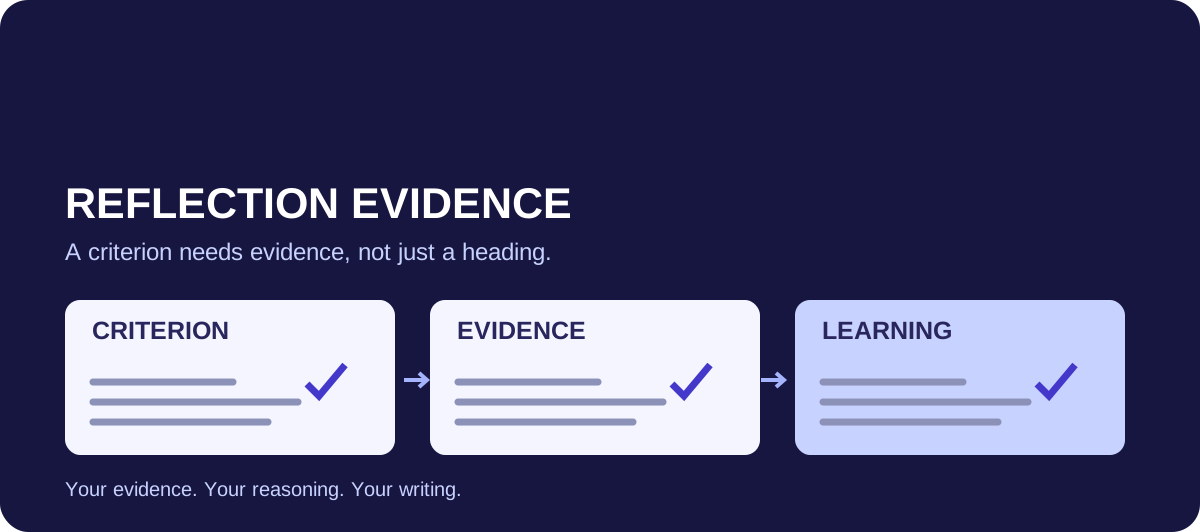
Start with one paragraph and one criterion. In the free Reflective Essay Criteria Evidence Checklist, record the requirement, the evidence location and the gap. A paragraph with no identifiable interpretation usually needs reasoning before stylistic editing; a claim with no support needs an evidence check.
Marker’s Eye accepts your own draft, brief and rubric for rubric-led academic feedback. Use its comments as review prompts and compare them with the actual task; they are not the lecturer’s final judgement. MPW education support can help with understanding expectations, developing your process and reviewing your own work.
For the full writing process, continue to the critical reflection essay guide. For a passage that simply recounts events, use the reflective-mistakes guide. Your next step here is narrower: make one required quality visible through specific evidence and reasoning.
Questions
Your next step
Use the free planner and relevant support to improve your process. You remain responsible for the interpretation and final writing.
Follow your brief and academic-integrity requirements.