
Thesis appendix: what to include
Decide what belongs in an appendix and how to format it — keep the main argument clean and the evidence organised.
Not sure where to start? Talk to our support team live.

Dissertation & Thesis
There is no single PhD timeline. This UK guide separates the full doctorate from the active thesis-writing period, with a realistic phase-by-phase roadmap, chapter planning, and how supervisor feedback fits in.
The short version
There is no single timeline. A UK doctorate often takes three to four years full-time, but the active thesis-writing and revision stage is only part of that — commonly several months to a year or more. It depends on your subject, research method, data, supervision and university regulations, so follow your own programme’s requirements.
On this page
The short answer
There is no universal answer, and anyone who gives you a single number is guessing. A UK full-time PhD is commonly around three to four years, and a part-time PhD often six or more — but these are the length of the whole doctorate, not the time spent writing the thesis itself. Programme lengths, extensions and submission deadlines are set by your university’s regulations, which is where you should always confirm the specifics.
The QAA’s Doctoral Degree Characteristics Statement describes what a doctorate involves across UK institutions, while funders such as UK Research and Innovation set expected durations for funded studentships. Use those as your framework, then plan the thesis-writing stage realistically within it.
Key point Treat any month figure in this guide as an adjustable example, not a rule. Your doctoral programme regulations are the authority on timing.
Two different questions
People ask “how long does a PhD take?” and “how long does it take to write a thesis?” as if they are the same question. They are not, and confusing them is the most common planning mistake.
Students who write chapters as they go — a methodology draft after ethics approval, a findings draft after analysis — face a shorter, calmer final write-up than those who leave everything to the end.
The variables
Your realistic timeline is shaped by factors that differ for every candidate, which is why comparison with peers is rarely useful:
Before you plan, it helps to understand your doctoral brief — the exact requirements, word limits and regulations your programme sets — so your schedule fits reality rather than a generic template.
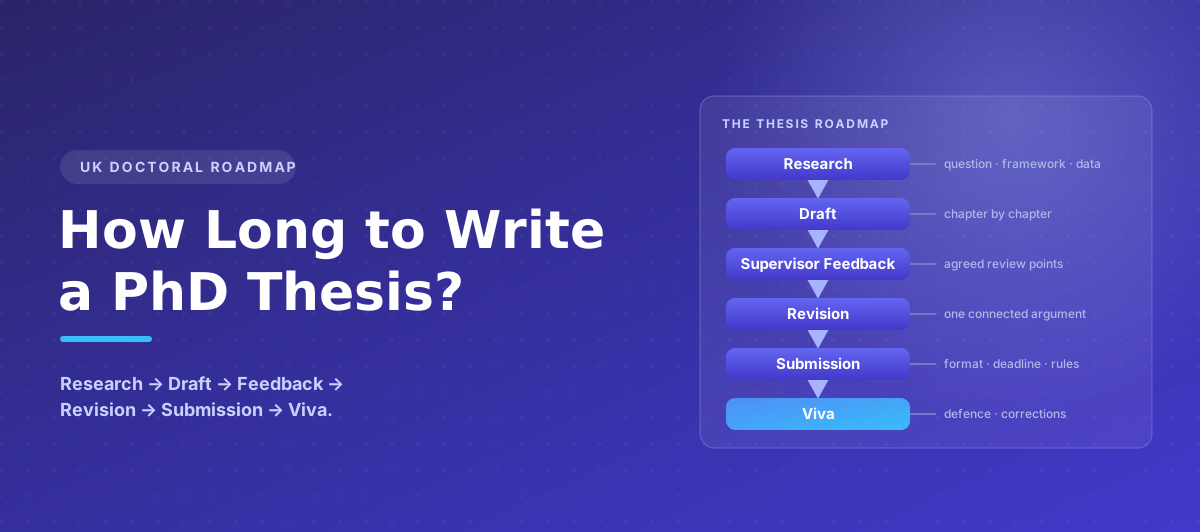
A realistic roadmap
| Phase | Main objective | Typical tasks | Evidence of progress | Discuss with supervisor |
|---|---|---|---|---|
| Scope & question review | Confirm the question is answerable | Refine aims and objectives, check scope | A clear, agreed research question | Is the scope realistic for the time left? |
| Literature & framework | Map the field and your framework | Update the review; define the theoretical/conceptual framework | An organised, current literature base | Does the framework fit the question? |
| Data collection / analysis | Gather and analyse evidence | Fieldwork or source analysis; ethics compliance | Enough analysed data to argue from | Any ethics or access risks to flag? |
| Chapter drafting | Get words on the page | Draft methodology, findings and discussion chapter by chapter | First drafts of the core chapters | Which chapter should you see first? |
| Cross-chapter revision | Make it one connected argument | Align introduction, chapters and conclusion | A thesis that reads as one argument | Does the argument hold across chapters? |
| Supervisor review | Act on structured feedback | Send agreed sections; keep a revision log | Feedback applied and logged | What feedback can you give at this stage? |
| Final editing & formatting | Polish and comply | Proofread, reference, appendices, formatting | A correctly formatted, submission-ready thesis | Do you meet the exact formatting rules? |
| Submission & viva prep | Submit and prepare to defend | Confirm deadlines; prepare for the viva voce | Submitted thesis; viva preparation underway | What are the confirmed submission deadlines? |
| Post-viva corrections | Complete required changes | Apply examiner corrections within the deadline | Corrections approved | What is the corrections scope and deadline? |
Phases often overlap and their order varies by discipline. The time you spend on each is an adjustable example — never treat it as an official requirement. Confirm every deadline in your own programme regulations.
Chapter planning
Plan the thesis around one central argument that answers your research question, then make every chapter serve it. A common UK structure is:
Chapter order, naming and count vary by discipline and university — a science thesis and a humanities thesis can look very different, and some use a paper-based (“three-paper”) format. Write the introduction and conclusion last, once the argument is settled. Our guide on how to organise thesis appendices covers what belongs in an appendix versus the main text, and thesis support explains how to keep the whole thing reading as one connected argument.
Working with your supervisor
Supervisor feedback is one of the biggest variables in your schedule, so plan it deliberately rather than hoping for quick turnarounds:
Supervisors guide and review your work — they do not co-write your thesis, and their availability is finite. For an additional check on your own draft between supervisions, review your own thesis chapter for clarity, structure and evidence use before you send it.
A planning example
Big items like “finish the discussion chapter” stall because they are not really tasks. Here is a short, fictional example of how a doctoral student might break one down — the work stays entirely theirs:
Vague goal Finish the discussion chapter.
Each of these is a session you can actually finish, which keeps momentum and makes progress visible. Note that this is a planning method, not chapter content — the analysis and words remain yours.
Bringing it together
Once the chapters exist, the thesis has to become one connected argument, not a stack of separate documents. Read it end to end for a consistent line of reasoning: does the introduction promise what the conclusion delivers? Do the chapters cross-reference each other?
Then handle the mechanics that quietly cost time: complete and consistent referencing in your required style, correctly placed appendices, and the exact formatting your university specifies (margins, word limit, declaration, layout). Building in academic editing and proofreading time near the end is not optional — it is part of the schedule.
The final stage
Submission is governed by hard deadlines and formatting rules, so confirm them early and independently. After submission comes the viva voce — an oral examination of your thesis and its contribution. Preparing well means re-reading your thesis critically, anticipating questions, and being ready to defend your choices.
Most candidates receive corrections after the viva (often minor or major), with a set deadline to complete them. Build this into your plan: the thesis is rarely “done” at submission. Organisations such as Vitae provide UK-focused researcher-development guidance on the viva and final stages. Outcomes and timescales vary by institution and examiner, so nothing here is a guarantee — check your own regulations.
When things slip
Timelines slip; it is normal, not failure. If you fall behind, act early: re-plan realistically, talk to your supervisor, and ask about formal options such as interruption or extension rather than silently overrunning. The common timeline mistakes to avoid:
Apply it to your own draft
Marker’s Eye reviews your own thesis chapter against academic expectations — clarity, structure, argument and evidence use — and flags where reasoning needs to be tighter. You make the changes; every word stays yours.
Track your progress
Use this checklist on your own thesis as you go — and confirm every requirement against your university’s doctoral regulations.
Why us
My Perfect Writing helps UK doctoral students plan their thesis and review their own drafts — while they stay responsible for their own research, analysis and writing. We do not write theses or replace your supervisor.
Guidance helps you turn research, drafting, feedback and revision into a realistic plan that fits your own programme regulations.
Marker’s Eye reviews your own chapter drafts for clarity, structure, argument and evidence use — you make the changes.
Advice reflects UK doctoral norms — supervision, the viva and university regulations — not a generic template or a fixed timeline.
The research, analysis and writing remain entirely yours. We do not write theses, and we never replace your supervisor.
Explore the tools and the free planner before deciding whether you need any further guidance.
You stay the author of your doctoral work — our tools help you plan and review it, they do not write it for you.
Questions
Before you submit
Use this roadmap to plan a realistic thesis schedule, then let Marker’s Eye review your own chapter drafts against academic expectations before you submit.
Guidance should support your doctorate, not replace your authorship or your supervisor.