

Finance
Finance Dissertation Topics: How to Choose a UK Research Focus
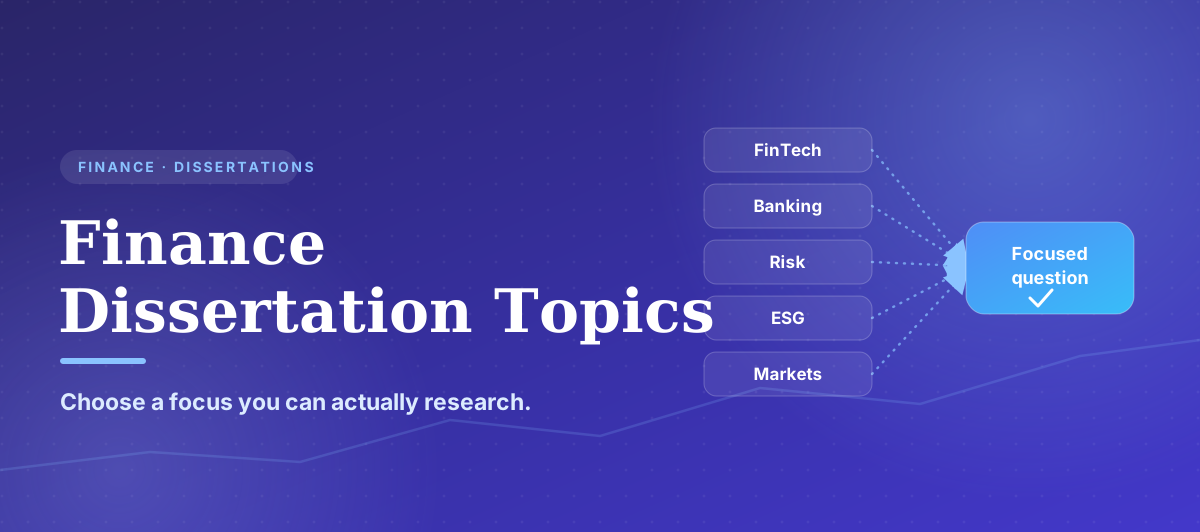
Long lists of finance topics are easy to find; a focus you can actually research is harder. This guide gives you current UK finance topic clusters for 2026 and a simple framework to turn a broad area — FinTech, ESG, risk — into a feasible, data-backed research question.
The short version
Quick answer
Good finance dissertation topics are focused, researchable questions — not broad themes like “FinTech” or “risk”. Start from a current area, find a genuine research gap, then check feasibility: can you access UK data (the ONS, Bank of England or FCA), is it ethical, and is the scope realistic for one dissertation? That turns a topic into a question you can actually answer.
On this page
In this guide
The basics
What makes a good finance dissertation topic?
A strong topic is a specific, answerable research question — not a broad subject area. “Risk management” is a field; “How do UK banks disclose and manage climate-related financial risk?” is a dissertation.
The best finance topics are current, connect to real UK evidence you can actually obtain, and target a research gap — something recent studies have not yet answered, or have answered only in another market. Most undergraduate and Master’s finance dissertations rely on secondary data (published figures, filings and databases) rather than collecting their own, which keeps them feasible.
Focus, not topic If you can state your work as one clear question with a defined variable, sample and period, you have a focus. If it still sounds like a module title, keep narrowing.
Where the ideas are
Finance dissertation topic clusters for 2026
Instead of a flat list, group current finance topics into clusters, then pull one focused question out of the cluster that fits your interests and the data you can reach:
- FinTech & digital banking — open banking, payments, digital-only banks. e.g. How has open banking affected competition among UK retail banks?
- Banking & regulation — capital rules, lending, supervision. e.g. How have post-crisis capital requirements affected UK bank lending to small firms?
- Corporate finance & governance — capital structure, board composition, performance. e.g. Does board diversity relate to the financial performance of FTSE 350 firms?
- Investment & financial markets — asset pricing, market reactions, portfolios. e.g. How do UK equity markets react to Bank of England interest-rate decisions?
- Risk management — credit, market, operational and climate risk. e.g. How do UK banks report climate-related financial risk?
- Behavioural finance — investor decision-making and biases. e.g. Does financial literacy affect the decisions of UK retail investors?
- Sustainable finance & ESG — ESG disclosure, green finance, impact. e.g. Does ESG disclosure quality affect the cost of capital for UK-listed firms?
- Financial inclusion — access to banking and credit. e.g. What drives access to banking among underserved UK communities?
- Monetary policy & the macro environment — interest rates, inflation, lending. e.g. How has recent monetary tightening affected UK mortgage pricing?
ESG (environmental, social and governance) and FinTech are especially active right now, but a well-scoped question in a “traditional” cluster like corporate finance can be stronger than a fashionable topic you cannot get data for.
The framework
How to choose your finance research focus, step by step
Work down from a broad cluster to a single question, checking feasibility before you commit:
- Pick a cluster that fits your interests and the modules you did well in.
- Narrow to a current theme — a policy, product or debate that is live in the UK now.
- Find a research gap by reading recent studies and noticing what they did not test.
- Run a feasibility check — data, method, ethics and scope (see below).
- Write it as a focused question with a clear variable, sample and time period.
Decode your brief before you write
Chosen a finance topic?
Brief Decoder turns your dissertation brief into a plain-English plan — the real question, where the marks are, the hidden requirements, and a step-by-step structure — so you can start with confidence. You stay the author of your work.
See it applied
Worked example: from a broad area to a focused question
Here is the funnel applied to one of the most active UK areas — sustainable finance and ESG:
Broad cluster Sustainable finance & ESG.
Current theme ESG disclosure by UK-listed companies.
Research gap There is a lot on whether firms publish ESG scores, but less on whether the quality of that disclosure affects how cheaply they can raise capital.
Feasibility check Annual reports, ESG ratings and financial data are secondary and obtainable; ethical risk is low; the scope is one clear relationship, not five.
Focused question Does the quality of ESG disclosure affect the cost of equity capital for FTSE 350 companies?
Notice how each step narrows the field until the question is specific enough — one variable, one sample, one period — to answer in a single dissertation.
Choosing a cluster
Comparing finance topic clusters
| Topic cluster | Why it is current in the UK | Possible UK data | Method options | Feasibility / ethics | Example research question |
|---|---|---|---|---|---|
| FinTech & digital banking | Rapid change in payments and open banking | FCA publications, company reports, ONS | Quantitative or case study | Low with secondary data | How has open banking affected UK retail-banking competition? |
| Banking & regulation | Capital and supervision reforms | Bank of England, PRA, bank accounts | Quantitative, secondary | Low–medium | How have capital rules affected UK bank lending to SMEs? |
| Corporate finance & governance | Board reform and performance debate | Annual reports, LSE-listed data | Quantitative (panel data) | Low with public filings | Does board diversity relate to FTSE 350 performance? |
| Investment & markets | Rate and inflation volatility | Market indices, price data | Quantitative (event study) | Low with public prices | How do UK markets react to interest-rate decisions? |
| Risk management | Climate and operational risk focus | Bank of England, bank disclosures | Quantitative or content analysis | Low–medium | How do UK banks report climate-related risk? |
| Behavioural finance | Investor protection and literacy | FCA surveys, published datasets | Quantitative or survey | Medium — ethics if primary | Does financial literacy affect UK retail investors? |
| Sustainable finance & ESG | Green finance and disclosure rules | Annual reports, ESG ratings | Quantitative (regression) | Low with secondary data | Does ESG disclosure affect cost of capital? |
| Financial inclusion | Access-to-banking policy focus | ONS, FCA, charity reports | Quantitative or mixed | Medium — sensitive groups | What drives access to banking in the UK? |
| Monetary policy & macro | Rate rises and mortgage stress | Bank of England, ONS | Quantitative, secondary | Low | How has tightening affected UK mortgage pricing? |
Data such as Office for National Statistics economic data and Bank of England statistics are free and widely accepted in UK finance dissertations.
UK context
What makes a finance topic workable in the UK
A topic is only as good as the evidence and context behind it. In a UK finance dissertation, three things make a topic workable:
- Accessible UK data. Favour areas where secondary data is public: ONS economic and financial data, Bank of England statistics, and company annual reports. If the only data you need sits behind a paywall or inside a firm, the topic may not be feasible.
- Regulatory relevance. UK finance is shaped by its regulators — the Financial Conduct Authority for conduct and markets, and the Prudential Regulation Authority for the safety of banks and insurers. Grounding a topic in the UK framework makes it more relevant than a generic, market-neutral question.
- Scope, ethics and feasibility. A narrow, well-evidenced UK question beats a broad international one you cannot resource in a few months.
If you want to know what UK markers expect from a finance dissertation as a whole, our accounting and finance guidance explains how scope, evidence and structure are assessed.
Before you commit
Feasibility: data, method and ethics
Most finance topics fail not because they are dull, but because they are not feasible. Check four things before committing:
- Data availability. Can you obtain the secondary data (prices, filings, published statistics) you need, for a large enough sample and period?
- Method. Match the method to the question — quantitative techniques (regression, event study) for “how much” questions; qualitative or content analysis for “how” or “why” questions about disclosure or behaviour.
- Scope. One clear relationship, not five. A narrow question you test well beats a broad one you only describe.
- Ethics. Secondary, public data usually raises few ethical issues; primary research — surveys or interviews with investors or staff — normally needs ethical approval. Check your university process early.
Avoid these
Common mistakes when choosing a finance topic
- Too broad. “FinTech in the UK” is a module, not a dissertation.
- No data access. A great idea with no obtainable data is not researchable.
- Chasing the trend. A fashionable ESG or crypto topic you cannot evidence is weaker than a well-scoped corporate-finance question.
- No research gap. Re-testing a settled relationship adds little; find where the evidence stops.
- Question and method mismatch. Asking a “how much” question with no quantitative data, or a “why” question with only numbers.
Whatever you choose, the research, analysis and writing must be your own, in line with academic integrity.
Before you write
Is my finance topic ready? A quick checklist
- Have you identified a genuine research gap?
- Can you realistically obtain the UK data you need?
- Is the scope a single, clear question with a defined sample and period?
- Does your method match the question?
- Is ethical approval feasible if you plan primary research?
- Does it fit a supervisor’s area of expertise?
If you can tick all six, you have a finance focus you can defend.
Why us
Why UK students use My Perfect Writing alongside this guide
My Perfect Writing helps UK students choose a focused, feasible finance topic and understand their dissertation brief — without taking authorship of the work away from them.
Your dissertation stays yours
We help you scope a topic and decode your brief. We do not choose your topic for you or write submission-ready work.
Built around UK academic expectations
Guidance reflects what UK markers and supervisors look for: a clear research gap, feasible methods, and well-scoped, evidenced questions.
Decode the brief, not just the topic
Brief Decoder turns your dissertation brief into the real question, the marking priorities and a step-by-step structure.
Ethical academic support
We support your own research and decisions, in line with academic integrity — never outsourcing your dissertation.
Start with a free preview
Explore Brief Decoder before deciding whether you need any further guidance.
You stay the author of your dissertation — Brief Decoder helps you plan it, it does not write it for you.
Questions
Frequently asked questions
What are good finance dissertation topics for UK students?
How do I narrow a finance dissertation topic into a question?
Which finance topics have accessible secondary data?
Can I write a finance dissertation about FinTech or ESG?
Do finance dissertations need primary research?
How current should a finance dissertation topic be?
Before you write
Choose your focus. Then decode the brief.
Use this guide to choose a feasible, UK-relevant finance research question, then let Brief Decoder turn your dissertation brief into a clear, structured plan before you start writing.
Guidance should support learning, not replace authorship.