
Writing a dissertation: proposal to submission
The full writing journey after your structure is set — using a Law dissertation as a worked example.
Not sure where to start? Talk to our support team live.

Dissertations & Study Skills
A blank 10,000–15,000-word dissertation is daunting until you see it as a set of chapters, each with one job. This UK guide walks through every chapter, what goes in it, a rough word budget, and how to keep your research question, methods and findings aligned.
The short version
A standard UK dissertation follows a clear structure: title page, abstract, introduction, literature review, methodology, results or findings, discussion, conclusion, references and appendices. Each chapter has one job, and together they form a single argument that runs from your research question to your conclusion. Getting the structure right early makes the writing far easier — always follow your own department’s guidelines for specifics.
On this page
The basics
A dissertation is the longest piece of writing most students ever produce, and the blank page is intimidating precisely because it is so large. The fix is to stop seeing it as one enormous document and start seeing it as a set of chapters, each with a single, clear job. Once you know what each chapter is for, the project becomes a series of manageable tasks rather than one impossible one.
Structure is not just an organisational convenience — it is how your reader (and your marker) follows your argument. A good structure acts as a roadmap: it guides the examiner logically from the problem you are investigating, through the evidence and methods, to what you found and what it means. This guide walks through the standard UK dissertation structure chapter by chapter. It is a general framework: your department’s handbook is always the final word on required sections, order, word count and formatting.
The honest answer
Most structuring problems come from a handful of predictable places:
Reassurance Every one of these is a structure problem, and structure can be planned before you write a word. Decide what each chapter must do and how much space it gets, and most of these problems disappear.
The overview
| Chapter | Its one job | Rough word share |
|---|---|---|
| Title & abstract | Name the study; summarise it in one paragraph | ~5% |
| Introduction | Set up the problem, aim and research question | ~10% |
| Literature review | Show the debate and find your gap | ~25% |
| Methodology | Explain and justify how you researched it | ~15% |
| Results / findings | Present what you found, clearly and neutrally | ~15% |
| Discussion | Interpret the findings against the literature | ~20% |
| Conclusion | Answer the question; state the contribution | ~10% |
| References & appendices | Evidence your sources; hold supporting material | Not counted |
A rough guide only — word shares vary by discipline and level. In some sciences, results and discussion are combined; always follow your own department’s guidelines.
Chapter by chapter
The title page and abstract come first but are often written last. The abstract is a single, self-contained paragraph (typically 150–300 words) that summarises the whole study: the problem, your aim, your method, your main findings and what they mean. Write it once everything else is done, because only then do you know what you are summarising.
The introduction is your hook and your contract with the reader. It should establish the topic and why it matters, narrow to the specific problem, and end with a precise aim and research question (or hypotheses). A strong introduction also gives a short roadmap of the chapters to come. Keep it focused — its job is to set up the study, not to review all the literature. If you are still shaping your topic, a subject-specific topic guide — such as our sociology dissertation topics — can help you land a researchable question before you build the structure around it.
Chapter by chapter
The literature review is not a summary of everything you read — it is a critical, thematic discussion of the existing debate that positions your study within it. Organise it by theme or argument rather than source by source, compare and contrast what scholars have found, and build towards the gap your research addresses. Done well, it makes your research question feel inevitable. Our guide on why adding more sources is not always the answer explains how to synthesise rather than list.
The methodology explains and, crucially, justifies how you carried out the research so that another researcher could evaluate or repeat it. Cover your overall approach (qualitative, quantitative or mixed), your methods of data collection and analysis, your sample, and your ethical considerations — and explain why each choice suits your research question. Description without justification is the most common way to lose marks here.
Chapter by chapter
Keep results/findings and discussion distinct — confusing them is the most common structural error. The findings chapter presents what you found clearly and neutrally (tables, figures, themes), without interpreting it. The discussion then interprets those findings: what do they mean, how do they compare with the literature, what are the implications and limitations? In some scientific disciplines these are combined, but check your own conventions before merging them. Our guide to writing a strong discussion shows how to move from result to interpretation.
The conclusion returns to your research question and answers it directly, drawing together the thread of the whole dissertation. Summarise your key findings, state your contribution, acknowledge limitations honestly and suggest future research — but introduce no new evidence. Finally, the references must be complete and consistent in your required style, and the appendices hold supporting material (instruments, transcripts, full data) that would interrupt the main text. For long theses, our thesis appendix guide covers what to include and how to format it.
The core skill
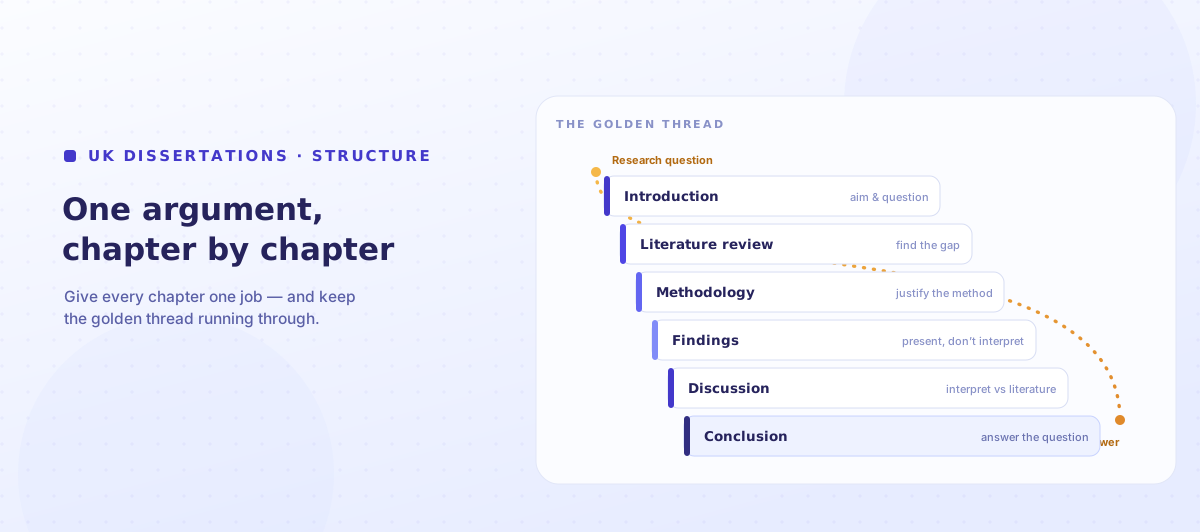
The mark of a strong dissertation is not just that each chapter is good, but that the chapters line up. This is often called the “golden thread”: your research question drives your literature review, which shapes your methodology, which produces your findings, which you interpret in the discussion and answer in the conclusion. Every chapter should point back to the question.
Before you write, do a one-page alignment check: write your research question at the top, then note how each chapter serves it. If your methods can’t actually answer the question, or your discussion drifts to themes your findings don’t cover, you have found an alignment problem early — when it is cheap to fix — rather than after 12,000 words. The free planner below turns this into a reusable alignment map, and the Manchester Academic Phrasebank is an excellent free source of academic phrasing for each section.
Planning
A little structural planning saves weeks of rewriting. Before drafting:
If you are unsure exactly what your brief or marking rubric is asking for, it is worth taking a moment to understand your dissertation requirements before you commit to an outline. With the structure mapped and the word budget set, you can then draft each chapter knowing precisely what job it has to do.
Pitfalls
Most structural marks are lost to a small set of avoidable errors:
Apply it to your own draft
Marker’s Eye reviews your own draft against UK marking expectations — structure, clarity, critical argument and how well your chapters align — and flags what to tighten. You make the changes; every word stays your own.
Before you submit
Use this on your own draft — always defer to your department’s handbook for the definitive required structure, word count and formatting.
Why us
My Perfect Writing helps students understand their brief and review their own dissertation writing — while they stay responsible for their own research, argument and submission. We do not write dissertations or complete chapters for you.
Brief Decoder helps you read your dissertation brief and marking rubric so your structure answers exactly what is required.
Marker’s Eye reviews your own draft against UK marking expectations for structure, clarity and argument — you make the changes.
The free planner helps you align your research question, methods, findings and conclusion before you write.
Guidance reflects how UK dissertations are structured, supervised and marked across disciplines.
The research, writing and argument remain yours. We do not write dissertations or chapters for you.
You stay responsible for your own dissertation — our tools help you plan and review it, they do not write it for you.
Questions
Before you submit
Use this guide to plan a clear, aligned dissertation structure, then let Marker’s Eye review your own draft against UK marking expectations before you submit.
Guidance should support your learning, not replace your own work.