
Write a clear dissertation abstract
Once the dissertation is done, distil it into a precise abstract that states your question, method, argument and contribution.
Not sure where to start? Talk to our support team live.

Law & Study Skills
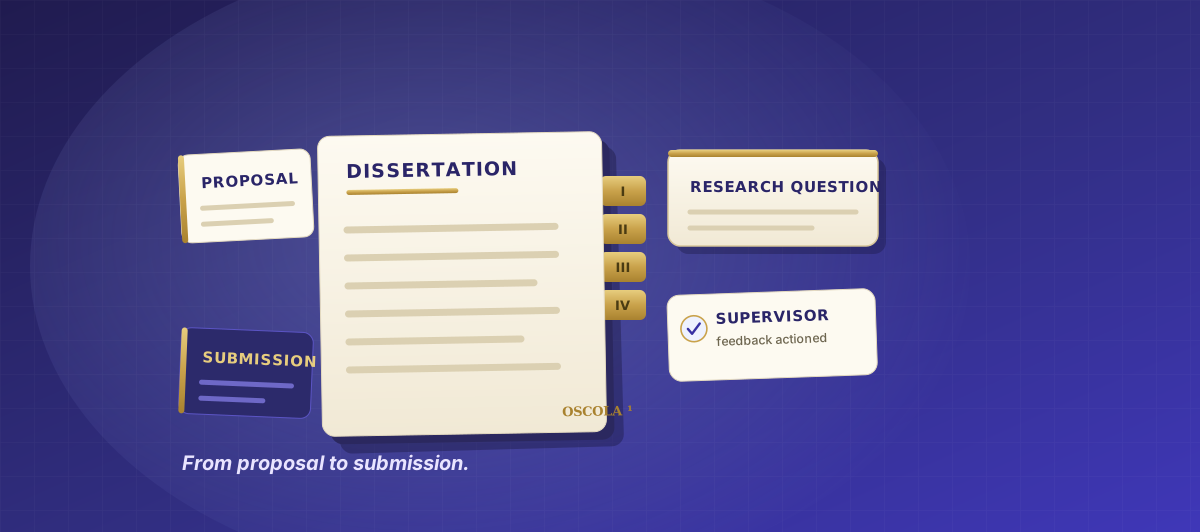
A Law dissertation is a long project best managed in stages. This UK guide takes you from proposal to submission: choosing a focused topic and research question, setting aims and objectives, picking a methodology, planning your structure, writing a critical literature review, working with your supervisor, referencing in OSCOLA, and reviewing before you submit.
The short version
Writing a Law dissertation means moving from proposal to submission in stages: choose a focused topic and research gap, turn it into a clear research question with aims and objectives, pick a suitable methodology, plan your chapter structure, research and write critically using primary and secondary sources, act on supervisor feedback, then reference in OSCOLA and review before you submit.
On this page
Start here
A strong dissertation begins with a focused topic, not a broad area. Start from something that genuinely interests you within a module you have enjoyed, then narrow it until it is small enough to explore in depth within your word limit. The key move is to identify a research gap — a question that is unsettled, under-analysed or newly raised by recent cases or legislation — rather than restating settled law.
Test the idea for feasibility early: are the primary sources accessible, is the area stable enough to analyse, and can you say something arguable about it? This guide is general UK study guidance, not legal advice; your department's requirements vary, so always follow your handbook, dissertation brief and supervisor. If you want structured help understanding what markers expect, see our law assignment help and dedicated dissertation support.
Focus the study
A topic is a subject; a research question is something you can answer with legal analysis. Convert one into the other by asking a precise, arguable question — often framed as "to what extent…", "how effectively…" or "should…" — that your whole dissertation will work to answer. A good question is narrow, contestable and answerable with the sources available to you.
From the question flow your aims and objectives: the aim is the overall purpose, and the objectives are the concrete steps (map the law, identify the gap, compare an approach, evaluate reform) that structure your chapters. Pinning down exactly what is being asked is a skill in itself — our Brief Decoder can help you read your dissertation brief closely before you commit.
The proposal
The proposal is where you show the work is viable. Most Law proposals set out the working title, the research problem and question, the aims and objectives, the proposed methodology, an outline chapter structure, a short indicative literature review, a note on feasibility and source availability, research ethics where relevant, and a timeline. Requirements differ between departments, so check your handbook for the exact format and length.
A short worked example. Take the broad topic "AI and the law":
This is a fictional illustration only — never submit a ready-made proposal or reproduce a live university brief; the research and writing must be your own.
Proposal at a glance
| Section | Purpose | One-line prompt |
|---|---|---|
| Research question | Defines what you will answer | This dissertation asks whether/how… |
| Aims and objectives | Sets the purpose and the steps | It aims to… by… |
| Methodology | Shows how you will answer it | Using doctrinal / comparative / socio-legal / empirical analysis |
| Literature and gap | Situates the work | Existing scholarship covers… but not… |
| Feasibility and ethics | Confirms it is workable | Sources are available; ethics approval is/ is not needed |
| Chapter outline | Maps the structure | Chapters will move from… to… |
A study aid only — your handbook and supervisor set the definitive proposal format and length.
Choose your method
Your legal research methodology should follow from your question, not the other way round:
Check feasibility and source availability before you commit: read the primary sources yourself using free, authoritative services such as legislation.gov.uk for statutes and BAILII or the National Archives' Find Case Law for judgments.
Plan the shape
Most Law dissertations share a recognisable structure, which you then adapt to your question. Each chapter should carry the argument forward — think of the dissertation as a single sustained argument answering your question, with every chapter doing one clear job and connecting to the next. Signpost those connections so the examiner can follow the thread from introduction to conclusion.
Build a one-line chapter argument for each chapter early, and revisit it as you write, so no chapter drifts off the question. The table below shows a typical shape; your handbook and supervisor may prefer a different arrangement.
A typical shape
| Chapter | What it does |
|---|---|
| Introduction | Sets the problem, research question, aims and structure |
| Literature review | Critically reviews existing scholarship and locates the gap |
| Methodology | Explains and justifies your research method |
| Analysis chapters | Apply the method to the law, building the argument issue by issue |
| Comparative / evaluation | Weighs approaches, reform or lessons (where relevant) |
| Conclusion | Answers the question and states the contribution and limits |
Illustrative only — some dissertations merge or reorder these; follow your own handbook.
Show the gap
A literature review is not a summary of everything written on the topic. It is a critical account that groups the scholarship by theme, weighs competing views, and shows where the debate is unresolved — which is exactly where your research gap sits. Use secondary legal sources (books, journal articles, reports) to map the argument, and make clear how your work will add to it.
Keep primary legal sources (cases and legislation) distinct from secondary commentary, and read leading authorities in full rather than through summaries. For the wider skill of building a legal argument, see our guides to UK law assignments and applying legal method in Equity and Trusts.
Do the work
With your method set, work through the analysis chapter by chapter, using cases, legislation and secondary sources to build the argument. The mark of a strong Law dissertation is critical legal analysis: not describing what the law is, but evaluating how well it works, where it is uncertain, and what should change. Apply authorities to the question rather than listing them, and connect each chapter's conclusion to the next chapter's starting point.
Write a clear methodology chapter that explains and justifies your approach and its limits, and keep your notes and sources organised as you go so your references stay complete and accurate. Momentum matters more than perfection in a first draft — you will revise heavily later.
Work with your supervisor
Your supervisor is your most valuable resource. Come to meetings with specific questions and a piece of work to discuss, take clear notes, and — crucially — act on the feedback before the next meeting. Feedback on an early chapter usually applies to later ones too, so look for the pattern rather than fixing only the sentences that were marked.
Once the draft is complete, revise the whole dissertation as one piece: check that every chapter still answers the research question, that the argument connects across chapters, and that your introduction and conclusion match what the middle actually does. Reviewing your own draft against marking criteria is where our Marker's Eye can help — you make the changes, and every word stays yours.
Finish well
Reference everything in OSCOLA, using footnotes and a full bibliography — the official Oxford OSCOLA guidance is the authority on format, and consistent referencing protects easy marks. Then handle the final details: a precise dissertation abstract, any appendices and formatting, and a careful proofread for sense, consistency and typos.
Leave time for a final pass against your handbook's submission requirements — word count, formatting, declaration, deadline and submission method. Rushing the last stage is a common way to lose marks that the content had already earned.
Avoid these
Most lost marks come from a short list of avoidable errors:
Apply it to your own work
Marker’s Eye reviews your own draft against UK marking expectations — structure, use of authority, critical analysis and whether each chapter answers your question — and flags what to tighten. You make the changes; every word stays your own.
Before you submit
Use this on your own draft — your handbook, brief and supervisor set the definitive requirements.
Why us
My Perfect Writing helps law students understand their requirements and review their own work — while they stay responsible for their own research, analysis and writing. We do not write dissertations or provide legal advice.
Brief Decoder helps you read your dissertation brief — the task, scope and requirements — so you plan around what is actually asked.
Marker’s Eye reviews your own draft for structure, argument and critical analysis against UK marking expectations — you make the changes.
Guidance reflects UK legal research, OSCOLA referencing and UK academic conventions, not generic overseas material.
The research, analysis and writing remain yours. We do not complete dissertations or give legal advice.
Use the free alignment map to keep your question, method and chapters coherent before deciding whether you need any further guidance.
You stay responsible for your own dissertation — our tools help you plan and review it, they do not do it for you.
Questions
Before you submit
Use this guide to move from proposal to submission with a clear question, method and structure, then let Marker’s Eye review your own draft against UK marking expectations before you submit.
Guidance should support your learning, not replace your own work.