
Express, resulting and constructive trusts
Compare the routes to beneficial ownership before applying a rule.
Not sure where to start? Talk to our support team live.

Law & Study Skills
Equity and Trusts is one of the toughest modules on a UK law degree. This guide explains what equity and trusts mean, the three certainties, the main types of trust, trustees’ and fiduciary duties, breach, tracing and equitable remedies — and how to structure problem-question and essay answers.
The short version
Equity and Trusts is the area of English law where equity — principles developed to soften the strict common law — governs trusts, arrangements in which a trustee holds property for beneficiaries. Mastering it means understanding equitable maxims, the three certainties, the main types of trust, trustees’ duties, breach and remedies such as tracing, then applying them precisely to problem facts.
On this page
The basics
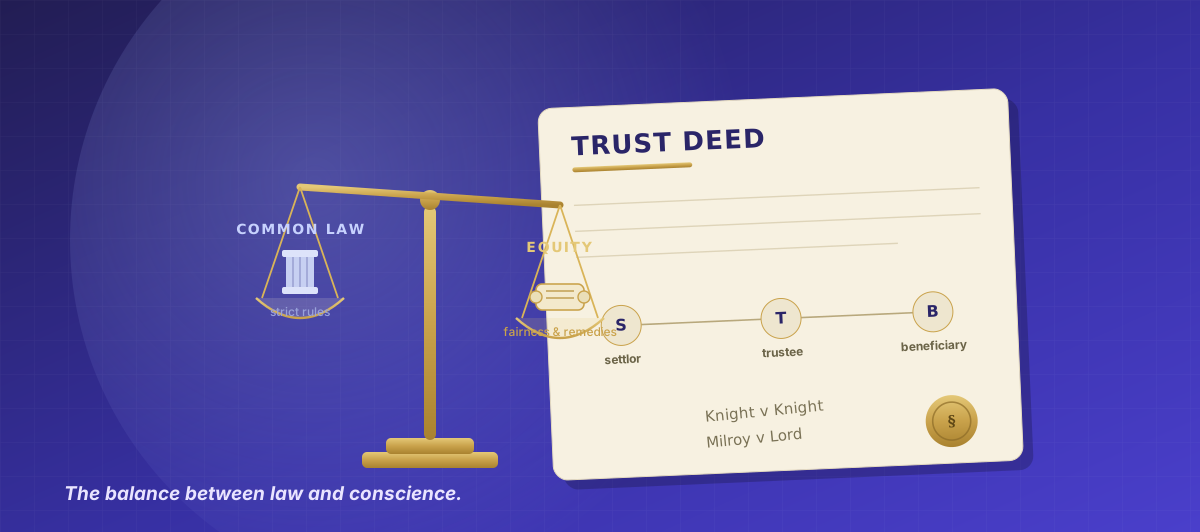
Equity is a body of legal principles that developed historically to correct the rigidity of the common law and to act on a defendant’s conscience. Trusts are equity’s most important creation: a trust arises where one party (the trustee) holds legal title to property but must use it for the benefit of others (the beneficiaries), on terms set by the person who created it (the settlor).
So Equity and Trusts as a module covers two linked things: the wider principles and remedies of equity, and the detailed law of trusts — how they are created, run and enforced. It is a demanding subject because the rules are precise and heavily case-based. This guide is general educational information about UK law, not legal advice; always verify the current law against primary sources and your own module materials, and if you need help with a live assignment our law assignment help explains what UK markers expect.
History
The common law was administered by the royal courts, but its remedies (mainly damages) and strict procedure could produce unfair results. Litigants petitioned the Court of Chancery, where the Lord Chancellor decided according to conscience and developed equity. Where the two conflicted, equity prevailed — confirmed in the Earl of Oxford’s Case (1615).
The Judicature Acts 1873–1875 fused the administration of law and equity into a single court system (a point continued today by s49 of the Senior Courts Act 1981), but they did not fuse the two bodies of rules themselves — equity and common law remain conceptually distinct. Understanding this relationship is essential, because many exam questions turn on where a strict legal rule gives way to an equitable one.
Principles
Equity is guided by maxims — short principles that capture how it operates. They are not rigid rules, but they explain many outcomes and are useful signposts in an answer:
Equitable remedies (such as injunctions and specific performance) are discretionary, which is why these maxims matter: they shape whether a court will grant relief.
Trust types
| Type of trust | What it is | Key example or authority |
|---|---|---|
| Express trust | Deliberately created by a settlor | Must satisfy the three certainties (Knight v Knight) |
| Fixed vs discretionary | Beneficiaries’ shares fixed, or at trustees’ discretion | Objects test differs (McPhail v Doulton) |
| Resulting trust | Beneficial interest returns to the settlor/contributor | Westdeutsche Landesbank v Islington LBC |
| Constructive trust | Imposed by law to prevent unconscionability | Family home cases: Stack v Dowden; Jones v Kernott |
| Bare trust | Trustee holds solely for one absolutely entitled adult | Beneficiary may call for the property (Saunders v Vautier) |
| Charitable (purpose) trust | For recognised charitable purposes, not individuals | Governed by charity law; exempt from the beneficiary principle |
A study aid only — always confirm the current law and full tests against primary sources and your module materials.
The core test
| Certainty | The question it asks | Key authority |
|---|---|---|
| Certainty of intention | Did the settlor intend to create a trust (not a gift or a moral wish)? | Paul v Constance |
| Certainty of subject matter | Is the trust property, and each beneficiary’s share, identifiable? | Palmer v Simmonds; Hunter v Moss |
| Certainty of objects (fixed trust) | Can a complete list of beneficiaries be drawn up? | IRC v Broadway Cottages |
| Certainty of objects (discretionary) | Can it be said of any person whether they are or are not a member of the class? | McPhail v Doulton |
The three certainties derive from Knight v Knight. If any fails, the trust may be void or the property may result back to the settlor.
Creation
Even a certain trust must be properly constituted — the property must actually be vested in the trustee, or the settlor must have declared themselves trustee. Milroy v Lord (1862) sets out the modes of transfer and the principle that equity will not perfect an imperfect gift or assist a volunteer. Later cases soften this: Re Rose treats a transfer as effective once the settlor has done everything in their power, and Pennington v Waine allowed a transfer where it would be unconscionable to recall it.
Formalities can also apply. Under the Law of Property Act 1925, a declaration of trust respecting land must be evidenced in signed writing (s53(1)(b)), and a disposition of a subsisting equitable interest must be in writing (s53(1)(c)). Testamentary trusts must comply with the Wills Act 1837. Missing a required formality can invalidate an otherwise well-intentioned trust.
Running the trust
Trustees hold significant powers (for example over investment and, sometimes, distribution) but are bound by strict duties. The Trustee Act 2000 imposes a statutory duty of care and a general power of investment subject to the standard investment criteria and a duty to review. Trustees must also act impartially between beneficiaries and keep proper accounts.
Above all, a trustee is a fiduciary. As Millett LJ explained in Bristol and West Building Society v Mothew, the distinguishing obligation is one of loyalty. That yields the no-conflict rule (Keech v Sandford) and the no-profit rule (Boardman v Phipps): a fiduciary must not allow duty and interest to conflict, nor profit from the position without authority. These duties are demanding precisely because they protect beneficiaries who cannot supervise every decision.
When things go wrong
A breach of trust occurs when a trustee fails in a duty — for example by making an unauthorised investment or distribution. A beneficiary may seek a personal remedy (an account, or compensation to restore the fund) or a proprietary remedy against the misapplied property or its substitute.
Tracing is the process of identifying trust property as it changes form; equitable tracing traditionally requires a fiduciary relationship (Re Diplock), and Foskett v McKeown confirms a beneficiary can claim the traceable proceeds or a proportionate share. Equity’s wider remedies — injunctions, specific performance, rescission, rectification and account of profits — are all discretionary. Proprietary estoppel, though distinct from trusts, often appears alongside them: where a clear assurance is relied on to the claimant’s detriment, equity may intervene (Thorner v Major; Gillett v Holt).
Exam skill
Problem questions reward a disciplined method — IRAC (Issue, Rule, Application, Conclusion) or ILAC. Identify each legal issue on the facts, state the relevant equitable rule and authority, apply it to those specific facts, then reach a reasoned conclusion. Work issue by issue; do not simply write everything you know about trusts. A structured way to start is to understand exactly what the question asks before you plan.
A short fictional example. Aisha tells her friend Ben, “this £5,000 in my account is as much yours as mine, for when you need it,” then dies. Her executors claim the money.
This example is illustrative only; never reproduce or submit a live assessed question, and keep your own analysis your own work.
Quick issue map · 30 seconds
Select the issues that appear in your problem question. We’ll help you organise the legal areas you should consider before you start writing.
This is an academic planning aid for fictional or assessed problem questions, not legal advice or a legal conclusion.
Your selected issues suggest a possible planning route. Check it against the full facts, your module materials and the relevant authorities.
Then apply the relevant authority to the specific facts and reach a reasoned conclusion. The map organises issues; it does not decide the legal outcome or write the answer.
Turn those issues into a structured problem-question plan so you do not miss a certainty, formality, duty or remedy.
Use the Free Equity & Trusts Problem-Question AnalyserWriting skill
An essay question is different: it argues a position rather than applying law to facts. Analyse the exact question and command word, set out a clear thesis, then build each paragraph around an authority — a case or statute — that you explain, apply and critically evaluate rather than merely describe. Weigh competing academic views and counterarguments, and link every paragraph back to your argument. Our step-by-step guide to writing a UK law essay covers this in depth.
Use cases and legislation critically: note the level of court — up to the UK Supreme Court — whether a decision is binding or persuasive, and how later cases have treated it. Read the full judgments and statutes for yourself using free primary sources such as BAILII for case law and legislation.gov.uk for statutes, rather than relying on summaries. Reference everything in OSCOLA, using footnotes and a bibliography — the official Oxford OSCOLA guidance is the authority on format. Reading widely also helps: our guide to the hardest law-school courses explains the study habits that make dense modules manageable.
Avoid these
The most common mistakes are avoidable once you know them:
Apply it to your own work
Marker’s Eye reviews your own draft against UK marking expectations — issue spotting, use of authority, structure and application — and flags what to tighten. You make the changes; every word stays your own.
Before you submit
Use this on your own drafts — always defer to your module materials and primary sources for the definitive law and requirements.
Why us
My Perfect Writing helps law students understand their brief and review their own work — while they stay responsible for their own research, analysis and writing. We do not write assessments or provide legal advice.
Brief Decoder helps you read an assignment brief — the task, command word and requirements — so you answer exactly what is asked.
Marker’s Eye reviews your own draft for structure, use of authority and application against UK marking expectations — you make the changes.
Guidance reflects UK cases, legislation and OSCOLA referencing, not generic overseas material.
The research, analysis and writing remain yours. We do not complete assessments or give legal advice.
Use the free problem-question analyser before deciding whether you need any further guidance.
You stay responsible for your own Equity and Trusts work — our tools help you plan and review it, they do not do it for you.
Questions
Before you submit
Use this guide to master the core Equity and Trusts principles and structure your analysis, then let Marker’s Eye review your own draft against UK marking expectations before you submit.
Guidance should support your learning, not replace your own work.