
Mastering equity and trusts the ultimate student guide to complex legal principles
Continue exploring this topic with a related practical guide.
Not sure where to start? Talk to our support team live.

Law
Identify where the beneficial interest comes from before applying a rule. A comparison guide for equity and trusts students in England and Wales.
The short version
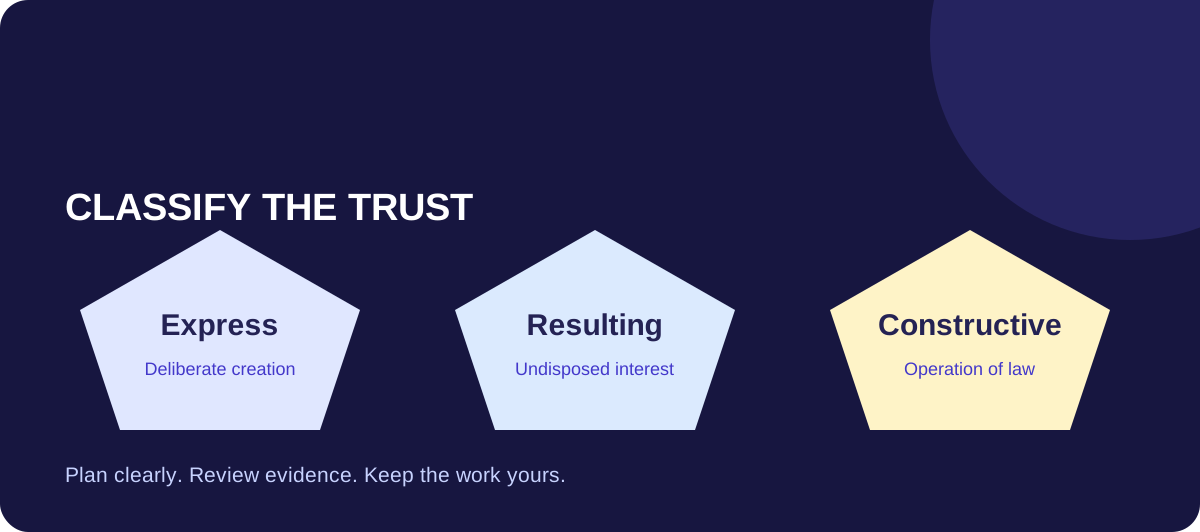
In England and Wales, an express trust is deliberately created by a settlor. A resulting trust may arise where beneficial ownership has not been fully disposed of or a relevant presumption applies. A constructive trust arises by operation of law in recognised circumstances. Identify the property, transaction and evidence before choosing the category.
On this page
Practical guidance
Express, resulting and constructive trusts describe different routes to beneficial ownership. Start with the asset, legal owner, claimant and relevant transaction. My Perfect Writing’s law assignment support helps students organise their own legal reasoning. This is academic study guidance for England and Wales.
Check whether an express declaration governs the interest before inferring one from other facts. Our equity and trusts guide covers the wider subject; this article focuses on classification.
At a glance
| Category | Starting question | Facts to investigate |
|---|---|---|
| Express | Did a settlor intentionally create a trust? | Words or conduct, certainty, constitution and applicable formalities. |
| Resulting | Has beneficial ownership been left undisposed of, or does a relevant presumption arise? | Terms, purchase contributions, intention and rebutting evidence. |
| Constructive | Do facts satisfy a recognised legal basis for a trust? | Relevant relationship, conduct and the doctrine’s particular requirements. |
A useful classification is the beginning of analysis, not a substitute for proving each requirement.
Practical guidance
An express trust is deliberately created. The word “trust” need not appear if the words and conduct establish the arrangement. For a private express trust, examine certainty of intention, subject matter and objects, then constitution through a valid transfer or self-declaration.
Keep those checks separate from formalities. Clear intention does not complete every transfer. Section 53(1)(b) of the Law of Property Act 1925 concerns signed written evidence of trust declarations respecting land; it is not a universal writing rule for every express trust.
Practical guidance
Automatic: an arrangement leaves some or all of the beneficial interest undisposed of. Presumed: a relevant transaction creates a rebuttable evidential starting point. Do not treat every failed gift as automatically producing the same result.
For a purchase-money scenario, record contributions, timing and evidence of intention, including whether a gift was intended. Later household spending is not automatically a purchase contribution. The CILEX 2026 specification distinguishes these routes and identifies authorities for further study.
Apply the guide
Use the tool to identify review priorities, then check them against your brief and evidence. You remain the author.
Practical guidance
A constructive trust arises by operation of law when a recognised doctrine’s requirements are met. Family-home disputes and fiduciary-profit cases involve different rules; neither is resolved by general fairness alone.
In home-ownership problems, distinguish sole from joint legal title, and establishing an interest from quantifying it. Jones v Kernott [2011] UKSC 53 concerns beneficial shares in a jointly owned home. It does not establish that unequal contributions always produce unequal shares or that sole-name cases have the same starting presumption.
Practical guidance
Section 53(2) preserves the creation or operation of resulting, implied and constructive trusts from the preceding requirements. It does not itself prove a trust: the claimant must still establish the substantive legal basis.
Keep remedies separate too. Personal liability does not always establish a beneficial interest in a particular asset. Explain the consequence of the doctrine you have actually proved.
Practical guidance
Express: A declares that identified shares are held for B. Check the declaration’s intention, property, beneficiary and validity.
Resulting: Trustees receive property under terms disposing of only part of the beneficial interest. Identify the undisposed interest and the applicable automatic resulting-trust rule.
Constructive: A claimant relies on a shared understanding about a home and conduct in reliance on it. Identify the legal-title position and analyse the relevant common-intention doctrine.
These invented examples isolate issues, not complete legal opinions. Use our problem-question guide to apply authority to fuller facts.
Apply the distinction
Check current course materials and primary authorities. This is a study aid for England and Wales.
Questions
Your next step
My Perfect Writing supports understanding, planning and draft review. Keep your decisions, evidence and final wording your own.
Follow your module brief and academic-integrity requirements.