
Mastering equity & trusts
The concept guide behind this revision piece: what equity is, the three certainties and the types of trust.
Not sure where to start? Talk to our support team live.

Law
You know the law, but the marks slip away in the exam. This revision guide covers the equity & trusts exam mistakes that cost students marks — issue spotting, IRAC, authority, analysis and timing — and how to fix your technique before exam day.
The short version
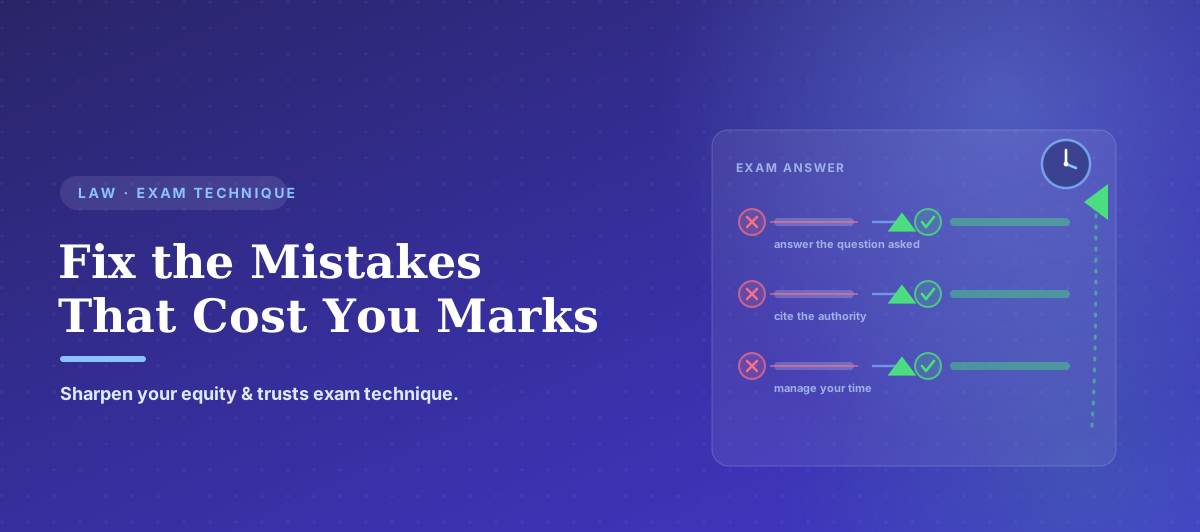
Students lose marks in equity and trusts exams not because they do not know the law, but because of exam technique: weak issue spotting, poor IRAC application, missing authority, describing the law instead of applying it, and running out of time. Fixing these is usually the fastest way to raise a grade.
On this page
Start here
Equity and trusts is one of the most content-heavy modules on a law degree, so it is easy to assume that lost marks mean gaps in your knowledge. Usually they do not. Most students who underperform in the exam actually know the law — they lose marks on exam technique: how they read the question, apply the rules and manage their time under pressure.
This guide is about that technique, not the substantive law. If you still need the concepts — the three certainties, the different types of trust, how equity works — the place to start is our full guide to mastering equity & trusts. Here we focus only on the mistakes that cost marks in the exam and how to fix them. If a particular assessment is worrying you, My Perfect Writing’s law assignment help can talk you through the technique — the goal is always to help you write stronger answers yourself.
Integrity first This is about revising and improving your own exam technique. Learn the method, practise it on past questions — every answer you sit stays entirely your own work.
Mistake 1
The most common mistake in a problem question is writing everything you know about a topic instead of answering what the question actually asks. Markers reward relevance: a problem question is testing whether you can spot the issues raised by these facts and address them, not whether you can recite a topic.
Before you write, read the facts twice and identify the specific legal issues each party or event raises. A short plan that lists the issues in order is worth the two minutes it takes — it stops you drifting into an unfocused essay and makes sure every paragraph earns its place.
Mistake 2
Knowing the IRAC method (Issue, Rule, Application, Conclusion) is not the same as using it well. The stage students rush is Application — the part worth the most marks. Stating the rule and then jumping to a conclusion skips the actual legal reasoning: you have to apply the rule to the specific facts and explain why it leads to your answer.
Application also needs authority. A rule asserted without a case or statute behind it reads as opinion. You do not need perfect citations under exam conditions, but you do need the key authorities and roughly what they decided; if you are revising from your notes, verify them against the actual judgments — UK cases are free to read on BAILII. For the wider skill of answering law questions well, our guide to assignments under UK law (LLB) is a useful companion.
Mistake 3
Even a well-structured answer stays in the lower bands if it only describes the law. The higher marks go to analysis: weighing competing arguments, dealing with the parts of the problem that are genuinely uncertain, and reaching a reasoned conclusion rather than a hedged one.
In equity and trusts, that often means acknowledging where the law is unsettled or where the facts could be read two ways, then arguing which is stronger. Showing the examiner your reasoning — not just your recall — is what separates a 2:1 answer from a first.
Mistake 4
Running out of time is one of the most avoidable ways to lose marks. A brilliant first answer is no use if the last question is a single rushed paragraph — the easy marks at the start of an unanswered question are the ones you never get back.
Divide your time by the marks available and hold to it, leaving a few minutes to plan each answer and a few at the end to check. If a question is worth a quarter of the paper, it gets roughly a quarter of your time — no more, however much you enjoy it.
The fix
The good news is that exam technique improves quickly with deliberate practice. Sit past questions to time, plan before you write, and force yourself through full IRAC on each issue — especially the Application stage. Then review what you wrote against the marking criteria, not just against the model answer.
That review step is the hardest to do on your own work, because your reasoning always feels clearer in your head than on the page. Marker’s Eye helps here: it reviews your own practice answer against UK marking criteria and flags where you describe rather than apply, or where an argument needs authority — so you can fix the habit before exam day.
At a glance
| Mistake | Why it costs marks | How to fix it |
|---|---|---|
| Data-dumping the topic | Ignores what the question actually asks; rewards recall, not relevance | Plan the issues from the facts before you write |
| Weak IRAC application | Skips the reasoning that carries the most marks | Apply each rule to the specific facts, step by step |
| Missing authority | Rules stated as opinion, not law | Back each rule with the key case or statute |
| Describing, not analysing | Keeps the answer in the lower bands | Weigh the arguments and reach a reasoned conclusion |
| Running out of time | Easy marks on later questions are lost for good | Split time by marks and stick to it |
Most of these are technique, not knowledge — which is exactly why they are quick to fix.
Free resource
Want these in a form you can revise from? Our Equity & Trusts Exam Mistakes Checklist puts the top mark-losing mistakes, issue-spotting prompts, IRAC reminders and a simple exam timing plan on one page — so you can check your technique as you practise, not just after the results come out.
Grab the checklist Use the free resource card on this page to get the Equity & Trusts Exam Mistakes Checklist sent to you — it’s built to sit beside your past-paper practice.
Apply it to your own answer
Marker’s Eye reviews your own practice answer against UK marking criteria — structure, issue spotting, application and use of authority — and flags where you describe the law instead of applying it, so you can improve before the exam. You make the changes; every word stays yours.
Before the exam
Practise this on past questions until it becomes automatic under pressure.
Why us
My Perfect Writing helps UK students understand their brief, review their own drafts and identify clear next steps without taking control of their work away from them.
We provide structured guidance and feedback on your own work. We do not write submission-ready assignments or replace student authorship.
Our tools focus on the areas UK markers assess, including task relevance, critical analysis, evidence, structure and academic integrity.
Instead of vague comments, students receive focused guidance showing what needs attention and what they can improve themselves.
Students can use focused tools such as Marker’s Eye and can also contact a human representative when they need additional guidance.
Students can explore the relevant report or tool before deciding whether they need further support.
You stay responsible for your own work — Marker’s Eye guides and reviews your draft, it does not write it for you.
Questions
Before the exam
Use this guide to fix the mistakes that cost marks, then let Marker’s Eye review your practice answers against UK marking criteria before exam day.
Guidance should support learning, not replace authorship.