

Law
What Is the Hardest Course in Law School?
Ask ten law students for the hardest module and you will get several answers. This UK guide explains what actually makes a law module difficult, why it varies from student to student, and how to study whichever one is toughest for you.
The short version
Quick answer
There is no single hardest law-school module for everyone. UK students often find Equity and Trusts, Land Law, Jurisprudence and EU Law challenging — but for different reasons, from abstract theory to dense case law and technical rules. The hardest module for you usually depends on whether you struggle more with theory, technical detail, volume of authority, or applying law to problem questions.
On this page
In this guide
The honest answer
What makes a law course difficult?
A law module is difficult when it demands a kind of thinking you find hard — not because its name is intimidating. That is why students disagree about the “hardest” module: the same content that one person finds abstract, another finds straightforward but dull.
On a UK LLB (Bachelor of Laws), difficulty usually comes from one or more of these: abstract concepts, the volume of cases and legislation, technical rules that interlock, the demand to apply law to problem questions, or the demand to build a critical essay around competing theory. Add the assessment format, time pressure and your own prior strengths, and you can see why there is no single right answer.
Careful with rankings You will see confident claims that one module is “the hardest”. Treat those as opinion. Difficulty varies by university, by assessment and by student — module names and content differ between institutions.
A framework
What makes a law module difficult? Six factors to weigh
Instead of trusting a list, judge any module against six factors. A module that scores high on several of them — especially ones that play to your weaknesses — is the one that will feel hardest to you.
The usual suspects
Which law modules do UK students most often find hard?
A few modules come up again and again when UK students talk about difficulty — each for a different reason. Names and content vary between universities, so treat these as common patterns, not a fixed ranking.
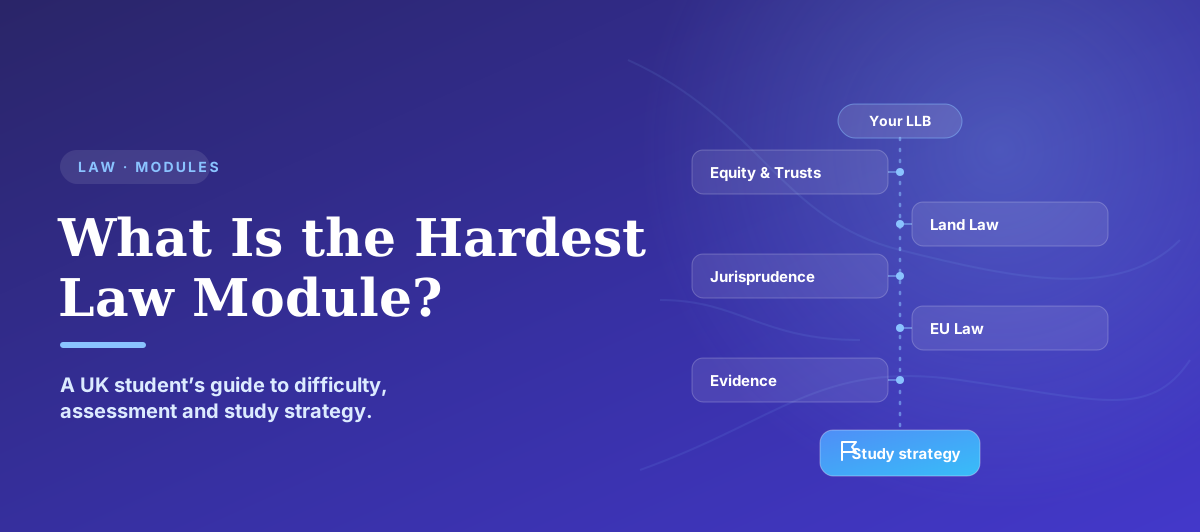
- Equity & Trusts is often found difficult because it is abstract: layered principles and several kinds of trust that only make sense once you apply them. It rewards conceptual reasoning, and is usually assessed by problem question and essay. The common mistake is memorising rules without tracing each to a case and a fact pattern.
- Land Law is technical: interlocking rules about interests in land and registration, where one missed step changes the answer. It rewards precision and a clear framework, and is usually a problem question. Students struggle when they lose track of competing interests.
- Jurisprudence (legal theory) is difficult in the opposite way — it is critical and essay-based, asking you to weigh competing schools of thought rather than apply rules. Students who are strong at problem questions can find it hard because describing a theory is not the same as evaluating it.
- European Union (EU) Law combines volume with change: many sources of law and an evolving UK relationship after Brexit. It rewards structured synthesis, and often mixes essay and problem assessment.
Modules like Public/Constitutional Law, Contract, Tort, Criminal Law, Evidence and Company/Commercial Law are demanding too — the comparison table below sets out why, and what to do about each.
At a glance
Common UK law modules: why they are hard, and how to study them
| Module | Why students may find it difficult | Main skill required | Common assessment | Frequent mistake | Helpful study approach |
|---|---|---|---|---|---|
| Equity & Trusts | Abstract principles and layered trust rules | Conceptual reasoning | Problem question + essay | Learning rules without applying them | Trace each rule to a case and a fact pattern |
| Land Law | Technical, interlocking rules and registration detail | Precision with detail | Problem question | Losing track of interests in land | Build a step-by-step framework for each interest |
| Jurisprudence | Abstract theory and competing schools of thought | Critical evaluation | Essay | Describing theories instead of evaluating them | Compare theorists on the same question |
| EU Law | Large volume and an evolving post-Brexit position | Structured synthesis | Essay + problem | Ignoring how the UK relationship has changed | Map sources of law and their current UK status |
| Public / Constitutional | An uncodified constitution and contested principles | Analysis of principle | Essay | Reciting facts without argument | Argue the principle, not the timeline |
| Contract | Broad first-year breadth and many rules | Issue spotting | Problem question | Missing issues under time pressure | Practise timed issue-spotting |
| Tort | A wide range of duties and tests | Applying tests to facts | Problem question | Reciting tests without applying them | Work through each element on the facts |
| Criminal | Technical elements and doctrinal debate | Precise application | Problem question + essay | Confusing the guilty act and guilty mind | Keep an elements checklist per offence |
| Evidence | Technical admissibility rules | Rule application | Problem question | Treating relevance as admissibility | Separate relevance, admissibility and weight |
| Company / Commercial | Dense statute interacting with case law | Statutory navigation | Essay + problem | Getting lost in statutory detail | Map the statute’s structure to the issues |
This table describes common patterns, not a universal ranking — always check what your own module actually assesses.
Two kinds of hard
Are legal essays harder than problem questions?
Neither is harder in general — they are hard in different ways, and which you find tougher tells you a lot about your hardest module.
- Problem-question modules (often Contract, Tort, Land, Criminal, Evidence) test application: spotting the legal issues in a fact scenario and applying the right rule and authority to reach a conclusion. Structures such as IRAC (Issue, Rule, Application, Conclusion) or ILAC (Issue, Law, Application, Conclusion) help here.
- Essay-heavy modules (often Jurisprudence, Public Law, parts of EU Law) test critical evaluation: building an argument about what the law should be or how a theory holds up. Here you need a thesis and evaluation, not an IRAC checklist.
If you are strong at applying rules but uncomfortable arguing theory, an essay module will feel like your hardest — and vice versa.
When it feels hard
Is the hardest module in first year or later?
It depends on why a module is hard, and year structures differ between universities, so treat this as a general pattern:
- First-year foundational modules (such as Contract, Tort, Criminal and Public Law) can feel hard mainly because legal study itself is new — you are learning to read cases, spot issues and apply rules for the first time.
- Intermediate compulsory modules (such as Land Law and Equity & Trusts) are often found harder because the content is abstract or technical, on top of skills you are still developing.
- Advanced or optional modules (such as Jurisprudence or specialist commercial subjects) can be demanding because of abstraction, volume or specialist rules — but you also choose them, so interest helps.
So a first-year module may feel difficult because everything is unfamiliar, while a later module is difficult because of what it contains.
Read the small print
What generic lists of the hardest law modules often miss
Module names alone do not decide difficulty. The same subject can be far harder in one programme than another because of how it is taught and assessed. Generic lists rarely mention:
- Assessment type — a problem-question exam and a research essay test very different skills.
- Open-book or closed-book exams, and how much you must memorise versus locate.
- Coursework weighting — whether one exam decides the grade, or work is spread across the year.
- Required case and statute reading, and how much of it is dense primary material.
- Seminar participation and teaching structure, which change how much independent work you carry.
- Your own learning style — the single biggest variable, and the one no list can know.
This is why the most reliable difficulty signal is not a blog list but your own module handbook and marking criteria.
UK context
What makes a law module difficult at a UK university?
At a UK university, a module’s difficulty is defined less by its topic than by its handbook, learning outcomes, assessment brief and marking criteria — and these vary between programmes. Two things help you judge and prepare:
- Read the module documents. The handbook and marking criteria tell you whether a module rewards application, critical evaluation, or both, and what a high mark actually requires. UK law degrees share a broad body of knowledge described in the QAA subject benchmark statements, but each university designs its own modules and assessments.
- Work with UK sources. Difficulty often comes from primary material: legislation on legislation.gov.uk and case law on BAILII. Getting comfortable reading statutes and judgments is often what separates a hard module from a manageable one, and it matters beyond your degree for routes such as the Solicitors Qualifying Examination (SQE).
A note on wording: “course”, “subject” and “module” are used loosely, but UK students usually call individual units modules. If you want to know what UK markers expect from a law assessment overall, our law assignment guidance explains how legal reasoning, authority and evaluation are assessed.
Decode your assessment brief
Facing a tough law module?
Brief Decoder turns your law assessment brief into a plain-English plan — the real question, the command words, where the marks are, and the traps to avoid — so a difficult module feels manageable. You stay the author of your work.
See it applied
Two students, two different “hardest” modules
The same degree can produce opposite answers. Consider two students (illustrative, not real):
Student A Comfortable with abstract theory, but finds it hard to apply rules to messy facts. Their hardest module is Land Law — a technical, problem-question subject where precision on the facts is everything.
Student B Strong at problem questions and issue-spotting, but uneasy building an argument. Their hardest module is Jurisprudence — an essay subject that rewards critical evaluation over rule application.
Same modules, opposite difficulty. That is why the useful question is not “what is the hardest law module?” but “which factors do I find hardest, and which modules load them most?”
What to do
How to study a difficult law module
Whatever your hardest module, the approach is similar: understand the assessment, organise the authority, then practise the skill it tests.
- Read the module handbook and marking criteria first — know what a high mark requires before you revise.
- Build a case and legislation map so you can see how authorities fit together.
- Separate the legal rules from the academic debate — you need both, but they are used differently in problems and essays.
- Practise issue spotting on past problem questions.
- Use IRAC or ILAC where it fits a problem question — but remember it is not a universal structure for every legal essay, which needs a thesis and evaluation.
- Compare strong and weak analysis of the same problem to see what “application” really means.
- Act on feedback from formative work before the summative assessment counts.
- Plan revision around the actual assessment format — a closed-book exam and a research essay need different preparation.
When you have a draft essay or problem-question answer, a second read against the criteria helps. Marker’s Eye reviews your own draft and flags where it is too descriptive, where application is thin, or where authority is missing — the reading, analysis and writing stay yours.
Before you commit or revise
Judging a law module: a quick checklist
- Have you read the module handbook and marking criteria?
- Do you know whether it is assessed by problem question, essay, or both?
- Is it closed-book or open-book, and how much must you memorise?
- Which of the six difficulty factors does it load most?
- Does it play to your strengths or your weak spots?
- Have you a plan to practise the specific skill it tests?
If you can answer these six, you can judge any module’s difficulty for yourself — without relying on a generic list.
Why us
How My Perfect Writing supports UK law students ethically
My Perfect Writing helps UK law students understand their assessment brief and review their own drafts — while they stay responsible for their own legal research, analysis and writing. We do not provide legal advice.
Understand your own brief
Brief Decoder helps you read a law assessment brief — the command words, scope, marking criteria and common traps — so you know exactly what is being asked.
Review your own draft
Marker’s Eye reviews your own essay or problem-question draft, flagging descriptive writing, weak application or missing authority against UK expectations.
Built around UK expectations
Guidance reflects what UK law markers assess — legal reasoning, application, use of authority and critical evaluation — not a generic template.
You stay the author
The reading, legal analysis and writing remain yours. We do not write law assignments, and we do not give legal advice.
Start with a free preview
Explore the tools before deciding whether you need any further guidance.
You stay the author of your legal work — our tools help you understand and improve it, they do not write it or give legal advice.
Questions
Frequently asked questions
What is considered the hardest law module in the UK?
Is Equity and Trusts the hardest law subject?
Why do students find Land Law difficult?
What is the hardest first-year law module?
Are legal essays harder than problem questions?
How can I study for a difficult law module?
Before you write
Understand the brief. Then tackle the module.
Use this guide to judge why a module is hard, then let Brief Decoder turn your assessment brief into a clear plan — and Marker’s Eye review your own draft — before you submit.
Guidance should support learning, not replace your own legal analysis.