
Mastering Equity and Trusts
Apply issue spotting, authority and IRAC to one of the toughest UK law modules — the three certainties, trusts and remedies.
Not sure where to start? Talk to our support team live.

Law & Study Skills
From legal essays and problem questions to case notes and legal research, LLB assignments test how you find, apply and evaluate the law. This guide explains each assignment type, how to spot the legal issue, how to use cases and legislation critically, how to structure an answer with IRAC or ILAC, and how to reference in OSCOLA.
The short version
UK LLB assignments are mostly legal essays and problem questions, alongside case notes, statutory-interpretation exercises and legal-research tasks. To do them well, identify the legal issue, find the relevant cases and legislation, apply the law using a structure such as IRAC or ILAC, analyse authorities critically rather than describing them, and reference everything accurately in OSCOLA.
On this page
The basics
An LLB (Bachelor of Laws) is assessed through several distinct assignment types, and each rewards a slightly different skill. Knowing which one you are facing is the first step, because it decides how you structure your answer.
This guide is general educational information about UK law study, not legal advice. If you need help understanding what UK markers expect from a specific brief, our law assignment help page explains the criteria in plain terms.
At a glance
| Assignment type | What it involves | What markers reward |
|---|---|---|
| Legal essay | Arguing a position on a legal question | A clear thesis, critical analysis and evaluation |
| Problem question | Advising a party on a set of facts | Issue spotting and accurate application of law |
| Case note / comment | Analysing a single judgment | Identifying the ratio and evaluating the reasoning |
| Statutory interpretation | Working out what a provision means | Correct use of interpretation rules and case law |
| Legal research task | Finding the law on a point | Locating primary sources and judging their weight |
A study aid only — always confirm the exact requirements against your module handbook and assessment brief.
Read the question first
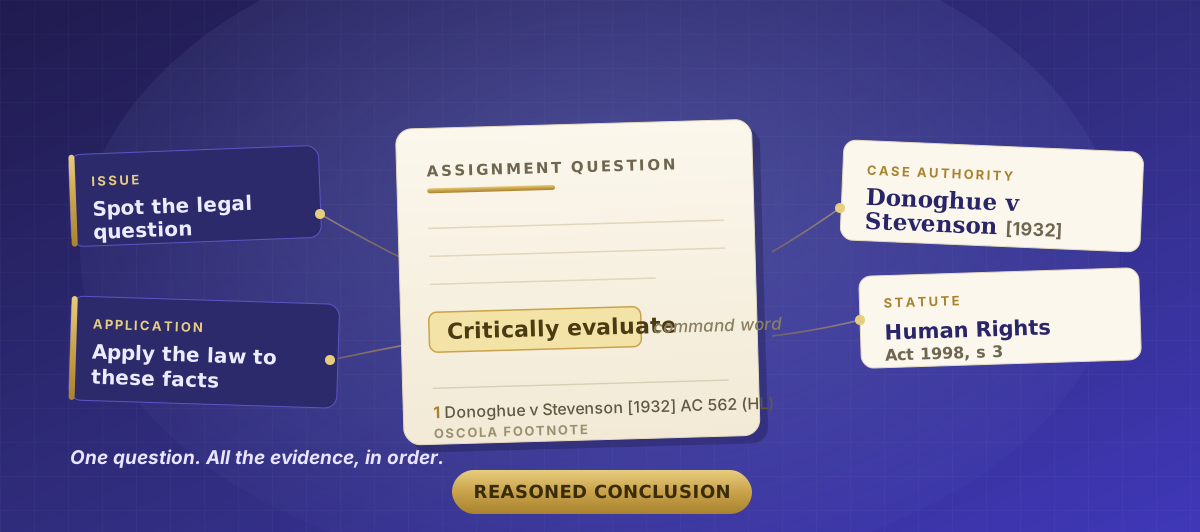
Marks are lost before a word is written when students answer the question they expected instead of the one on the page. Start by reading the command word, because it tells you what kind of thinking is required. "Describe" or "outline" asks mainly for explanation; "critically evaluate", "analyse", "discuss" and "to what extent" demand judgement, weighing competing arguments and reaching a reasoned view.
Next, identify the legal issue. In an essay, the issue is the debate the question raises; in a problem question, there are usually several issues buried in the facts, each signalled by a legally significant detail. Underline the parties, the events and the words that trigger a legal rule, then turn each into a precise legal question. A structured way to start is to break the brief down into exactly what is being asked before you plan your answer.
Legal research
Legal authority comes in two layers. Primary sources are the law itself — legislation (Acts of Parliament and statutory instruments) and case law (judgments). Secondary sources — textbooks, journal articles and practitioner works such as Halsbury's Laws — explain and analyse the primary law but are not themselves binding. Good assignments are built on primary authority, with secondary sources used to support argument and critique.
Read the full statute or judgment rather than relying on a summary. Free, authoritative primary sources include legislation.gov.uk for statutes, BAILII and the National Archives' Find Case Law service for judgments, and the UK Supreme Court website for the most senior decisions. For where to search and how to evaluate what you find, your own university law library guides and the Oxford Law Faculty's OSCOLA resources are reliable starting points.
Using cases well
To use a case properly you must separate its ratio decidendi — the binding legal reason for the decision — from obiter dicta, the judges' remarks "by the way" that are only persuasive. A large part of legal skill is stating the ratio of a case accurately and then arguing how far it applies to your facts.
Weigh authorities rather than listing them. Under the doctrine of binding precedent (stare decisis), a case's force depends on the court hierarchy: decisions of the UK Supreme Court (which replaced the House of Lords as the final court in 2009) bind the courts below, while first-instance decisions carry less weight. Note whether a case is binding or merely persuasive, whether it has been distinguished, followed or overruled, and how later courts have treated it. Reading widely makes this manageable — our guide to the hardest courses in law school covers the study habits that help.
Core exam skill
Problem questions reward a disciplined method. IRAC stands for Issue, Rule, Application, Conclusion; the closely related ILAC uses Issue, Law, Application, Conclusion. Either way you work through the scenario issue by issue: identify the legal issue, state the relevant rule and authority, apply the law to the specific facts, and reach a reasoned conclusion. The application step is where marks are won — never simply write everything you know about a topic.
A short fictional example. Sam buys a sealed soft drink from a café. The bottle was sealed by the manufacturer, so Sam cannot inspect the contents. After drinking some, Sam discovers a foreign object inside and becomes unwell. Sam has no contract with the manufacturer. Advise Sam.
This example is illustrative only. Never reproduce or submit a live assessed question, and keep your own analysis your own work.
Building an argument
An essay argues a position rather than applying law to facts. Set out a clear thesis in your introduction, then build each paragraph around a single point supported by an authority you explain, apply and critically evaluate — not merely describe. Use a consistent paragraph shape (point, authority, analysis, link) so each paragraph advances the argument, and deal honestly with counterarguments and competing academic views before responding to them. Distinguishing critical legal analysis from description is the single biggest driver of higher marks.
Support your argument with both primary authorities (cases and statutes) and secondary authorities (academic commentary), and make clear which is which. For the full method, see our step-by-step guide to writing a UK law essay, and for a worked example in a demanding module, Mastering Equity and Trusts shows how to apply these principles to trusts problems and essays.
Referencing
| Source type | OSCOLA format | Example |
|---|---|---|
| Case (law report) | Case name [year] or (year) volume Report abbreviation first page (court) | Donoghue v Stevenson [1932] AC 562 (HL) |
| Statute | Short title Year, section | Human Rights Act 1998, s 3 |
| Statutory instrument | Name Year, SI Year/Number | The example follows the Year/Number pattern |
| Book | Author, Title (edition, publisher year) | Author, Title (2nd edn, publisher 2024) |
| Journal article | Author, 'Title' (Year) Volume Journal first page | Author, 'Article Title' (2023) 82 CLJ 1 |
| Footnotes | Numbered footnotes for every citation; pinpoint with the page or paragraph | Cite the source in a footnote, not in brackets in the text |
Follow the current edition of OSCOLA and your module’s referencing guidance; formats here are a study aid, not a substitute for the official manual.
Do it properly
Law schools take authorship seriously, and legal study depends on being able to trust that an argument is your own. Reference every case, statute and secondary source you rely on, quote accurately and sparingly, and make clear where an idea comes from someone else. Paraphrasing still needs a citation. Keep a note of your sources as you research so your OSCOLA footnotes are complete and honest.
Using study tools responsibly means using them to understand and review your own work, not to produce it. Our academic integrity page explains where that line sits and how to stay on the right side of it. The research, analysis and writing in your assignment should always remain your own.
Avoid these
Most lost marks come from a handful of avoidable errors:
Apply it to your own work
Marker’s Eye reviews your own draft against UK marking expectations — issue spotting, use of authority, structure and application — and flags what to tighten. You make the changes; every word stays your own.
Before you submit
Use this on your own drafts — always defer to your module handbook and primary sources for the definitive law and requirements.
Why us
My Perfect Writing helps law students understand their brief and review their own work — while they stay responsible for their own research, analysis and writing. We do not write assessments or provide legal advice.
Brief Decoder helps you read an assignment brief — the task, command word and requirements — so you answer exactly what is asked.
Marker’s Eye reviews your own draft for issue spotting, use of authority, structure and application against UK marking expectations — you make the changes.
Guidance reflects UK cases, legislation and OSCOLA referencing, not generic overseas material.
The research, analysis and writing remain yours. We do not complete assessments or give legal advice.
Use the free case analysis and ratio sheet before deciding whether you need any further guidance.
You stay responsible for your own LLB assignments — our tools help you plan and review them, they do not do them for you.
Questions
Before you submit
Use this guide to plan your law assignment and structure your analysis, then let Marker’s Eye review your own draft against UK marking expectations before you submit.
Guidance should support your learning, not replace your own work.