
The hardest law modules
Why some UK law modules feel harder — and how essays and problem questions test different skills.
Not sure where to start? Talk to our support team live.

Law
Learn how to analyse the question, form a clear thesis, use legal authority critically and structure a strong UK university law essay.
The short version
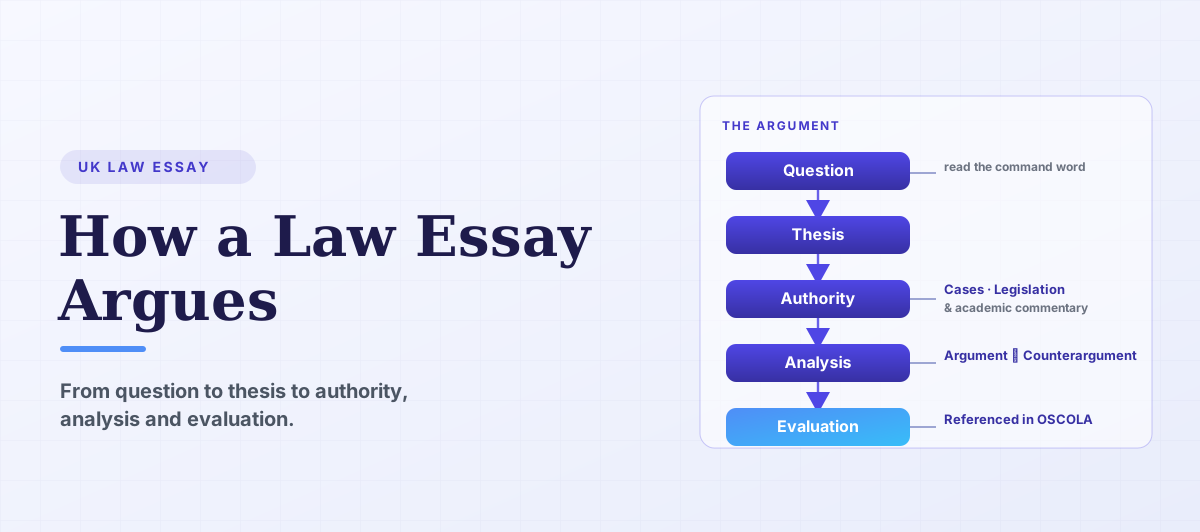
To write a strong UK law essay, analyse the exact question and its command word, then set out a clear thesis that answers it. Build each body paragraph around a legal authority — a case or a piece of legislation — that you explain and apply rather than just name, weigh competing interpretations and counterarguments, and link every paragraph back to your thesis. Finish with a direct conclusion and reference everything in OSCOLA. A law essay argues a position; it is not the same as a legal problem question, which applies the law to a set of facts and is where structures like IRAC belong.
On this page
What good looks like
A strong law essay is an argument, not a description. Weaker essays retell what the law is; stronger ones take a clear position on the question and defend it with authority and critical evaluation. UK markers reward reasoning — how well you use case law, legislation and academic commentary to build and test a point — far more than how much law you can recite.
Three things separate a first-class approach from a merely competent one: a clear thesis that answers the exact question, legal authority that is explained rather than name-dropped, and honest critical evaluation that weighs competing interpretations instead of asserting one. Everything in this guide serves those three goals.
Descriptive vs analytical “Section 2 says X and the court in Case Y held Z” is description. “Because the court in Case Y reasoned Z, section 2 is better read as X — though a competing view suggests otherwise” is analysis. Aim for the second in every paragraph.
If you are unsure what your marker actually rewards, our Law assignment support explains how UK examiners assess legal reasoning, use of authority and evaluation — the criteria a strong essay is written against.
Know the difference
| Aspect | Law essay | Legal problem question |
|---|---|---|
| Purpose | Argue a position on a legal issue, theory or reform | Advise on the likely legal outcome of a set of facts |
| What it tests | Critical evaluation and legal argument | Issue spotting and application of law to facts |
| Core structure | Thesis, then evidenced argument and evaluation | Issue, rule, application, conclusion (IRAC / ILAC) |
| Use of IRAC | Not the default — only if the brief or lecturer asks | The natural fit for working through each issue |
| Sources | Cases, legislation and academic commentary | Mostly cases and legislation applied to the facts |
| Conclusion | A direct answer to the essay question | A reasoned prediction of the legal result |
IRAC (Issue, Rule, Application, Conclusion) is built for problem questions. Using it as a default essay skeleton often produces descriptive writing — unless your brief or lecturer specifically requires it, structure an essay around a thesis instead.
Start here
Most marks are won or lost before you write a sentence, in how precisely you read the question. Identify the command word — it tells you what kind of thinking is required — then narrow the legal issue the question is really about.
Underline every word that limits the scope: a named statute, a specific area of doctrine, a jurisdiction, or a date range. A question about “the fairness of a rule” is not answered by explaining what the rule is. Read the assignment brief and marking criteria alongside the title, because they define what a high mark requires.
If a brief feels ambiguous, decode it before you plan. Brief Decoder can help you understand your Law assignment brief — the command words, scope and where the marks sit — so you answer the question that was actually set.
Your position
A legal thesis is the single sentence that states your answer to the question. It should be direct (it takes a side), arguable (a reasonable person could disagree) and specific (it names the issue and your reason). In law, suspense is a weakness: the marker should know your position from the first paragraph.
Turn the question into a claim. If the question asks “To what extent does the current test for X achieve certainty?”, a thesis might be: “The current test achieves certainty in routine cases but not at the margins, where judicial discretion reintroduces the very unpredictability it was meant to remove.” That sentence commits you to an argument and a structure — each body paragraph now has a job.
Test your thesis If your answer could not be disagreed with, it is a description, not a thesis. Sharpen it until a competent classmate could argue the opposite.
Before you write
A law essay plan is a map of your argument, not a list of topics. Once you have a thesis, decide the two to four points that prove it, put them in the order that builds your case most persuasively, and attach the legal authority each point needs.
Planning first is what stops an essay drifting into a description of everything you read. If you cannot say in one line how a paragraph advances the thesis, it does not belong in the essay yet.
The first 150 words
A law essay introduction does three jobs quickly: it frames the issue, states your thesis, and signposts the route your argument will take. It should answer the question in miniature, so a marker knows where you stand before the analysis begins.
Avoid a long history of the area or a dictionary definition of obvious terms. Save detailed authority for the body; the introduction earns its marks by being clear and committed, not comprehensive.
The engine of the essay
Give each paragraph one job and a repeatable shape. A reliable pattern for a law essay is Point → Authority → Explanation → Evaluation → Link — make a claim, ground it in authority, explain why that authority supports the claim, weigh it critically, then link back to your thesis. This is not IRAC: it is built to argue, not to apply law to facts.
The most common failure is stopping at “Authority” — naming a case and moving on. The Explanation and Evaluation steps are where analysis lives, and where the marks are.
Use authority, don’t list it
Legal authority is only persuasive if you explain why it is relevant. For a case, that means using its ratio decidendi (the binding reason for the decision) rather than the facts alone, distinguishing obiter dicta (persuasive but not binding remarks), and noting how precedent and judicial reasoning make it apply — or not — to your question. Read cases as primary sources where you can: UK judgments are freely available as UK case law on BAILII.
For legislation, quote the operative words of the relevant section, then interpret them — do not paraphrase a statute and treat that as analysis. Work from the current text on legislation.gov.uk, and note amendments or commencement where they matter to your argument.
Naming vs analysing Naming: “This is supported by Case A and section 3.” Analysing: “The ratio in Case A ties liability to foreseeability, which is why section 3 cannot extend to this situation.” Only the second earns analytical marks.
How many authorities you need depends on the question, not a target number: enough to prove each point and test it, chosen for relevance over volume. Choosing well is itself a skill — the same skill that makes the law modules UK students find most demanding feel manageable once you can organise authority around an argument.
Depth and balance
Primary sources tell you what the law is; academic commentary — journal articles and leading textbooks, your secondary sources — helps you argue about what it should be or how well it works. Use commentary to support a claim, to show a debate exists, or to disagree with a position on reasoned grounds.
Critical evaluation means engaging the other side. For each main point, put the strongest counterargument or competing interpretation, then explain why your reading is still better — on the authority, the legal doctrine, or the consequences. An essay that only marshals evidence for one view reads as advocacy; an essay that answers the best objection reads as analysis.
Balance is not fence-sitting. You still reach a conclusion — you have simply earned it by testing your thesis against the alternatives rather than ignoring them.
Land the answer
A law essay conclusion answers the exact question and restates your thesis in light of the argument you have made. It should feel earned: the reader has followed your reasoning, and now you state the verdict plainly.
If your conclusion could sit at the top of a different essay, it is too generic. It should only make sense as the ending of this argument, about this question.
Reference precisely
Most UK law schools require OSCOLA (the Oxford University Standard for the Citation of Legal Authorities). OSCOLA uses footnotes for citations rather than in-text author–date references, and a bibliography at the end. Cite the authority at the point you rely on it, and keep formatting consistent throughout — consistency is part of the mark.
Always confirm the exact style your department requires, as some ask for Harvard in specific modules. For the authoritative rules and examples, use the official OSCOLA guide rather than second-hand summaries. When you are polishing citations and prose together, our editing and formatting support explains how to check consistency without changing your authorship.
Apply it to your own draft
Marker’s Eye reviews your own law essay draft against UK expectations — thesis clarity, use of authority, critical evaluation and OSCOLA — and flags where description should become analysis. You make the changes; every word stays yours.
Avoid these
| Mistake | Why it costs marks | Do this instead |
|---|---|---|
| Being descriptive | Retells the law without arguing anything | Take a position and defend it in every paragraph |
| Naming authority without analysis | Cites cases and statutes but never explains them | Use the ratio and apply it to the question |
| No clear thesis | The marker cannot see your answer | State a direct, arguable thesis in the introduction |
| IRAC-ing an essay | Turns an argument into a mechanical checklist | Use a thesis-led structure unless the brief asks for IRAC |
| Ignoring counterarguments | Reads as one-sided advocacy | Answer the strongest opposing view, then conclude |
| A generic conclusion | Could belong to any essay | Answer this exact question in the first line |
| Inconsistent OSCOLA | Loses easy presentation marks | Footnote as you go and check the bibliography |
Requirements vary between modules and lecturers — always check your own brief and marking criteria before applying any general rule.
Before you submit
If you want a second read against these points, Marker’s Eye can help you <a href="/tools/markers-eye/">review your own Law essay draft</a> — it flags descriptive writing, thin analysis and missing authority, while the argument stays yours.
Why us
My Perfect Writing helps UK law students understand their assessment brief and review their own drafts — while they stay responsible for their own legal research, analysis and writing. We do not provide legal advice.
Brief Decoder helps you read a law essay brief — the command words, scope and marking criteria — so you answer the question that was set.
Marker’s Eye reviews your own essay draft, flagging descriptive writing, thin analysis or missing authority against UK expectations.
Guidance reflects what UK law markers assess — legal argument, use of authority, critical evaluation and OSCOLA — not a generic template.
The reading, legal analysis and writing remain yours. We do not write law essays, and we do not give legal advice.
Explore the tools before deciding whether you need any further guidance.
You stay the author of your legal work — our tools help you understand and improve it, they do not write it or give legal advice.
Questions
Before you submit
Use this guide to build a clear legal argument, then let Marker’s Eye review your own law essay draft against UK marking criteria before you submit.
Guidance should support learning, not replace your own legal analysis.