
UK Law Assignments: an LLB guide
How to approach essays, problem questions and legal research — issue spotting, authority and structure.
Not sure where to start? Talk to our support team live.

Law & Study Skills
Your abstract is the first thing an examiner reads and the last thing you write. This UK guide explains what a Law dissertation abstract is, how it differs from an introduction, how to summarise your research question, methodology, argument and contribution, what to leave out, and how to cut it to your university’s word limit.
The short version
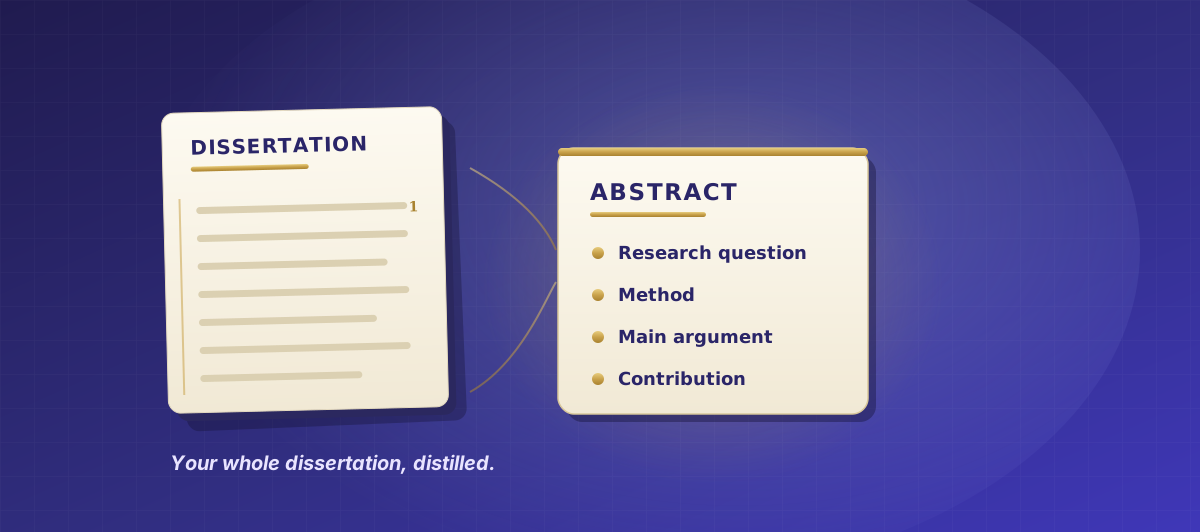
A Law dissertation abstract is a short, standalone summary of your whole dissertation, written after you finish it. In one concise paragraph it states the legal problem and research question, your methodology — doctrinal, comparative, empirical or socio-legal — your main argument or findings, and your contribution to legal scholarship. Always follow your own university’s word limit.
On this page
The basics
A Law dissertation abstract is a short, self-contained summary of your entire dissertation — usually a single paragraph placed before the introduction. It lets a reader understand your legal problem, approach, argument and contribution without reading the whole thesis, and it is what appears in library catalogues and repositories, so it is often the only part strangers ever read.
Because it must stand alone, an abstract normally contains no footnotes, quotations or long case citations. It is a piece of tight legal academic writing that distils tens of thousands of words into a few hundred. This guide is general UK study guidance, not legal or academic-regulations advice: your own module handbook, supervisor and dissertation requirements always take priority over any general rule here.
Purpose and timing
The abstract has one job: to give the reader an accurate map of the whole dissertation in miniature. A good abstract signals the research question, the methodology, the main argument or findings and the contribution, so an examiner knows what to expect before turning the page.
Write it last. You can only summarise findings and a contribution once they exist, so draft the abstract after the dissertation is essentially complete. Trying to write it early usually produces a vague description of what you intend to do rather than what you actually did. Understanding exactly what your brief asks for helps here — our Brief Decoder can help you pin down the requirements before you plan.
A common confusion
Students often blur the two, but they do different work. The abstract summarises the whole dissertation, including the outcome — it reveals your findings and conclusion. The dissertation introduction sets the study up: it provides context, states the problem and research question, and outlines the structure, but it deliberately does not give away the findings.
Put simply, the abstract is a complete summary that could be read on its own; the introduction is the opening chapter that leads the reader in. Getting this distinction right is one of the quickest ways to sharpen both. For the wider skill of structuring legal writing, see our guide to UK law assignments.
At a glance
| Feature | Abstract | Introduction |
|---|---|---|
| Covers | The whole dissertation, in miniature | Sets up the study only |
| Findings | Stated — the outcome is included | Not revealed |
| Reads alone | Yes — fully self-contained | No — part of the main text |
| Citations | Usually none | Full citations and footnotes |
| Length | One short paragraph (per your handbook) | A full chapter |
| Written | Last, after the dissertation is done | Early, then revised |
A study aid only — confirm the exact expectations against your university handbook and supervisor guidance.
What to include
A strong abstract answers a predictable set of questions in order. You do not need a heading for each — they flow as sentences — but every element should be present:
If a reader cannot find each of these, the abstract is incomplete. The table below turns them into one-line prompts you can write against.
Build it element by element
| Element | What it does | One-line prompt |
|---|---|---|
| Legal problem | Frames the issue or gap | This dissertation addresses… |
| Research question | States what you answer | It asks whether/how… |
| Methodology | Shows how you answer it | Using doctrinal / comparative / empirical / socio-legal analysis of… |
| Argument / findings | Gives your central claim | It argues / finds that… |
| Contribution | Explains why it matters | It contributes by… |
| Scope / limitations | Sets the boundaries | The study is limited to… |
Prompts are a starting point, not a template to submit — the wording and analysis must be your own.
Name your method
Examiners want to know how you reached your conclusions. Name your legal methodology in a phrase rather than explaining it at length:
Read the primary sources themselves as you write — free, authoritative sources include legislation.gov.uk for statutes and BAILII for judgments — and cite them in the dissertation itself using OSCOLA, even though the abstract stays citation-free.
The payoff
This is where weak abstracts fall down: they describe a topic but never state a position. Say plainly what you argue or found — "this dissertation argues that…" or "it finds that…" — and then make the contribution to legal scholarship explicit: does the work fill a gap, challenge an assumption, synthesise scattered authority, or offer a reform proposal?
Keep the significance proportionate and honest; you are summarising a student dissertation, not claiming to have settled the law. A precise, modest claim reads as more scholarly than an over-broad one, and it gives the examiner a clear sense of what your work adds.
Make it concise
There is no single universal word count for an abstract: the required length is set by your university and can range from a short single paragraph to a longer summary. Always check your handbook and confirm with your supervisor before finalising. To hit that limit, cut ruthlessly — an abstract should exclude long case citations and footnotes, background history, headings, direct quotations, tables, a reference list and any information not in the dissertation.
A short before-and-after. Compress vague sentences into precise ones that carry a question, a method and a claim:
The improved version names the method (doctrinal), the question (are the safeguards adequate?) and the argument (they are insufficient) in one sentence. For tightening academic wording, the University of Manchester's Academic Phrasebank is a reliable, free reference. This is one illustrative sentence only — never submit a ready-made abstract as your own.
Avoid these
Most lost marks come from a short list of avoidable errors:
Apply it to your own work
Marker’s Eye reviews your own draft against UK marking expectations — clarity, structure, argument and whether your summary matches your work — and flags what to tighten. You make the changes; every word stays your own.
Before you submit
Use this on your own draft — your handbook and supervisor set the definitive requirements.
Why us
My Perfect Writing helps law students understand their requirements and review their own work — while they stay responsible for their own research, analysis and writing. We do not write dissertations or provide legal advice.
Brief Decoder helps you read your dissertation or assignment brief — the task, scope and requirements — so you answer exactly what is asked.
Marker’s Eye reviews your own draft for structure, argument and clarity against UK marking expectations — you make the changes.
Guidance reflects UK legal research, OSCOLA referencing and UK academic conventions, not generic overseas material.
The research, analysis and writing remain yours. We do not complete dissertations or give legal advice.
Use the free abstract builder to pressure-test your own summary before deciding whether you need any further guidance.
You stay responsible for your own dissertation — our tools help you plan and review it, they do not do it for you.
Questions
Before you submit
Use this guide to summarise your research question, methodology, argument and contribution, then let Marker’s Eye review your own draft against UK marking expectations before you submit.
Guidance should support your learning, not replace your own work.