
Description vs analysis
How to move from describing your findings to arguing what they mean — key to dissertation marks.
Not sure where to start? Talk to our support team live.

Sociology & Research Topics
Looking for a sociology dissertation topic? This guide gives ideas across class, gender, race and migration, education, family, crime, work, health, media and youth — and shows how to turn a social issue you care about into a concept-led, feasible research question.
The short version
A strong sociology dissertation topic connects a social issue you care about to a clear sociological concept, a defined population or context, and evidence you can realistically gather and analyse ethically. The best ideas start broad, then narrow to a specific concept and group so you can turn them into a focused, answerable research question.
On this page
Start here
Sociology gives you almost unlimited things to study, which is exactly why so many students get stuck: everything is interesting, but not everything is researchable in a dissertation. Our sociology assignment support is built around helping you plan and review your own research rather than writing it for you, and the same principles apply whatever topic you pick. A strong sociology topic is:
Below you will find ideas by field, then the process that turns any of them into a defensible research question.
The essential skill
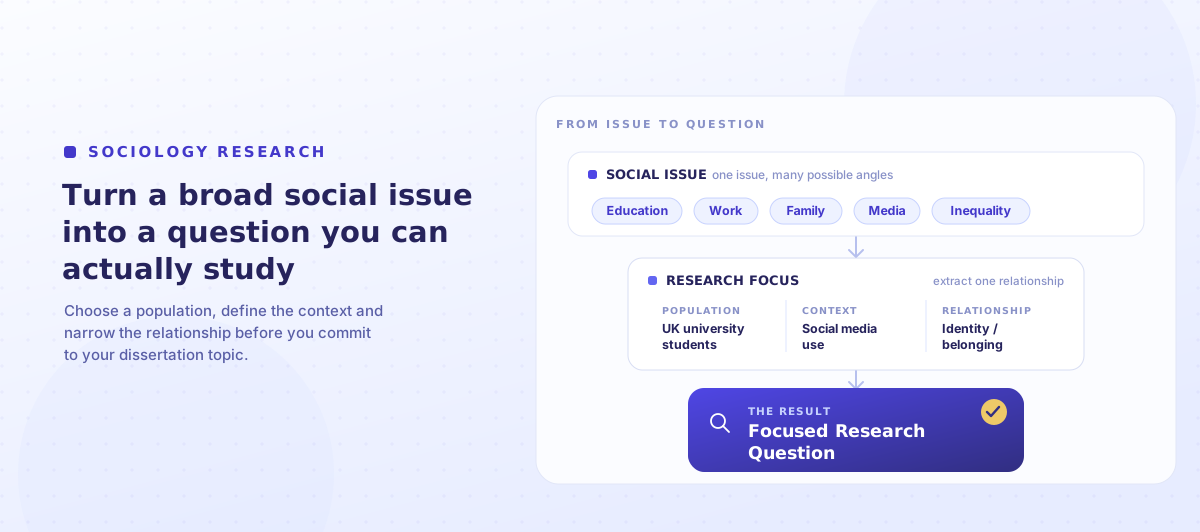
A subject like “social media” is not a research question — it is a whole field. Narrowing means adding a sociological concept, a specific population or context, and a feasible evidence base until you have something answerable. Work through it in stages:
From social issue to a research question
Before committing, check the question against five things: a clear concept, a defined population or context, a feasible method (can you actually collect or access this data?), research ethics (consent, sensitivity, vulnerability), and scope that fits the word count. The example above is a teaching illustration — your concept, design and analysis must be your own. For turning findings into argument, see our guide on description vs analysis.
Check the brief first
Before choosing a topic, check what your dissertation brief actually asks for
Brief Decoder breaks your assignment or dissertation handbook into clear requirements — task, scope, methods expectations and marking criteria — so you can test an idea before you invest in it.
Decode My BriefIdeas by field (1 of 2)
Use these as starting points, then narrow the one that fits your brief using the process above.
For data to scope these, the Office for National Statistics and the UK Data Service hold large-scale survey data you can use as secondary evidence, and the Joseph Rowntree Foundation is strong on poverty and inequality.
Ideas by field (2 of 2)
For media and communications topics, Ofcom’s research is a useful evidence base, and the Equality and Human Rights Commission publishes on discrimination and inequality. If you are choosing between several ideas, our research topic-selection guide covers the same narrowing method.
Before you commit
In sociology, feasibility and ethics are inseparable. An important question is still the wrong dissertation if you cannot gather the evidence responsibly. Before you build a study around a question, check it honestly:
A narrower, ethical question you can evidence will always beat a sweeping one you cannot.
Test your idea
Found a topic? Check it fits the brief before you design your study
Use Brief Decoder to clarify the task, scope and marking expectations, then shape your own research question and method around what the dissertation actually requires.
Try Brief DecoderWhy us
My Perfect Writing helps UK sociology students understand their brief, plan their own research, review their own drafts and understand feedback — while the concept, design, analysis and writing remain entirely their own.
Brief Decoder helps you identify the task, scope, methods expectations and criteria before you choose or narrow a topic.
Once you have written your own work, Marker’s Eye reviews structure, argument and use of evidence against marking expectations. It does not write or rewrite it.
Feedback Decoder helps you turn supervisor or marker comments into clear, specific actions on your own work.
We help you think through feasibility and research ethics so your design is realistic — the study and its conduct remain yours.
Your concept, method, analysis and final writing remain your own; support is focused on clarity, planning and review.
Use the free Dissertation Topic & Feasibility Checker to test an idea before you commit.
You stay the author of your own research — our tools help you understand, plan and review it, they do not do it for you.
Questions