
100+ accounting dissertation topics
A focused set of accounting research topics — useful if your course blends business and finance.
Not sure where to start? Talk to our support team live.

Business & Management
Stuck for a business or management research topic? This guide gives evergreen dissertation and research ideas across strategy, leadership, HR, marketing, entrepreneurship, sustainability, operations and AI — and, just as importantly, shows you how to narrow a broad subject into a focused, researchable question.
The short version
The best business or management research topic is relevant to your module or brief, focused enough for the word count, supported by credible evidence and data, specific enough to form a clear research question, and genuinely interesting to you. This guide gives topic ideas across the main fields and shows how to narrow a broad subject into a researchable question.
On this page
Start here
A long list of topic ideas is only half the job — the harder part is choosing one you can actually research well. Whether you are writing a short research report or a full dissertation, the same academic skills apply, and our business and management assignment support is built around helping you plan and review your own work rather than doing it for you. A strong topic is:
The rest of this guide gives you ideas by field, then shows the narrowing process that turns any broad area into a question you can defend. Use the ideas as starting points — the value is in how you make one your own.
The most important skill
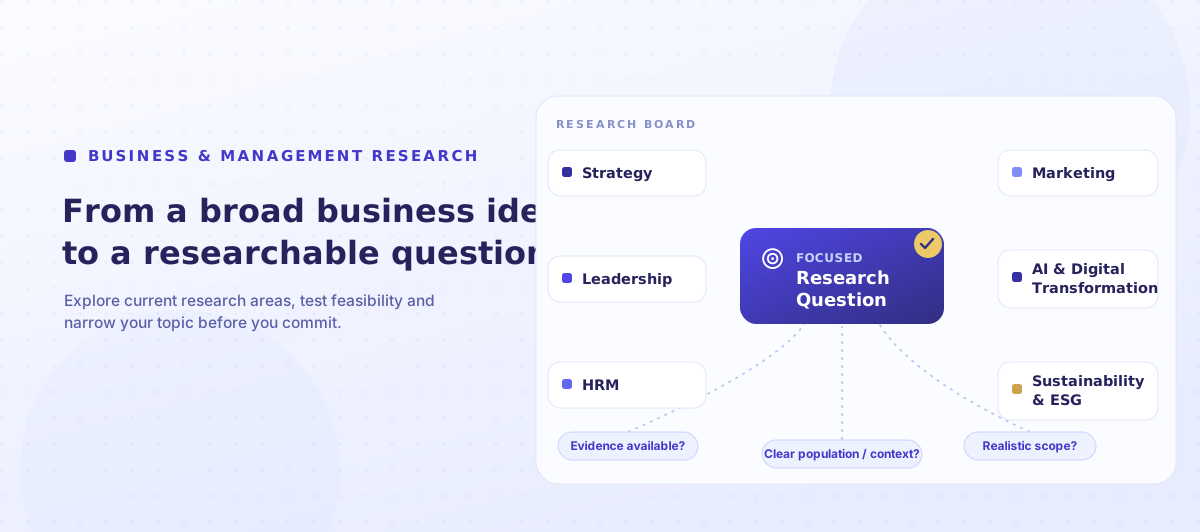
Most weak topics fail for the same reason: they are too broad. “AI in business” or “leadership” is a field, not a question. Narrowing means adding a specific problem, a context or population, and a clear outcome or theme until you have something answerable. Work through it in stages:
From broad topic to a researchable question
The same move works for any field. Two more short, teaching-only examples:
These are illustrations of the process, not ready-made questions to copy — your question must come from your own reading and brief. For turning a claim into an argument once you are writing, our guide to description vs analysis is a useful companion.
Check the brief first
Before you choose the topic, decode what the brief actually allows
Your topic still has to answer the assignment or dissertation brief. Brief Decoder breaks the task into clearer requirements so you can check your idea before committing to weeks of research.
Decode My BriefIdeas by field (1 of 2)
Use these as starting points, then narrow the one that fits your brief using the process above.
For HR and workplace topics, the CIPD publishes UK evidence and reports you can cite, and the Chartered Management Institute is a useful source for management and leadership research.
Ideas by field (2 of 2)
For business-population and SME context, the GOV.UK business population estimates and the Office for National Statistics (ONS) provide credible, citable UK data.
For any of these, you can often build a strong secondary-research study from published datasets — the UK Data Service gives students access to major UK social and economic datasets. Adjacent fields also spark ideas: see our accounting dissertation topics and finance dissertation topics if your course leans that way.
Before you commit
A topic can look exciting and still be a bad idea if you cannot actually research it. Before you commit weeks to one, check it honestly:
A note on ethics and access. If you plan primary research inside an organisation, you will usually need ethical approval and genuine consent, and you must protect confidential or personal information. Do not collect sensitive workplace, customer or employee data informally — check your university's ethics requirements first, and choose a secondary-data route if access is uncertain.
Test your idea
Got a research idea? Check it against the brief before you start
Use Brief Decoder to identify the task, scope and marking expectations, then shape your own research question around what the assessment actually requires.
Try Brief DecoderWhy us
My Perfect Writing helps UK business and management students understand requirements, plan their own work, review their own drafts and understand feedback — while the research, analysis and writing remain entirely their own.
Brief Decoder helps you identify the task, command words, requirements and marking expectations before you choose or narrow a topic.
Once you have written your own proposal, chapter or draft, Marker’s Eye reviews structure, argument, evidence use and alignment with marking expectations. It does not write or rewrite it for you.
Feedback Decoder helps you translate tutor or marker comments into clear, specific actions you can take on your own work.
Your research, source selection, argument, analysis and final writing remain your own — support is focused on clarity, planning and review.
Use the free Research Topic Selector to move from a broad interest to a focused, feasible topic before you commit.
You stay the author of your own work — our tools help you understand, plan and review it, they do not write it for you.
Questions