

Accounting
Accounting Dissertation Topics: How to Choose a UK Research Focus
A list of a hundred topics will not write your dissertation; a focus you can research will. This guide organises current UK accounting topics into clusters and gives you a framework to turn a broad area — audit, tax, ESG — into a feasible, evidence-backed research question.
The short version
Quick answer
Good accounting dissertation topics are focused, researchable questions — not broad labels like “auditing” or “tax”. Start from a current area, find a genuine research gap, then check feasibility: can you access UK data (company annual reports via Companies House, HMRC publications), is it ethical, and is the scope realistic? That turns a topic into a question you can actually answer.
On this page
In this guide
The basics
What makes a good accounting dissertation topic?
A strong topic is a specific, answerable research question — not a broad subject label. “Audit quality” is a field; “Does long auditor tenure relate to earnings management among UK FTSE 250 companies?” is a dissertation.
The best accounting topics are current, connect to UK evidence you can actually obtain — usually secondary data such as company annual reports and filings on Companies House — and target a research gap that recent studies have not closed.
Topic vs question A topic names an area; a research question defines a variable, a sample and a period. If your idea still reads like a module title, it is a topic, not yet a focus.
Where the ideas are
Accounting dissertation topic clusters for 2026
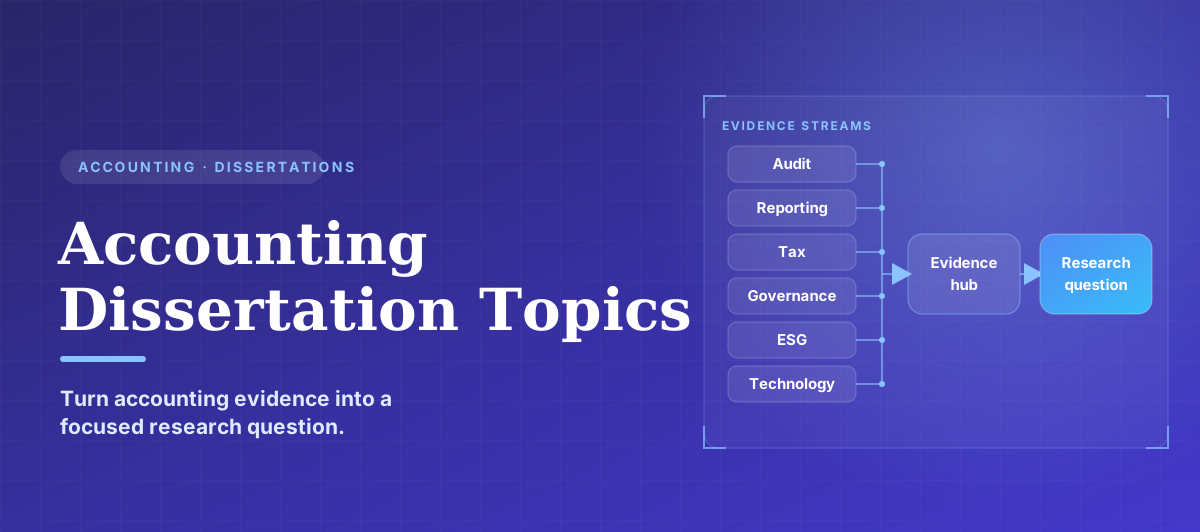
Rather than a flat list of a hundred labels, group current accounting topics into clusters and draw one focused question from the cluster that fits your interests and the data you can reach:
- Audit & assurance — audit quality, auditor tenure, audit committees. e.g. Does audit-firm tenure relate to audit quality in UK-listed firms?
- Financial reporting — IFRS application, comparability, disclosure. e.g. How has IFRS adoption affected the comparability of UK company accounts?
- Management accounting — budgeting, costing, performance. e.g. How do UK SMEs use budgeting to manage performance?
- Forensic accounting — fraud detection, misstatement, investigation. e.g. How effective are UK fraud-risk disclosures at signalling misstatement?
- Taxation — corporation tax, compliance, incentives. e.g. How do corporation-tax changes affect small-company investment in the UK?
- Accounting technology & information systems — cloud accounting, automation, AIS. e.g. How is cloud accounting changing the UK management-accountant role?
- Corporate governance — board and committee structure, earnings management. e.g. Does audit-committee independence relate to earnings management in UK firms?
- Ethics in accounting — professional codes, ethical decision-making. e.g. How do professional codes shape ethics among UK trainee accountants?
- Sustainability & ESG reporting — ESG and climate disclosure quality. e.g. Does mandatory climate reporting improve UK corporate disclosure quality?
- Public-sector & non-profit accounting — financial sustainability, accountability. e.g. How do UK local authorities report financial sustainability?
If your interest leans toward markets, banking or corporate finance rather than reporting and audit, our finance dissertation topics guide covers those clusters.
The framework
How to turn an accounting topic into a research question
Work down from a broad cluster to a single question, checking feasibility before you commit:
- Pick a cluster that fits your interests and your strongest modules.
- Narrow to a specific issue — a rule, practice or debate that is live in the UK now.
- Find a research gap by reading recent studies and noticing what they did not test.
- Check the evidence — can you obtain the reports, filings or data you would need?
- Choose a feasible method and write it as a focused question with a clear variable, sample and period.
Decode your brief before you write
Chosen an accounting topic?
Brief Decoder turns your dissertation brief into a plain-English plan — the real question, where the marks are, the hidden requirements, and a step-by-step structure — so you can start with confidence. You stay the author of your work.
See it applied
Worked example: from a broad area to a focused question
Here is the framework applied to one of the most-researched UK areas — audit and assurance:
Broad area Audit & assurance.
Specific issue Whether how long an auditor stays with a client affects the quality of the audit.
Research gap There is a lot on audit fees, but less UK-specific evidence on whether long auditor tenure is linked to more earnings management in mid-cap firms.
Available evidence Auditor details and financial figures from annual reports and Companies House filings — all secondary and obtainable.
Feasible method A quantitative panel study relating auditor tenure to an earnings-management measure.
Focused question Does long auditor tenure relate to earnings management among UK FTSE 250 companies?
Each step narrows the field until the question is specific enough — one relationship, one sample, one period — to answer in a single dissertation.
Choosing a cluster
Comparing accounting topic clusters
| Accounting area | Possible UK data source | Suitable method | Access / ethics concern | Example research question |
|---|---|---|---|---|
| Audit & assurance | Annual reports, Companies House, FRC reports | Quantitative (panel data) | Low with public filings | Does auditor tenure relate to audit quality? |
| Financial reporting | Annual reports, IFRS disclosures | Content analysis or quantitative | Low | How has IFRS affected UK account comparability? |
| Management accounting | SME surveys, case-study firms | Qualitative or mixed | Medium — firm access | How do UK SMEs use budgeting to manage performance? |
| Forensic accounting | Enforcement notices, annual reports | Case study or content analysis | Low–medium | How effective are UK fraud-risk disclosures? |
| Taxation | HMRC publications, ONS, filings | Quantitative or policy analysis | Low | How do tax changes affect small-company investment? |
| Accounting technology & AIS | Firm reports, professional surveys | Qualitative or survey | Medium — practitioner access | How is cloud accounting changing the accountant role? |
| Corporate governance | Annual reports, governance disclosures | Quantitative (panel data) | Low with public data | Does audit-committee independence affect earnings management? |
| Ethics in accounting | Professional-body codes and reports | Qualitative or survey | Medium — ethics if primary | How do professional codes shape trainee ethics? |
| Sustainability & ESG reporting | Annual reports, ESG/climate disclosures | Content analysis or quantitative | Low with secondary data | Does mandatory climate reporting improve disclosure? |
| Public-sector & non-profit | Local-authority and charity accounts | Quantitative or case study | Low with public accounts | How do UK councils report financial sustainability? |
Sources such as Companies House filings, the Financial Reporting Council and HMRC are free, official and widely accepted in UK accounting dissertations.
Weigh your options
How to weigh an accounting topic before you commit
Most topics fail on feasibility, not interest. Before committing, weigh each idea across seven dimensions — if it scores poorly on data, access or ethics, narrow it or choose another:
UK context
What makes an accounting dissertation topic workable in the UK?
In a UK accounting dissertation, a workable topic is one you can evidence within the UK framework and your deadline. Five things matter most:
- Access to reports and data. UK company annual reports and filings are public on Companies House, which makes reporting, audit and governance topics highly feasible on secondary data.
- UK audit and reporting context. Corporate reporting and audit are overseen by the Financial Reporting Council, and UK-listed groups apply IFRS Accounting Standards — grounding a topic in this framework makes it more relevant than a generic one.
- Tax and public data. Taxation topics can draw on HMRC publications, but remember that individual taxpayer records are confidential — work from published statistics, not private data.
- Professional and ethical context. Bodies such as the ICAEW set ethical codes that support governance and ethics topics; primary research with accountants normally needs ethics approval.
- Feasibility and guidance. A narrow question you can evidence beats a broad one you cannot resource — and your university handbook and supervisor guidance take priority over any general rule.
If you want to know what UK markers expect from an accounting dissertation overall, our accounting and finance guidance explains how scope, evidence and structure are assessed.
Avoid these
Common mistakes when choosing an accounting topic
- Too broad. “Auditing in the UK” is a module, not a dissertation.
- Naming a topic, not a question. A label has no variable, sample or period to test.
- No data access. A topic needing private company or taxpayer records is usually not researchable at this level.
- No research gap. Re-testing a settled relationship adds little; find where the evidence stops.
- Method mismatch. Asking a “how much” question with no quantitative data, or a “why” question with only numbers.
Whatever you choose, the research, analysis and writing must be your own, in line with academic integrity.
Before you write
Is my accounting topic ready? A quick checklist
- Have you identified a genuine, UK-relevant research gap?
- Can you obtain the reports, filings or data you need?
- Is the scope a single, clear question with a defined sample and period?
- Does your method match the question?
- Is ethical approval feasible if you plan primary research?
- Does it fit a supervisor’s area of expertise?
If you can tick all six, you have an accounting focus you can defend.
Why us
How My Perfect Writing supports accounting students ethically
My Perfect Writing helps UK accounting students choose a focused, feasible topic and understand their dissertation brief — while they stay fully responsible for the research, analysis and writing.
Understand your own brief
Brief Decoder helps you read your dissertation brief clearly — the command words, criteria, scope and marking expectations behind it.
It plans, it does not write
We help you scope a topic and structure your approach. We do not write your accounting dissertation or hand you finished work.
Built around UK expectations
Guidance reflects what UK markers and supervisors look for: a clear research gap, feasible methods and well-evidenced questions.
You stay responsible
The research, analysis and writing remain yours, in line with academic integrity — support is focused on clarity and planning.
Start with a free preview
Explore Brief Decoder before deciding whether you need any further guidance.
You stay the author of your dissertation — Brief Decoder helps you understand and plan it, it does not write it for you.
Questions
Frequently asked questions
What are good accounting dissertation topics for UK students?
How do I turn an accounting topic into a research question?
Can I use company annual reports as dissertation data?
Which accounting topics are suitable for secondary research?
Do accounting dissertations require primary data?
What makes an accounting dissertation topic feasible?
Before you write
Choose your focus. Then decode the brief.
Use this guide to choose a feasible, UK-relevant accounting research question, then let Brief Decoder turn your dissertation brief into a clear, structured plan before you start writing.
Guidance should support learning, not replace authorship.