
Constructing a critical literature review
Structure a review that argues rather than lists.
Not sure where to start? Talk to our support team live.

Research Skills
Your literature review reads “Smith says… Jones says… Patel says…”, and the feedback is “too descriptive”. The problem is not your reading—it is that you are summarising sources one by one instead of synthesising them into a single argument.
The short version
Source synthesis means combining several sources around a theme to build one argument, rather than summarising each source in turn. You group sources by idea, show where they agree, disagree or leave a gap, and use that pattern to support your own point. The test is simple: a synthesised paragraph is organised by theme, not by author.
On this page
The real problem
You have read widely, understood each source and written a paragraph on each—yet the marker writes “descriptive” or “where is the synthesis?”. If your review is organised author-by-author rather than idea-by-idea, our literature review assignment guidance can help you restructure your own draft while the reading, analysis and writing stay yours.
Synthesis is the skill of making sources talk to each other. A summary tells the reader what one author said; a synthesis shows how several authors together support, complicate or leave open a point you are making. The evidence is the same—the organisation is completely different.
At a glance
| Feature | Summary (descriptive) | Synthesis (analytical) |
|---|---|---|
| Organised by | Author / source | Theme / idea |
| Structure | One paragraph per source | One paragraph per point, several sources |
| Shows | What each author said | How sources agree, differ or leave a gap |
| Reader learns | A reading list in prose | Your argument, evidenced |
If each paragraph starts with an author’s name, you are probably summarising, not synthesising.
Why students struggle
Synthesis is not advanced or mysterious. It is a change of organising principle: from “what did each source say?” to “what do the sources, together, tell us about my question?”
The core technique
A synthesis matrix is a simple grid: themes down the side, sources across the top. In each cell you note what a source contributes to that theme. Reading across a row shows you which sources speak to the same idea—and whether they agree, disagree or fall silent. That row becomes a paragraph, organised by the theme rather than by any single author.
The matrix also exposes the research gap: a theme with thin or conflicting coverage is exactly where your analysis adds value. This is the same evidence-led move as critical analysis in essays—you are weighing sources, not just reporting them.
Practical framework
| Move | Purpose | Prompt |
|---|---|---|
| Theme | State the idea the paragraph is about | What point am I making here? |
| Hold up evidence | Bring in the sources on that theme | Which sources speak to this? |
| Evaluate agreement | Show consensus, tension or gap | Do they agree, differ or leave a gap? |
| Make the link | Connect the pattern to your argument | So what does this mean for my question? |
| End with your point | Close on your reasoned position | What do I conclude from this? |
THEME is a planning aid, not a sentence formula—paragraphs should still read naturally.
Worked teaching example
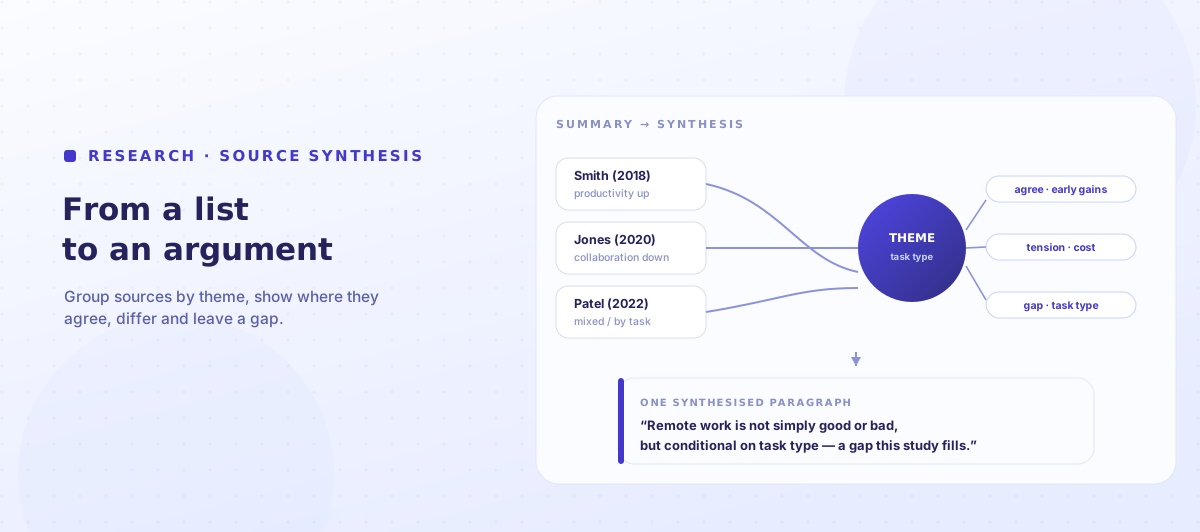
Descriptive: “Smith (2018) found remote work raised productivity. Jones (2020) found it lowered collaboration. Patel (2022) found mixed results depending on the task.”
Synthesised: “The effect of remote work on performance appears to depend on the type of task. While early studies reported productivity gains (Smith, 2018), later work found these came at the cost of collaboration (Jones, 2020), and more recent evidence reconciles the two by showing outcomes vary by task complexity (Patel, 2022). Together, the literature suggests remote work is not simply ‘good’ or ‘bad’ but conditional—a gap this study addresses by isolating task type.”
The synthesised version is organised by an idea, shows how the sources relate, and ends on the writer’s own point and gap.
Synthesis and integrity
Synthesis relies on accurate paraphrase, not on stitching quotations together. Represent each source fairly, cite every claim, and never merge authors into a position none of them actually held. Bringing sources together is legitimate scholarship; misrepresenting them—or presenting synthesised passages you did not write—is not.
Quality beats quantity: a tight synthesis of a few strong, relevant studies is worth more than a long list. For more on that, see why adding more sources is not always the answer, and make sure each source is cited consistently using your required referencing style.
Review your draft
Marker’s Eye reviews your own draft for genuine synthesis, evidence use and critical analysis against the question and rubric, flagging where summary should become synthesis. You make every change; the writing stays yours.
Avoidable pitfalls
Before you submit
Check this against your own module rubric and literature-review guidance.
Why us
Our tools help you review your own draft and understand your feedback. They do not read, analyse or write your literature review for you.
Marker’s Eye checks whether your own draft synthesises sources or only summarises them.
Feedback Decoder turns comments like “too descriptive” into concrete revision actions.
The free synthesis matrix helps you regroup sources by idea before you write.
You remain responsible for the reading, analysis and final wording.
Ethical support improves your process while the assessed thinking remains yours.
Questions
Before you submit
Use the synthesis matrix to regroup your sources by theme, then review your own draft for synthesis and evidence before you hand it in.
Your reading, analysis and final writing remain your responsibility.