
Analyse the Ryanair case
Apply business models to a real organisation without slipping into company description.
Not sure where to start? Talk to our support team live.

Business & Management
You may understand SWOT, PESTLE or Porter’s Five Forces and still be told that your essay is “too descriptive”. The missing step is not another framework—it is using evidence and theory to make a qualified business judgement.
The short version
Critical analysis in a business essay means using relevant evidence and theory to explain why something happened, compare plausible interpretations, test assumptions and limitations, and reach a qualified judgement. Do not merely describe a company or list a framework. Make a claim, support it with credible evidence, apply the framework selectively, consider a counterargument and explain the significance for the question.
On this page
The real problem
Many students collect company facts and explain several models, yet the marker still writes “where is the analysis?” If you are unsure how the task word changes what the essay must do, our business assignment guidance can help you interpret the expectations while the research, decisions and writing stay yours.
The difficulty is the gap between knowing a framework and using it to answer a question. Description identifies what happened. Analysis explains relationships, tests explanations and weighs what the evidence permits you to conclude. Critical analysis adds competing views, limitations and context before reaching a reasoned judgement.
At a glance
| Level | What the writer does | Typical question |
|---|---|---|
| Description | Reports a fact, theory or framework output | What happened? |
| Analysis | Explains causes, relationships and implications | How and why did it happen? |
| Critical evaluation | Weighs evidence, alternatives, limitations and context | How convincing or useful is this explanation? |
A strong paragraph may use brief description as evidence, but it spends more space explaining and evaluating its significance.
Why students struggle
Critical does not mean negative. It means appropriately sceptical, evidence-led and willing to say what a model or claim explains well—and what it cannot establish.
Before researching
Underline the command word and the object of judgement. “Analyse the causes” asks for relationships; “evaluate the strategy” asks for criteria and a verdict; “critically discuss” asks you to weigh positions. Then turn the marking criteria into a working question for each section. If the language is dense, Brief Decoder can convert it into a practical plan without writing the answer.
Practical framework
| Move | Purpose | Prompt |
|---|---|---|
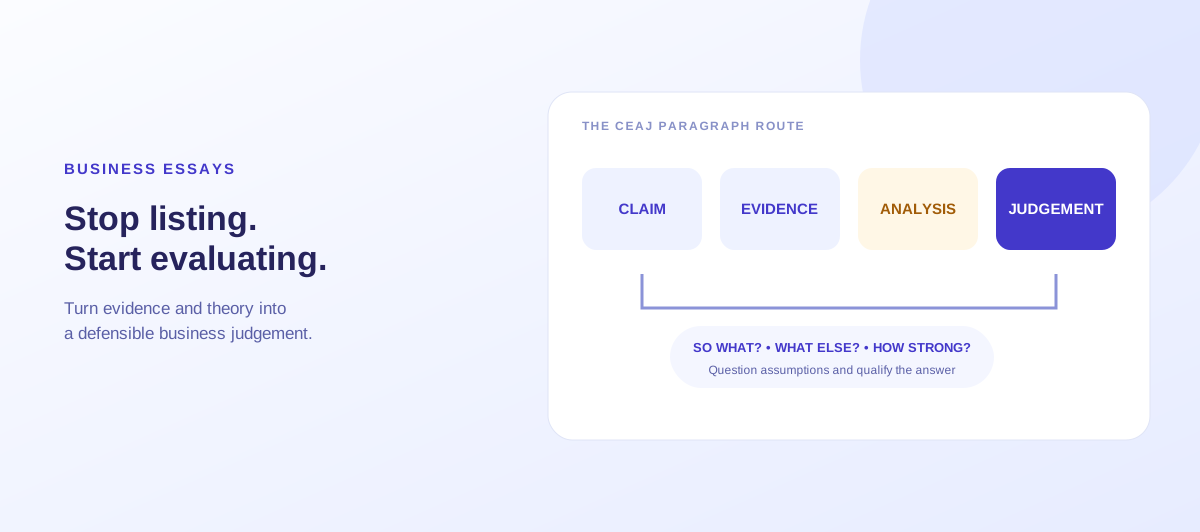
| Claim | State the paragraph’s answer | What am I arguing? |
| Evidence | Support it with credible, current material | What evidence justifies this claim? |
| Analysis | Apply theory and test relationships | Why does this matter, and what else could explain it? |
| Judgement | Weigh the point against the question | How strong is the claim, in this context? |
CEAJ is a planning aid, not a sentence formula. Paragraphs should still read naturally.
Theory into practice
A framework organises attention; it does not generate a conclusion. Select the elements that help answer the question, support them with evidence, explain connections and identify what the model leaves out. A SWOT list becomes analytical when you test whether a claimed strength is valuable, durable and relevant under the stated market conditions.
Triangulate framework outputs where useful. PESTLE may identify regulatory change, Five Forces may explain its industry effect, and resource-based analysis may show whether the firm can respond. Do not stack models merely to display knowledge; each one consumes words and must earn its place.
Worked teaching example
Descriptive: “The retailer expanded its online channel and sales increased.”
Analytical: “Online expansion increased access and may have supported sales growth by reducing geographic friction. However, the timing does not prove causation: changing demand and competitor closures may also explain the increase. The strategy therefore appears supportive rather than solely responsible, and its long-term value depends on fulfilment costs and retention.”
The stronger passage explains a mechanism, challenges a causal assumption, introduces alternatives and qualifies the judgement. It uses uncertainty responsibly rather than pretending the evidence is conclusive.
Evidence quality
Company reports, trade publications, market data and journal research serve different purposes. A corporate annual report is useful primary evidence for reported performance and management priorities, but claims about success should be checked against independent evidence. Ask who produced the source, what period and sample it covers, what it measures and what interest the publisher has.
Link every statistic to an analytical purpose. A number without comparison or interpretation is still description. Explain the baseline, trend, relevance and limitation, and avoid claiming causation from correlation alone.
Review your analysis
Marker’s Eye reviews your own business essay for theory application, evidence, counterargument and qualified judgement. You choose and make every revision.
Avoidable pitfalls
Before you submit
Check this against your own rubric and module conventions.
Why us
Our tools help you understand the brief and review your own reasoning. They do not research, decide or write the essay for you.
Brief Decoder turns task words and criteria into actions you can plan.
Marker’s Eye checks your own draft for evidence, application, evaluation and judgement.
The free builder helps you connect claims, evidence, analysis and judgement.
You remain responsible for the sources, interpretation and final wording.
Ethical support improves your process while the assessed thinking remains yours.
Questions
Strengthen the argument
Use the critical-analysis builder to plan each section, then review your own draft against the question and rubric.
Your evidence, reasoning and final writing remain your responsibility.