
Critical analysis in business essays
Turn facts and framework outputs into qualified academic judgement.
Not sure where to start? Talk to our support team live.

Business & Management
The easy version of a Ryanair case study says the airline offers low fares. The assessed challenge is to explain the activity system behind those fares, test its strategic trade-offs and build recommendations from current evidence.
The short version
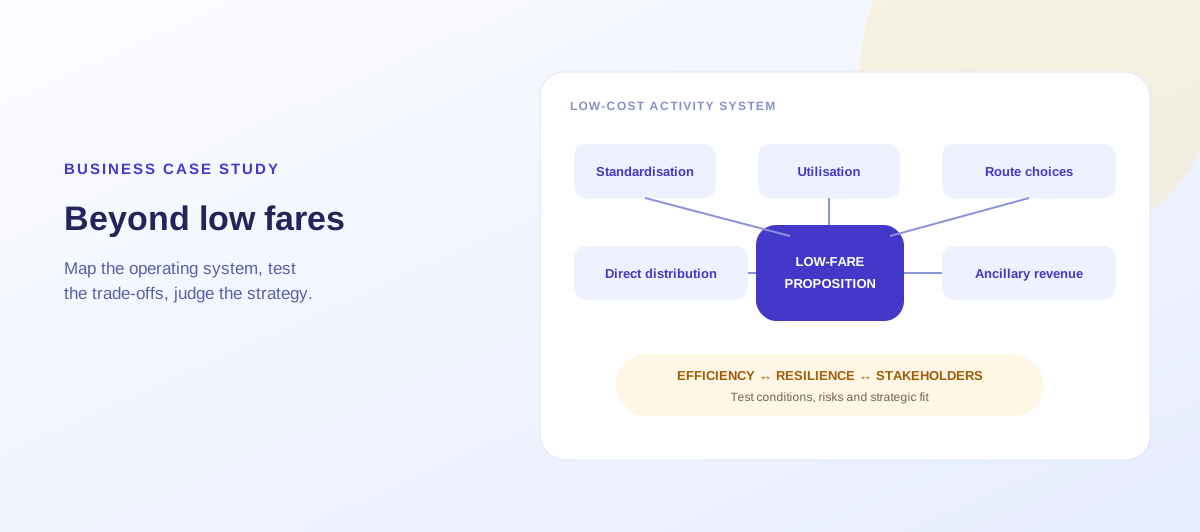
A strong Ryanair case study analysis explains how an interconnected activity system supports cost leadership: standardisation, aircraft utilisation, route and airport choices, direct distribution and ancillary revenue can reinforce a low-fare proposition. Students should test that model with current, cited evidence; assess customer, labour, regulatory, environmental and operational trade-offs; compare alternatives; and make feasible recommendations linked to the assignment question rather than simply describing the airline.
On this page
The student problem
Most students already know Ryanair is associated with low fares, but that fact alone cannot answer a strategy, operations or marketing question. If you need help interpreting what your particular case-study brief is asking, our business assignment guidance can clarify the academic expectations while you remain responsible for the research and analysis.
The challenge is to trace the system behind the outcome. You must distinguish current evidence from familiar claims, connect operational choices to strategic effects, test trade-offs and decide what the evidence means for the exact period and question in your brief.
Quick analysis map
| Business choice to investigate | Possible mechanism | Question to evaluate |
|---|---|---|
| Fleet and process standardisation | May simplify training, maintenance and scheduling | What efficiency is achieved, and what concentration risk follows? |
| Aircraft utilisation and turnaround | May spread fixed costs over more flying activity | What operational or resilience trade-off appears? |
| Airport and route choices | May affect charges, competition and demand access | How sustainable is the advantage by market? |
| Direct sales and ancillary revenue | May separate the base fare from optional services | How does this affect yield, transparency and customer value? |
| Scale and bargaining position | May influence purchasing and network economics | Which benefits are durable and which depend on conditions? |
These are hypotheses to test, not facts to repeat without evidence.
Start with the brief
A prompt may ask you to evaluate competitive strategy, diagnose an operations problem, recommend growth options or assess sustainability. Each requires different evidence and criteria. Extract the command word, decision-maker, timeframe, geographic scope, required models and deliverable. Brief Decoder can help turn the requirements into a case-analysis plan before you collect material.
Fix a clear evidence cut-off date. Ryanair’s fleet, routes, performance, regulation and strategic priorities change, so a claim that was true in an older teaching case may not support a current assignment.
Build the evidence base
Start with the supplied case and module readings. Then use current primary sources such as Ryanair investor reports for reported performance and stated strategy, while recognising that management communications have a purpose. Test broader market and regulatory claims against independent sources such as aviation regulators, official statistics and peer-reviewed research.
For every important claim, record the source, period, measure and limitation. Passenger volume does not by itself establish profitability; a low advertised fare does not capture total customer spend; and a successful route does not prove the whole strategy is transferable.
Core strategic logic
Do not treat cost leadership as a label. Map how choices may reinforce one another: standardisation can affect training and maintenance; scheduling and turnaround can affect utilisation; network choices can affect charges and demand; direct distribution and ancillary products can affect revenue per customer. Then identify tensions between efficiency, resilience, service expectations and growth.
The important analytical question is not “does Ryanair cut costs?” but “which linked activities create advantage, under what conditions, and what could weaken that fit?” That turns a company profile into strategic analysis.
Choose the right lens
| Framework | Useful for | Common misuse |
|---|---|---|
| Porter’s generic strategies | Testing the logic and trade-offs of cost leadership | Calling every low price proof of sustainable advantage |
| Five Forces | Assessing industry pressure and bargaining relationships | Listing five headings without evidence or interaction |
| Value chain / activity system | Connecting operational choices to cost and customer value | Describing activities without explaining reinforcement |
| PESTLE | Examining regulatory, economic, social, technological and environmental change | Producing an unprioritised external-factors list |
| Stakeholder analysis | Weighing effects on customers, employees, airports, investors and regulators | Assuming all stakeholders have equal power or interests |
One deeply applied framework can be stronger than several superficial diagrams.
Critical evaluation
A credible analysis examines what the model may cost as well as what it achieves. Possible lines of enquiry include service perceptions, employee relations, disruption resilience, airport dependence, regulatory exposure, emissions pressure, fleet concentration and the tension between simplicity and expansion. Treat these as research questions, not predetermined criticisms.
Compare explanations. If performance changes, is strategy responsible, or could fuel prices, capacity, demand recovery, exchange rates or competitor behaviour explain part of the movement? A qualified conclusion is academically stronger than a confident claim the data cannot isolate.
From analysis to action
Recommendations should solve a diagnosed problem and follow from the evidence. State the action, responsible area, intended outcome, implementation horizon and measure of success. Then test strategic fit, cost, operational complexity, stakeholder response, regulatory constraints and risk.
A recommendation to “improve customer service” is too broad. A stronger recommendation identifies the particular friction, proposes a bounded change, explains why it fits a low-cost model and states what evidence would show whether it worked.
Review your case analysis
Marker’s Eye reviews your own draft for case focus, framework application, evidence, trade-offs and recommendation logic. You decide and make every revision.
Avoidable pitfalls
Before you submit
Adapt this checklist to your module rubric and the date of your case.
Why us
Our tools help you unpack the case requirements and review your own analysis. They do not research the case, choose your judgement or write the assignment.
Brief Decoder identifies the command word, scope, decision problem and required output.
Marker’s Eye checks whether your own draft connects evidence, frameworks, trade-offs and judgement.
The free analysis map keeps facts, claims, counterclaims and recommendations aligned.
You verify the sources and make every analytical decision yourself.
The support structures your review process; the assessed case analysis remains yours.
Questions
Before submission
Use the analysis map to organise the case, then review your own structure against the brief and rubric.
Verify current facts and keep every conclusion your own.