
Why more sources isn’t the answer
Why synthesis beats sheer volume — and how to make fewer sources work harder in your review.
Not sure where to start? Talk to our support team live.

Research & Study Skills
The most common feedback on a literature review is “too descriptive”. This UK guide explains the difference between summarising and critically reviewing the literature, and gives you a step-by-step process — from searching to synthesis — for building a review that leads to your gap.
The short version
A critical literature review does not summarise sources one by one — it organises them by theme, compares and evaluates what scholars have found, and synthesises them into an argument that reveals a gap your research will address. The process is a cycle of searching, reading strategically, note-taking and writing: you group studies by debate, weigh their strengths and weaknesses, and build towards your research question.
On this page
The basics
A literature review is where most researchers lose easy marks, because they describe sources instead of critically reviewing them. If you are unsure what “critical” really means in this context, our literature review support can help you understand the expectations — while the reading, thinking and writing stay entirely your own. A critical review is not an annotated reading list; it is an argument built from the literature.
Put simply, a critical literature review does three things at once: it maps the existing debate on your topic, evaluates the strengths and weaknesses of that work, and synthesises it into a case for why your research is needed. It should read as a single, flowing discussion that leads the reader — and the examiner — to the gap your study will fill. For the exact requirements, always follow your own brief and marking criteria.
The honest answer
The literature review defeats capable students for predictable reasons:
Reassurance “Critical” is a skill, not a talent. Organise by theme, evaluate as you read, and keep asking “so what does this mean for my question?” — and description turns into genuine critique.
The key distinction
| Move | Descriptive (weaker) | Critical (stronger) |
|---|---|---|
| Reporting | States what a study found | Weighs how convincing the finding is |
| Structure | One paragraph per source | One section per theme or debate |
| Comparison | Lists studies side by side | Explains where they agree and clash |
| Evaluation | Accepts findings at face value | Questions method, sample and context |
| Direction | Stops at “what is known” | Builds towards the gap and your question |
A study aid only — always follow your own brief and marking criteria for the definitive expectations.
Step by step
A literature review is a cycle, not a single pass: you search, read, think and write, then loop back as your understanding sharpens. Start with a focused search — use databases such as Google Scholar, JSTOR or Scopus with keywords tied to your research question, and set simple inclusion criteria so you are not drowning.
Then read strategically: scan the abstract and conclusion before committing to a full text, so you spend your time on the studies that matter. Take notes against your themes rather than per paper, capturing not just what each study found but how strong it is and how it relates to the others. Reading with volume in mind can backfire — our guide on why adding more sources is not always the answer explains why synthesis beats sheer quantity.
The core skill
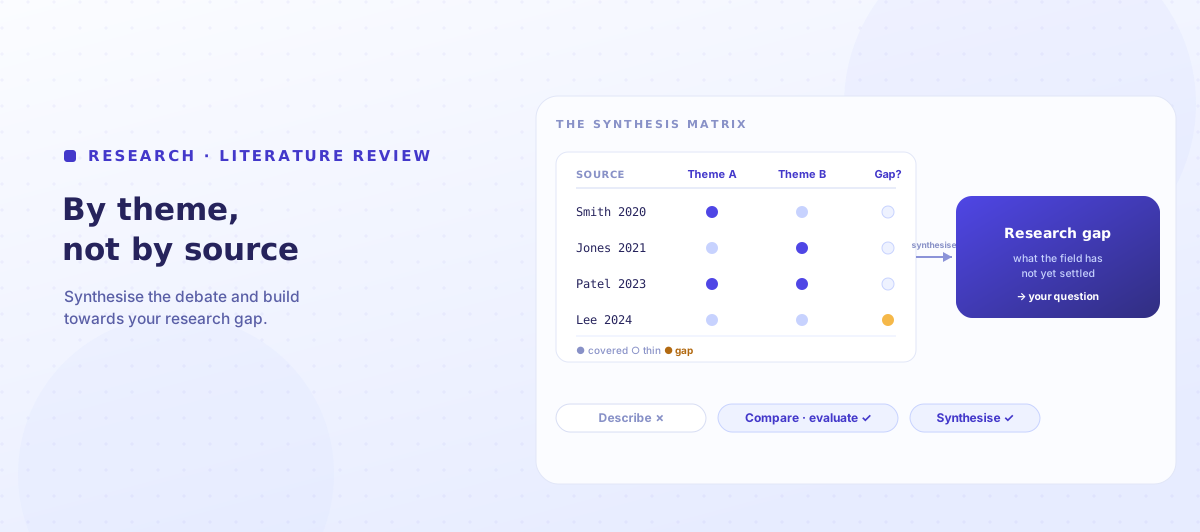
The single change that makes a review critical is organising by theme, not by source. Group studies into the two or three debates that run through your topic, then within each theme compare and contrast what different researchers found and why they might differ. A simple synthesis matrix — sources down the side, themes across the top — makes the patterns visible and stops you slipping back into a source-by-source list.
Synthesis means writing about the theme, citing several studies together to support or complicate a point, rather than marching through papers one at a time. This is the same description-to-analysis shift that markers reward across academic writing — our guide on what markers mean by analysis shows how to make it in any section, including the literature review.
The destination
A critical review has a destination: the gap. As you evaluate the themes, you are looking for what the existing work has not settled — a population it overlooked, a context it never tested, a contradiction nobody has resolved, or a method that could be improved. That gap is what justifies your study and makes your research question feel inevitable rather than arbitrary.
State the gap explicitly near the end of the review and connect it directly to your question. In a dissertation, the review then feeds naturally into the rest of the project — see how it fits the wider dissertation structure so the golden thread runs from your gap through to your findings.
A simple example
Here is a short, generic teaching example of the shift from describing to critically synthesising:
The critical version cites both studies together, explains why they differ, and opens a gap (context-dependence) — without adding new data. That is synthesis. This example is deliberately generic; keep your own review your own work, and support your points with the academic phrasing conventions your field expects.
Acting on feedback
“Too descriptive” and “needs more critical analysis” are the most common comments on a literature review — and the most frustrating, because they rarely say how. The fix is to translate the comment into concrete edits: re-group a source-by-source section under themes, add a sentence of evaluation after each study, and make the paragraph’s point about the debate rather than the paper. Phrases like “critically evaluate” carry specific expectations, which our guide to understanding UK feedback unpacks.
If a marker’s comment is still unclear, our Feedback Decoder helps you turn it into specific, actionable next steps for your revision. The rethinking and the writing stay entirely yours.
Act on your feedback
Feedback Decoder turns comments like “too descriptive” or “needs more critical analysis” into clear, specific edits — re-group by theme, add evaluation, build towards the gap — for your next draft. You make the changes; every word stays your own.
Pitfalls
Most marks are lost to the same avoidable habits:
Before you submit
Use this on your own draft — always defer to your brief and marking criteria for the definitive requirements.
Why us
My Perfect Writing helps students review their own literature reviews and make sense of marker feedback — while they stay responsible for their own reading, evaluation and writing. We do not write literature reviews for you.
Marker’s Eye reviews your own review against academic expectations for critical depth, synthesis and structure — you make the changes.
Feedback Decoder turns comments like “too descriptive” into concrete edits you can apply to your next draft.
The free framework gives you a synthesis matrix and gap-builder so your review is thematic and critical from the start.
Guidance reflects how UK dissertations and research assessments judge critical analysis and synthesis.
The reading, evaluation and writing remain yours. We do not write literature reviews for you.
You stay responsible for your own literature review — our tools help you review and refine it, they do not write it for you.
Questions
Before you submit
Use this guide and the free framework to build a thematic, critical review, then let Feedback Decoder turn any “too descriptive” feedback into concrete edits before you submit.
Guidance should support your learning, not replace your own work.