
Writing an annotated bibliography
Evaluate and record sources properly before you cite them.
Not sure where to start? Talk to our support team live.

Referencing
Oxford and Harvard are not two versions of the same thing—they handle citations in fundamentally different ways. Mixing them, or misreading which one your assignment wants, is one of the easiest ways to lose marks you have already earned.
The short version
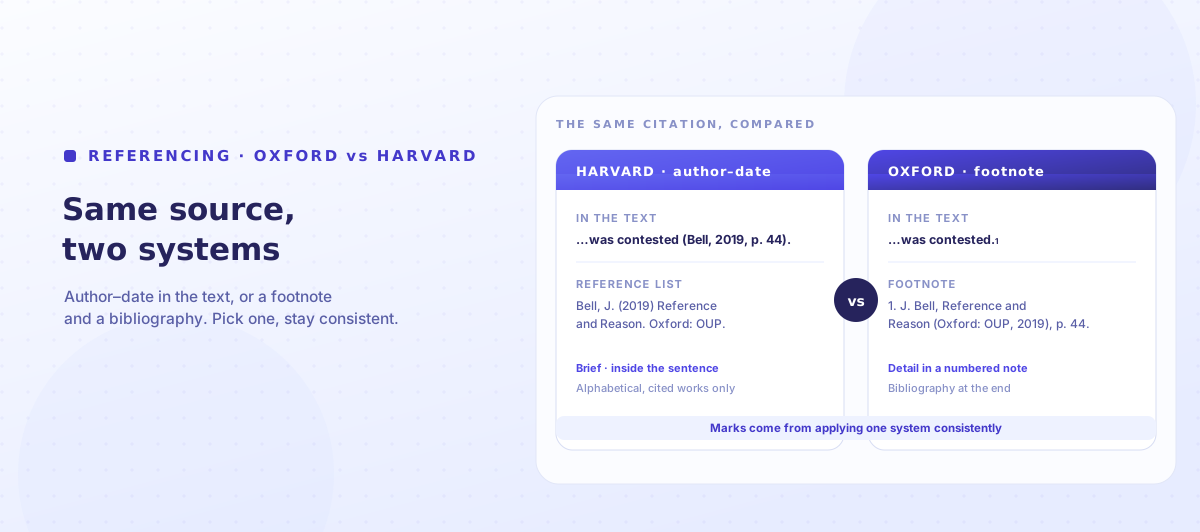
Harvard is an author–date system: you cite in the text as (Author, Year, page) and list sources alphabetically in a reference list. Oxford is a documentary-note system: you place a superscript number in the text and give the full source in a footnote, with a bibliography at the end. Choose the one your department requires, then apply it consistently throughout.
On this page
The real problem
You can research well, write well and still drop a grade band because your citations are inconsistent or in the wrong system. If you are unsure whether your draft applies one style cleanly and formats the reference list correctly, our editing and formatting assignment guidance can help you check consistency while the research and writing stay entirely yours.
The confusion is understandable: Oxford and Harvard are built on different logic. Harvard keeps the citation brief and inside the sentence; Oxford moves the detail into footnotes. Once you see how each one actually works, choosing and applying the right one becomes mechanical rather than stressful.
At a glance
| Feature | Harvard (author–date) | Oxford (documentary-note) |
|---|---|---|
| In-text citation | (Author, Year, p. x) | Superscript number¹ |
| Where the detail sits | Reference list at the end | Footnote at the bottom of the page |
| End list | Reference list (cited works) | Bibliography (often all works consulted) |
| Typical disciplines | Sciences, business, social sciences | History, classics, some humanities |
| Repeat citations | Repeat the short (Author, Year) | Shortened note or ibid. |
Conventions vary by university. Always follow your department’s guide or a reference such as Cite Them Right.
Why students struggle
Referencing is not about memorising every rule. It is about picking the required system and applying it consistently, then checking it deliberately before you submit.
Before you cite
Start with the brief and the module handbook, not with your last essay. Look for the named style (“Harvard”, “Oxford”, or a specific guide) and any local rules on page numbers, DOIs and bibliography scope. Where the requirement is buried in dense guidance, Brief Decoder can surface exactly what the assignment asks for—including the referencing expectation—without doing the citing for you.
If the brief is genuinely silent, ask your tutor rather than guessing; do not mix a footnote system into an author–date paper because it “looks academic”.
Worked comparison
| Element | Harvard | Oxford |
|---|---|---|
| First mention | The theory was contested (Bell, 2019, p. 44). | The theory was contested.¹ |
| The note / entry | — (no footnote) | ¹ J. Bell, Reference and Reason (Oxford: OUP, 2019), p. 44. |
| Repeat mention | (Bell, 2019, p. 51) | ² Bell, Reference and Reason, p. 51. |
| End-of-work list | Bell, J. (2019) Reference and Reason. Oxford: OUP. | Bell, J., Reference and Reason (Oxford: OUP, 2019). |
Formatting details (punctuation, italics, order) follow your department’s guide; the pattern above shows the structural difference.
Apply it cleanly
Whichever system you use, the marks come from applying it the same way every time: identical punctuation, consistent author formatting, page numbers where required, and an end list that matches your in-text citations exactly. In Oxford, keep your footnotes uniform and use shortened forms or ibid. correctly for repeats; in Harvard, make sure every in-text citation has a matching reference-list entry and vice versa.
Do not confuse Oxford referencing with OSCOLA (a distinct legal citation style) or MHRA (another footnote style); if your course names one of those, follow that guide specifically. When you use sources well, referencing supports the argument—see why adding more sources is not always the answer.
Confirm the requirement
Brief Decoder reads a dense brief or handbook and tells you exactly what is required—including the referencing expectation—so you apply the right system from the start. It never cites or writes for you.
Avoidable pitfalls
Before you submit
Check this against your own department’s referencing guide or Cite Them Right.
Why us
Our tools help you understand the requirement and review your own draft. They do not cite, format or write the assignment for you.
Brief Decoder surfaces exactly what the assignment asks for, including the referencing style.
Marker’s Eye checks your own writing for structure, clarity and marking alignment.
The free quick-reference shows the same source in both systems so you stay consistent.
You remain responsible for the sources, citations and final wording.
Ethical support improves your process while the assessed work remains yours.
Questions
Before you submit
Use the quick-reference to see the same source in Oxford and Harvard, then review your own draft for consistent citations before you hand it in.
Your sources, citations and final writing remain your responsibility.