
Write a critical literature review
Turn evaluated sources into thematic synthesis and a defensible research gap.
Not sure where to start? Talk to our support team live.
Research & Study Skills
An annotated bibliography can feel like a reference list with an extra paragraph attached. This guide shows what the annotation is really assessing and how to move from summary to credible evaluation, one source at a time.
The short version
To write an annotated bibliography, first confirm the required citation style, annotation type and word count. Select credible, relevant sources; format each full citation; then write a concise annotation that summarises the source’s argument, evaluates its authority and evidence, and explains how it contributes to your research question. Arrange entries exactly as your brief requires and check citation consistency before submitting.
On this page
Start with the struggle
Students often find the sources but get stuck on what to write underneath each citation: how much should be summary, what counts as evaluation, and how can relevance be explained without repeating the same sentence? Our annotated bibliography guidance can help you understand those expectations while the source selection, judgement and writing remain your own.
An annotated bibliography contains complete citations followed by short annotations. Depending on the brief, an annotation may be descriptive, evaluative or both. Its academic purpose is to show that you understand each source, can judge its usefulness and can connect it to a developing research question. Always treat your module brief and required style guide as the final authority.
Quick framework
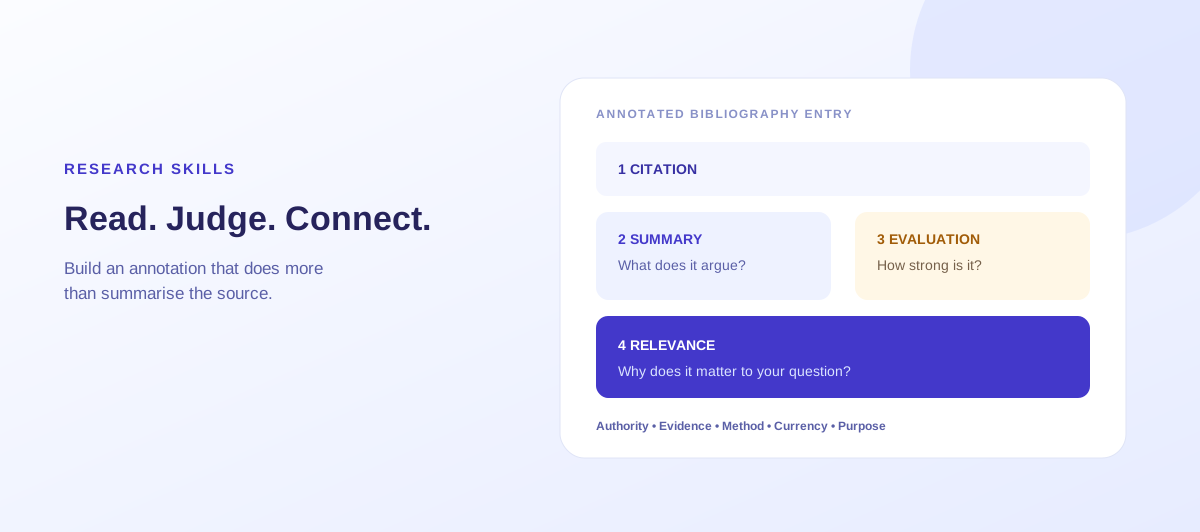
| Part | Question to answer | What to include |
|---|---|---|
| Citation | What is the source? | A complete, consistently formatted reference |
| Summary | What does it argue? | Purpose, central claim, scope and key finding |
| Evaluation | How trustworthy and useful is it? | Authority, evidence, method, limitations and possible bias |
| Relevance | Why does it matter to my project? | Its role in your question, theme, evidence or counterargument |
Some briefs combine these elements in one paragraph; others prescribe headings. Follow yours.
Why it feels difficult
Summary is easier to see: you can point to an author’s claim or finding. Evaluation asks you to make and justify a judgement. That means considering who produced the source, how the evidence was gathered, whether the method suits the question, what the source overlooks and whether it is current enough for your purpose.
The tight word count adds another problem. Students either retell the whole article and leave no room for evaluation, or make vague claims such as “this is reliable”. A better habit is to record only the information needed to judge and use the source.
Step by step
Identify the number and type of sources, citation style, word limit per entry, ordering rule and whether the annotation must be descriptive, critical or reflective. Do not assume APA, Harvard, MLA and Chicago use identical layouts.
Search your library databases and scholarly indexes, then test relevance before reading everything. Prefer the best evidence for your question, not simply the first accessible results. Record citation details immediately so they do not have to be reconstructed later.
Capture the research purpose, argument, evidence, method, scope, author or publisher authority, limitations and relationship to your topic. This makes critical notes while the details are fresh.
Begin with the main claim, evaluate the source with a specific reason, and finish by stating exactly how it informs your project. Cut background detail that does not serve one of those jobs.
Source judgement
Credibility is contextual. A peer-reviewed study may offer strong research evidence; a government dataset may provide authoritative statistics; a company report may be essential primary evidence about what the company claims, but still require scrutiny because it serves corporate communication goals.
Test authority, evidence, method, currency, relevance and purpose. Then state the consequence: a narrow sample may limit transferability, an old dataset may not represent current conditions, or a first-hand corporate source may be useful for strategy claims but weak as independent evaluation.
Worked teaching example
Weak: “This article discusses hybrid work. It is reliable and will be useful for my essay.”
Stronger: “The study examines how hybrid schedules relate to employee engagement using interviews across three UK technology firms. Its comparative design reveals differences between teams, although the sector-specific sample limits wider generalisation. It will support the essay’s argument about managerial context and provide a counterpoint to survey-based research.”
The stronger version remains concise but identifies the source’s scope, explains a limitation and assigns it a specific role. It does not invent certainty that the source cannot support.
Improve your draft
If feedback says “too descriptive”, “evaluate the source” or “explain relevance”, revise the thinking first. Mark the sentence performing each job—summary, evaluation and relevance—then add or rebalance the missing function. Our Feedback Decoder can turn an unclear tutor comment into concrete revision steps without rewriting the entry for you.
Review your own draft
Marker’s Eye reviews your own entries for balance, critical depth, relevance and consistency. You decide what to change and keep authorship of every word.
Avoidable pitfalls
Before you submit
Use your brief, university referencing guidance and marking criteria as the final check.
Why us
My Perfect Writing helps you understand requirements, review your own entries and act on feedback. We do not research, write or submit an annotated bibliography for you.
Marker’s Eye highlights where your entries may need stronger evaluation, relevance or consistency.
Feedback Decoder turns comments into revision actions you can apply yourself.
The free planner separates citation, summary, evaluation and relevance before drafting.
You choose, read, judge and write about every source.
Support should strengthen your research judgement, never replace it.
Questions
Before submission
Use the planner to build each annotation, then review your own draft for summary, evaluation, relevance and citation consistency.
You remain responsible for every source and every word.