
Description vs analysis
The single biggest thing to check when you review your argument.
Not sure where to start? Talk to our support team live.

Study Skills
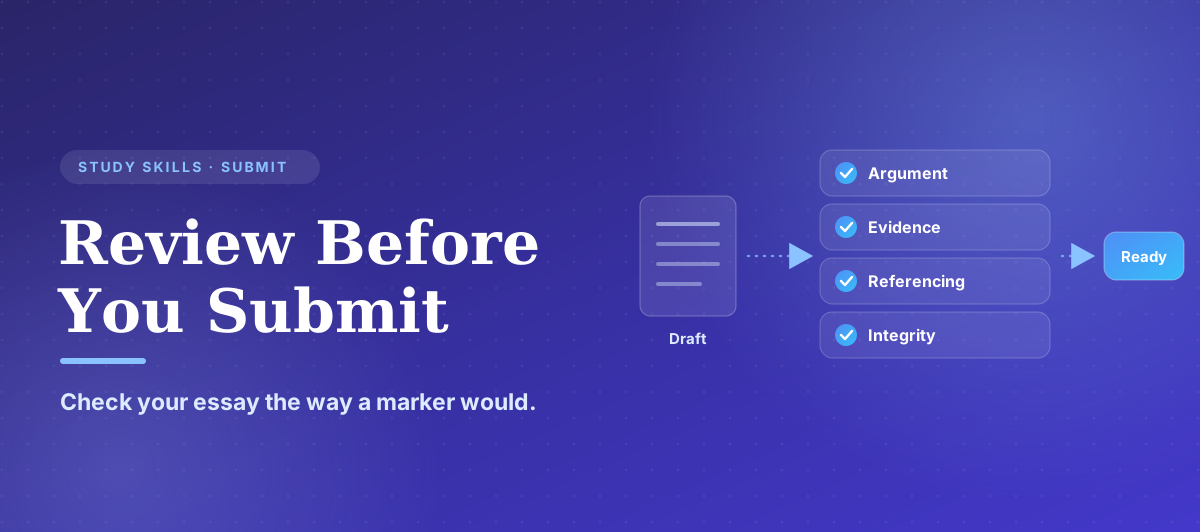
Finishing a draft is not the same as it being ready. This guide shows how to review your own essay the way a marker would — argument, evidence, structure, referencing and integrity — in a clear order, so problems are caught before they cost marks.
The short version
To review your essay before submitting, read it the way a marker would rather than just proofreading. Check it against the question and marking criteria first, then work through argument and critical analysis, evidence and referencing, structure and flow, and academic integrity — in that order. Leave a final proofread for spelling and typos until last, once the bigger issues are fixed.
On this page
Start here
Most students do one quick read for typos and call it “checked.” But proofreading (spelling, grammar, formatting) and reviewing (does this actually answer the question well?) are two different jobs, and the marks live in the second. A perfectly proofread essay can still lose heavily if the argument is thin, the evidence is unexplained, or it drifts off the question. Reviewing means reading your own work the way a marker would — against the criteria, not just for surface errors. If you want a structured second read of formatting and consistency once the content is right, My Perfect Writing’s editing and formatting help explains how to check presentation without changing your authorship.
The hard part is that you are too close to your own work: you know what you meant, so you read it into gaps that a marker will not. The fix is to review in a fixed order and to create distance — leave the draft for a day, then read it as if someone else wrote it. UK university academic-skills guides on self-review and proofreading (for example, from your own library’s study-skills pages) recommend exactly this separation of tasks.
Order matters Fix the big things first. There is no point perfecting a sentence you will delete when you realise the paragraph does not answer the question.
Pass 1
Before anything else, put the title and the marking criteria next to your essay and ask one question of every section: is this helping me answer the exact task? Check that you have responded to the command word (analyse, evaluate, discuss) and stayed inside the scope. Anything that is interesting but off-question is costing you words and marks.
Then read only your introduction and conclusion together. They should answer the question in miniature and match each other. If your conclusion argues something your introduction did not promise, the essay has drifted, and that is far more important to fix than any typo.
Pass 2
Now read for argument. Does the essay take a clear position and defend it, or does it describe? Go paragraph by paragraph and ask whether each one makes a point, supports it, weighs it and links back to the question — or whether it just reports information. Description is the most common reason good content still gets low marks; the fix is the shift explained in what markers actually want. If a paragraph reads as flat reporting, the University of Manchester’s Academic Phrasebank offers sentence patterns for phrasing critical, evaluative points.
Reviewing your own analysis is genuinely hard, because you already believe your point. This is exactly where a structured second read helps: Marker’s Eye reviews your own draft against UK marking criteria and flags where description should become analysis, where an argument is asserted rather than evidenced, and where a section drifts from the question — you decide what to change and make every edit yourself. Use it to review your own essay draft before you submit.
Review your own draft
Reviewing your own work is hard because you already know what you meant. Marker’s Eye reviews your own draft against UK marking criteria and flags where description should become analysis, where evidence is thin, and where referencing slips — so you can fix the things that cost marks. You make every change; the work stays yours.
Pass 3
Read for evidence next. Every key claim should be supported and, crucially, explained — a citation that is named but not used adds nothing. Watch for two opposite problems: claims with no source, and sources with no analysis. Remember that more references are not automatically better; relevance and use matter more than volume, as our guide on why adding more sources is not always the answer explains.
Then check referencing consistency: every in-text citation has a matching entry in the reference list, the style is consistent throughout, and page numbers are present where you quote. Small referencing slips lose easy presentation marks; our guide to Oxford vs Harvard referencing helps if you are unsure which your module requires.
Pass 4
Read the first sentence of every paragraph in order. Together they should tell the story of your argument — if they do not, your structure needs work. Each paragraph should have one job, follow logically from the last, and signpost where it fits. Look for paragraphs that do two things at once (split them) and abrupt jumps between ideas (add a linking sentence).
Check the balance too: are you spending most words on the parts that carry the most marks, or has a background section grown out of proportion? A well-structured essay guides the reader without them having to work to follow you.
Pass 5
Before you submit, make sure the work is genuinely and defensibly your own. Check that every source is properly cited, that any paraphrase is in your own words rather than lightly reworded, and that quotations are marked and referenced. If you used any tools during your research, confirm the final analysis and writing are yours and that you have followed your university’s policy on acceptable use. Good academic practice is not about “beating” a checker; it is making sure the essay reflects your own understanding.
This matters as much for a reflective piece as for an essay — the same integrity checks apply when you write a critical reflection essay or any assessed work.
Pass 6 — last
Only now, once the argument, evidence and structure are right, do the surface proofread: spelling, grammar, punctuation, formatting and the word count. Read slowly — reading aloud, or changing the font, helps you see errors you skim over on screen. Check the brief’s formatting requirements (font, spacing, title page, word limit) and that your file name and submission format are correct.
Leave time The best pre-submission review needs a gap between finishing and checking. A draft finished the night before cannot be reviewed properly — build in at least a day.
Before you submit
Work top to bottom — fix the argument and evidence before the typos.
Free resource
Want the whole review in one place? Our Pre-Submission Essay Review Checklist takes you through every pass in order — question fit, argument, evidence, referencing, structure, integrity and the final proofread — so nothing slips through before you hand in.
Grab the checklist Use the free resource card on this page to get the Pre-Submission Essay Review Checklist sent to you — run it on every essay before you submit.
Questions
Before you submit
Use this checklist to review your essay like a marker, then let Marker’s Eye review your own draft against UK marking criteria for the things that are hardest to spot in your own work.
Guidance should support learning, not replace authorship.