
Is M250 Java too challenging?
Object-oriented programming strategies for Open University students.
Not sure where to start? Talk to our support team live.

Computer Science
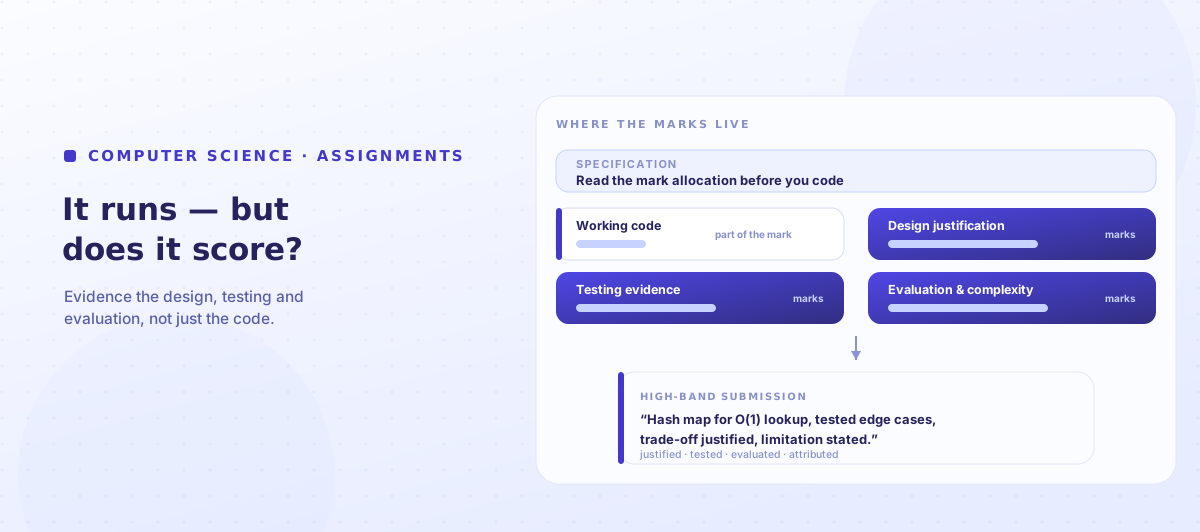
Your program compiles, runs and passes your own tests—and the grade is still a low 2:2. In most computer science assignments, working code is only part of the mark; the design justification, testing evidence and evaluation earn the rest.
The short version
A high-quality computer science assignment does more than run. It maps directly to the specification and rubric: it justifies design decisions, shows testing evidence, analyses efficiency and limitations, documents the code clearly, and attributes any external sources. Read the mark allocation first, then build the code and the report so that every requirement and criterion is visibly evidenced.
On this page
The real problem
Many computer science students spend almost all their time getting the program to run, then write the report in the final hour. If you are unsure how the marks are actually split between the code and the write-up, our computing and IT assignment guidance can help you interpret the specification while the design, coding and writing stay entirely yours.
In most CS modules the rubric rewards reasoning about the solution as much as the solution itself: why you chose a data structure, how you tested it, how efficient it is, and what its limitations are. A program that runs but is undocumented, untested and unexplained can only reach the lower bands, however clever the code.
At a glance
| Component | What markers look for | Common student gap |
|---|---|---|
| Working solution | Meets the functional requirements | Often the only part done well |
| Design justification | Reasoned choices, alternatives considered | Choices made but never explained |
| Testing evidence | Test cases, results, edge cases | Tested informally, not documented |
| Evaluation | Efficiency, limitations, improvements | Missing or one vague sentence |
Check your own rubric: some modules put 40–60% of the marks outside the code itself.
Why students struggle
Quality in CS is not just elegant code. It is a clear, honest account of how you built a correct, efficient solution—and how you know it works.
Before you code
Read the specification as a contract. Underline every deliverable and every graded criterion, then note the marks attached. A line like “evaluate the time complexity of your solution” is not optional context—it is marks with your name on them. When a brief bundles code, report and testing into dense prose, Brief Decoder can turn it into a clear, actionable requirement list without writing any of it for you.
Convert the criteria into a checklist you build against: Which requirements are functional? What evidence proves each one? Which marks sit in design, testing and evaluation rather than in the code?
Practical framework
| Move | Purpose | Prompt |
|---|---|---|
| Spec | List every requirement and its marks | What exactly is being assessed? |
| Plan | Design and justify before coding | Why this approach over alternatives? |
| Anchor tests | Define test cases, including edge cases | How will I prove it works? |
| Develop | Implement with clear, documented code | Is the code readable and attributed? |
| Evaluate | Analyse efficiency, limits, improvements | How good is this, and what next? |
SPADE is a planning aid, not a rigid order—design, tests and code iterate together.
Make reasoning visible
Turn hidden decisions into written evidence. For design, state the choice, the alternative you rejected and why (for example, a hash map for O(1) lookup instead of a list scan). For testing, show a small table of inputs, expected outputs, actual outputs and edge cases—unit tests and version-control history (Git) strengthen this. For complexity, give the Big-O of the key operations and explain the trade-off you accepted.
Clear code documentation, a sensible README and consistent naming are part of the quality mark, not decoration. Markers should be able to follow your reasoning without running the program.
Worked teaching example
Low-band write-up: “I used a list to store the users and a loop to find them. It works.”
High-band write-up: “User lookup is the most frequent operation, so I stored users in a hash map keyed by ID, giving average O(1) retrieval versus O(n) for a list scan. I accepted higher memory use for faster lookups, which suits the stated workload. Tests covered a present key, a missing key and a duplicate-insertion edge case (see Table 3); all passed. A limitation is worst-case O(n) on hash collisions, which I would mitigate with load-factor tuning in a production build.”
The stronger version justifies the choice, quantifies the trade-off, evidences testing and states a limitation—each of which maps to a rubric line.
Integrity in code
Academic integrity applies to code as much as to prose. Reused snippets, library usage and tutorials must be cited in the way your module requires, and generated or copied code presented as your own is misconduct. Similarity and code-comparison tools are widely used, so keep your commit history and drafting notes as evidence of your own process.
Working with classmates on understanding is fine; sharing solutions is collusion. If you review your own report for clarity and rubric alignment, see how to move from description to evaluation—the same shift from “what I did” to “why it is good” earns CS marks too.
Review your write-up
Marker’s Eye reviews your own CS report for design justification, testing evidence, complexity analysis and evaluation against the rubric. You choose and make every revision; the code stays yours.
Avoidable pitfalls
Before you submit
Check this against your own module rubric and submission guidelines.
Why us
Our tools help you understand the specification and review your own write-up. They do not design, code or write the assignment for you.
Brief Decoder turns a dense specification into a clear, graded requirement list.
Marker’s Eye checks your own report for design justification, testing evidence and evaluation.
The free mapper links each requirement to the artefact that proves it.
You remain responsible for the design, code, testing and final wording.
Ethical support improves your process while the assessed work remains yours.
Questions
Before you submit
Use the spec-to-marks mapper to evidence every requirement, then review your own report against the criteria before you hand it in.
Your design, code and final writing remain your responsibility.