
Why is M269 so difficult?
A later, more demanding OU computing module — how to approach the algorithms, complexity and problem-solving of M269.
Not sure where to start? Talk to our support team live.

Computing & Study Skills
TM112 (Introduction to Computing and Information Technology 2) turns theory into practical programming, which is what makes it a step up. This UK guide explains what TM112 covers, why students struggle, and how to build computational thinking, trace code, debug and plan your study and TMAs.
The short version
TM112 (Introduction to Computing and Information Technology 2) at the Open University feels difficult because it turns theory into practical programming: computational thinking, variables, selection, iteration, functions, debugging and testing, often inside multi-step problems. The real skill is decomposing a problem and tracing code, not memorising syntax. With steady weekly practice it is very manageable — always follow your official module materials.
On this page
The basics
TM112 is the Open University module Introduction to Computing and Information Technology 2. It is the second compulsory entry-level module for most Computing and IT qualifications, and it develops your problem-solving and programming skills alongside a broader understanding of information technologies.
Its main themes include computational thinking and algorithms, hands-on programming in Python with real-world data, and core information technology topics such as computer architecture, the cloud and mobile computing. It also introduces networks and communication ideas including the Internet of Things, and cybersecurity concepts such as encryption, alongside the legal, social and ethical issues technology raises. For the exact units, software, study calendar and assessment structure, always rely on your official module website and materials — this guide explains the ideas and how to study them, not your specific deadlines or rules.
The honest answer
TM112 has a reputation as a step up from TM111, and the reasons are consistent:
Reassurance “Difficult” is not “impossible”. Almost every point above is answered by the same habit: write and trace small pieces of code every week, so programming becomes something you do, not just something you read about.
The core skill
The skill TM112 really builds is computational thinking — solving a problem in a way a computer can carry out. In practice that means problem decomposition (breaking a task into smaller steps), spotting patterns, and algorithmic thinking (writing those steps as a precise, ordered procedure).
This is why passive reading rarely works here. You can understand a concept perfectly and still be unable to apply it to a fresh problem. The shift TM112 rewards is from “I recognise this idea” to “I can turn this problem into steps and write code that runs”. You close that gap by doing — writing small programs, running them, and fixing them — rather than only watching solutions.
Concept map
| Concept | What it is | Why it feels hard | How to practise |
|---|---|---|---|
| Variables | Named stores for values | Tracking what each holds as code runs | Trace values line by line on paper |
| Selection | Making decisions with if/else | Getting the conditions exactly right | Test every branch with sample inputs |
| Iteration | Repeating steps with loops | Off-by-one and never-ending loops | Dry-run the loop counter each pass |
| Functions | Reusable, named blocks of code | Inputs, outputs and reuse | Write small functions and test them alone |
| Debugging | Finding and fixing errors | The bug is rarely where it looks | Read the error; trace back from the output |
| Testing | Checking code against expected results | Thinking of the cases that break it | List input → expected output before coding |
| Data & information | Working with real-world data | Turning messy data into usable form | Practise reading, filtering and summarising |
A study aid only — always follow your official TM112 materials for the definitive definitions, scope and assessment.
Two key habits
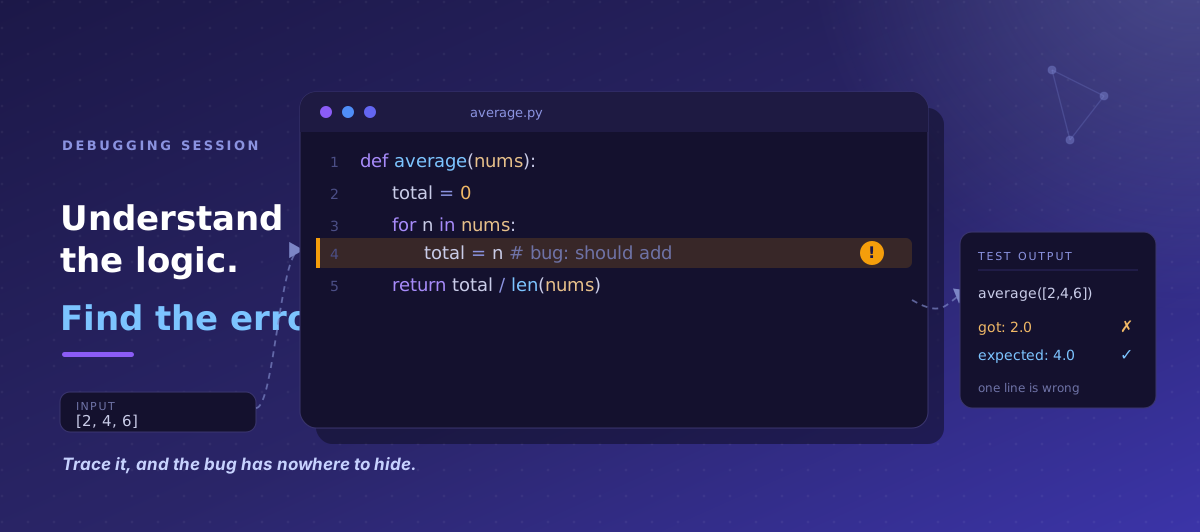
Two habits separate a confident TM112 student from a struggling one. The first is reading unfamiliar code: before you change anything, trace it line by line and predict the output — a “dry run” on paper is the single most useful technique in the module. The second is debugging and testing: treating a wrong result as information, not failure.
When code misbehaves, read the error message, then work backwards from the output to find where reality and your expectation first diverge. Before you even run a program, write down a few input → expected output test cases; if the actual output differs, you have found a bug and know roughly where to look. The official Python tutorial is a reliable reference when a language feature is unclear.
A simple example
Here is a short, generic teaching example — not a live assessed task — showing how to break a programming problem into smaller logical steps. The problem: find the average of a list of numbers.
The point is the method — decompose, sequence, test — not this specific answer. Every TM112 task becomes manageable when you break it into ordered steps. This example is deliberately generic — never copy or reproduce a live TMA question, and keep your submitted work your own.
Study planning
Because TM112 is practical and cumulative, consistency beats intensity. Protect a regular study slot and spread coding across the week rather than cramming. A workable weekly rhythm:
Revise by writing small programs from a blank page, not by re-reading solutions, and build a one-page summary per concept with a worked example and a common pitfall. The free workbook below turns this into action — trace code, find common errors, and plan input/output tests. For official study-skills and assessment guidance, the Open University Help Centre is the place to check.
Assessment prep
For a Tutor-Marked Assignment, read the brief slowly and answer exactly what is asked, showing your working and commenting your code where it helps. A structured way to start is to understand your TMA requirements so nothing is missed. Test your program against sensible input/output cases before you submit — a marker credits clear, working logic.
Then use tutor feedback deliberately: note the recurring issues on a returned TMA and apply them next time. Between submissions you can review your own written explanations for clarity, and our computing and IT assignment support explains what UK markers look for. If TM112 feels hard, you are not alone — our guides to why M269 is so difficult and whether MST124 is challenging take the same honest approach to other demanding OU modules. Keep every submission your own; guidance helps you improve your work, it never replaces it.
Avoid these
The most common mistakes are avoidable once you know them:
Apply it to your own work
Marker’s Eye reviews your own written explanations against UK marking expectations — clarity, structure and how well you justify each step — and flags what to tighten. You make the changes; every submission stays your own.
Before your next TMA
Use this on your own study and drafts — always defer to your official TM112 materials for the definitive requirements.
Why us
My Perfect Writing helps OU computing students understand their brief and review their own written work — while they stay responsible for their own study, code and answers. We do not complete assessments, write code for TMAs or solve iCMAs.
Brief Decoder helps you read a TMA brief — the task, requirements and instructions — so you answer exactly what TM112 asks.
Marker’s Eye reviews your own written explanations for clarity and structure against UK marking expectations — you make the changes.
Guidance reflects how UK and Open University study works, including tutors, TMAs and self-directed learning.
The study, code and answers remain yours. We do not complete assessments or write your programs for you.
Explore the tools and the free debugging workbook before deciding whether you need any further guidance.
You stay responsible for your own TM112 work — our tools help you plan and review it, they do not do it for you.
Questions
Before your next TMA
Use this guide to build computational thinking and steady TM112 practice, then let Marker’s Eye review your own written explanations against UK marking expectations before you submit.
Guidance should support your learning, not replace your own work.