
Why is M269 so difficult?
Another demanding Open University module — how to approach the algorithms, complexity and problem-solving of M269.
Not sure where to start? Talk to our support team live.

Mathematics & Study Skills
MST125 (Essential Mathematics 2) moves fast and reuses earlier topics in later questions, which is what makes it hard. This UK guide explains what MST125 covers, why students struggle, and how to plan your study and practice.
The short version
MST125 (Essential Mathematics 2) at the Open University feels difficult because it moves fast and stacks topics: algebra, functions, calculus, vectors, matrices and complex numbers, often reused within multi-step problems. The challenge is applying earlier ideas in later questions, not memorising formulas. With steady weekly practice it is manageable — follow your own module materials for specifics.
On this page
The basics
MST125 is the Open University module Essential Mathematics 2. It builds the core mathematics you need for further study in maths, computing, engineering and the sciences, moving from technique into more careful reasoning and notation.
Its main themes include algebraic manipulation, functions and graphs, differentiation and integration, vectors, matrices, complex numbers and precise mathematical notation. For the exact units, assessment structure and study calendar, always rely on your official module website and materials — this guide explains the ideas and how to study them, not your specific deadlines or rules.
The honest answer
MST125 has a reputation for being a step up, and the reasons are consistent:
Reassurance “Difficult” is not “impossible”. Nearly every point above is answered by the same habit: steady weekly practice on worked problems, keeping earlier topics warm so they are ready when later questions need them.
The step up
Earlier study — including Essential Mathematics 1 (MST124) or A-level — often rewards following a familiar procedure. MST125 asks for more: choosing the right method for an unfamiliar problem, using correct notation to justify each step, and connecting topics that were previously taught separately.
The mindset shift is from “which formula do I use?” to “what does this problem actually need, and can I justify each step?” That is why passive reading rarely works here — the skill is built by doing problems, not just watching them be solved.
Topic map
| Topic | What it is | Why it feels hard | How to practise |
|---|---|---|---|
| Algebra | Manipulating expressions and equations | It underpins everything else | Drill until it is fast and automatic |
| Functions & graphs | Relationships and their shapes | Linking equation to graph | Sketch by hand, then check |
| Differentiation | Rates of change and gradients | Rules stack up quickly | Work many small examples |
| Integration | Areas and reverse of differentiation | Choosing the right technique | Recognise the form first |
| Vectors | Quantities with size and direction | Geometry meets algebra | Draw the diagram every time |
| Matrices | Arrays for transformations and systems | New notation and rules | Practise the operations by hand |
| Complex numbers | Numbers with a real and imaginary part | They feel abstract at first | Plot them; connect to geometry |
A study aid only — always follow your official MST125 materials for the definitive definitions, scope and assessment.
The core skill
Two things separate a confident MST125 student from a struggling one. The first is notation: writing mathematics precisely so each line means exactly what you intend. The second is multi-step problem solving — holding a method together across several stages without losing the thread.
The practical fix is to show your working as a sequence of justified steps. Each line should follow clearly from the one before, so an error is easy to find and a marker can follow your reasoning. This also protects marks: even if the final answer slips, a clear method is credited. Keeping earlier topics fresh matters here, because a later question will often assume you can still do the algebra or trigonometry from before.
A simple example
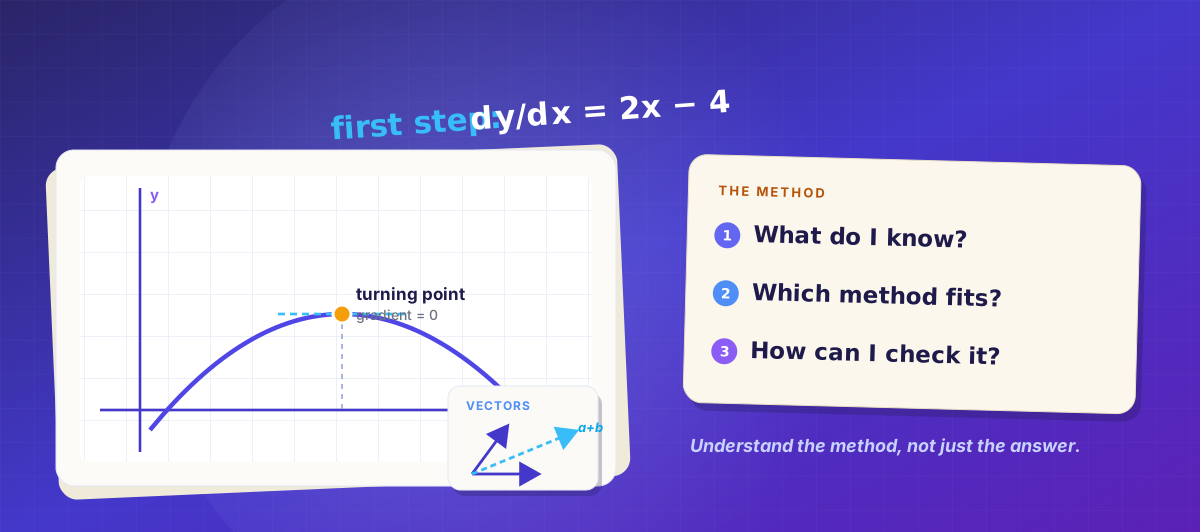
Here is a short, generic teaching example — not a live assessed task — showing how to break a multi-step problem into stages. The problem: find and classify the turning point of y = x² − 4x + 1.
The point is the method, not the answer: every MST125 problem becomes manageable when you split it into justified stages. This example is deliberately generic — never copy or reproduce a live TMA question, and keep your submitted work your own.
Study planning
Because MST125 is fast and cumulative, consistency beats intensity. Protect a regular study slot and spread practice across the week rather than cramming. A workable weekly rhythm:
The free workbook below helps you turn this into action — find your weak topics, choose the right method for a question, and work multi-step problems through a checkable process. For official study-skills and assessment guidance, the Open University Help Centre is the place to check.
Assessment prep
For a Tutor-Marked Assignment, read the brief slowly and answer exactly what is asked, showing full working for each step. A structured way to start is to understand your TMA requirements so nothing is missed. Present your solutions as clear, justified lines — a marker credits a sound method even when a final answer slips.
Then use tutor feedback deliberately: note the recurring issues on a returned TMA and apply them next time. Between submissions you can review your own written explanations for clarity, and our mathematics assignment support explains what UK markers look for. If MST125 feels hard, you are not alone — another demanding OU module is covered in our guide to why M269 is so difficult. Keep every submission your own; guidance helps you improve your work, it never replaces it.
Revision
Revise MST125 by doing problems from a blank page, not by re-reading solutions. Build a one-page summary per topic — key rules, a worked example and a common pitfall — and space your revision over weeks. Mix topics as you revise, because the exam-style challenge is switching between them.
The most common mistakes are avoidable:
Apply it to your own work
Marker’s Eye reviews your own written explanations against UK marking expectations — clarity, structure and how well you justify each step — and flags what to tighten. You make the changes; every submission stays your own.
Before your next TMA
Use this on your own study and drafts — always defer to your official MST125 materials for the definitive requirements.
Why us
My Perfect Writing helps OU mathematics students understand their brief and review their own written work — while they stay responsible for their own study, working and answers. We do not complete assessments or solve TMAs.
Brief Decoder helps you read a TMA brief — the task, requirements and instructions — so you answer exactly what MST125 asks.
Marker’s Eye reviews your own written explanations for clarity and structure against UK marking expectations — you make the changes.
Guidance reflects how UK and Open University study works, including tutors, TMAs and self-directed learning.
The study, working and answers remain yours. We do not complete assessments or solve TMAs for you.
Explore the tools and the free workbook before deciding whether you need any further guidance.
You stay responsible for your own MST125 work — our tools help you plan and review it, they do not do it for you.
Questions
Before your next TMA
Use this guide to plan steady MST125 study, then let Marker’s Eye review your own written explanations against UK marking expectations before you submit.
Guidance should support your learning, not replace your own work.