
Tackling a notoriously hard course
How to approach a subject with a fearsome reputation — the mindset and study habits that make hard modules manageable.
Not sure where to start? Talk to our support team live.

Computing & Study Skills
M269 combines abstract theory with hands-on problem-solving, which is what makes it hard. This UK guide explains what M269 covers, why students struggle, and how to plan your study, practice and TMA preparation.
The short version
M269, the Open University’s Algorithms, Data Structures and Computability module, feels difficult because it combines abstract theory with practical problem-solving. Students juggle algorithmic thinking, recursion, pseudocode, complexity and computability at once, and must apply concepts to unfamiliar problems rather than memorise them. With steady weekly study and practice it is manageable — check your own module materials for specifics.
On this page
The basics
M269 is the Open University module Algorithms, Data Structures and Computability. It is a computing module that moves beyond writing programs into how and why algorithms work: how to design them, how to reason about their efficiency, and what computers can and cannot compute in principle.
Its core themes are algorithms and data structures, algorithmic thinking and abstraction, recursion, searching and sorting, pseudocode, computational complexity (time and space), and computability. For the exact assessment structure, study calendar and module rules, always rely on your official module website and materials — this guide explains the ideas and how to study them, not your specific deadlines.
The honest answer
M269 has a reputation for being demanding, and the reasons are consistent:
Reassurance “Difficult” is not the same as “impossible”. Almost every struggle above is answered by the same fix: consistent weekly practice on small problems, not last-minute cramming.
Core ideas
An algorithm is a precise sequence of steps that solves a problem; a data structure is a way of organising data so those steps are efficient. Algorithmic thinking is the skill of seeing a messy problem and expressing it as clear, ordered steps — and abstraction is deciding which details matter and which to ignore.
The reason this feels hard is that it is a design skill, not a fact to learn. You build it by solving many small problems and noticing patterns: when a list beats a dictionary, when a tree fits better than a queue, and why the choice changes the algorithm’s speed. Practise on tiny examples first, then scale up.
Techniques
Recursion — a function defined in terms of itself — is the classic M269 sticking point. The trick is to trust the “smaller” case: define what the function does for the simplest input (the base case), then assume it works for a smaller problem and build one step on top. Trace a small example by hand until the pattern clicks.
Searching and sorting algorithms (such as linear versus binary search, or comparison-based sorts) are where efficiency becomes concrete: two algorithms can produce the same answer while one is dramatically faster. Learning why is the bridge into complexity. Work each one on a short list on paper before trusting the code.
Before you code
Pseudocode is a plain-language description of an algorithm’s logic, free of a specific language’s syntax. It matters in M269 because it forces you to get the thinking right before you get lost in code. Many students who “can’t do M269” can actually think through the problem — they just skip pseudocode and drown in syntax.
Write the steps in words first, check the logic on an example, and only then translate to code. If the pseudocode is wrong, the code will be wrong; if the pseudocode is clear, the code usually follows.
The theory
Computational complexity is about resources: how the time and space an algorithm needs grow as the input grows, usually expressed with Big-O notation. It is what lets you say one algorithm “scales” and another does not — a central M269 skill and a common exam-style focus.
Computability goes deeper still: which problems can be solved by any algorithm at all, and which are provably impossible. This is the most abstract part of the module and feels the furthest from everyday coding, which is exactly why it needs slow, example-led study rather than memorisation.
Topic map
| Topic | What it is | Why it feels hard | How to practise |
|---|---|---|---|
| Algorithmic thinking | Turning a problem into ordered steps | It is a design skill, not a fact | Solve many small problems; note patterns |
| Data structures | Organising data for efficient access | Choosing the right one is non-obvious | Compare two structures on the same task |
| Recursion | A function defined in terms of itself | Hard to picture the “smaller” case | Trace a tiny example by hand |
| Searching & sorting | Finding and ordering data | Same answer, very different speed | Run each on a short list on paper |
| Pseudocode | Language-free algorithm logic | Students skip it and fight syntax | Write steps in words before coding |
| Complexity | How time/space grow with input | Big-O feels abstract | Count operations on growing inputs |
| Computability | What is solvable in principle | Furthest from everyday coding | Study one worked argument slowly |
A study aid only — always follow your official M269 materials for the definitive definitions, scope and assessment.
Study planning
Because M269 is cumulative, consistency beats intensity. Spread study across the week rather than in one long session, and protect a regular slot. A workable weekly rhythm looks like:
The free planner below turns this into a reusable weekly tracker with study hours and topic checkpoints. For general study-skills support, the Open University Help Centre is the official place for module and assessment guidance.
A simple example
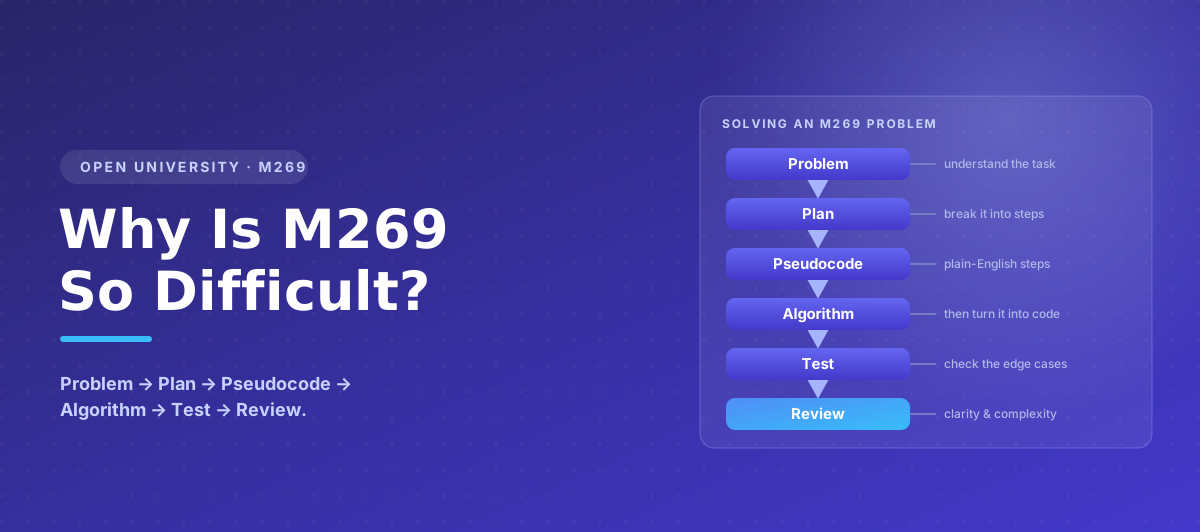
Here is a simple, generic teaching example — not a live assessed task — showing how to break a problem down. The problem: find the largest number in a list.
The point is the method, not the answer: every M269 problem gets easier when you separate planning from coding. This example is deliberately generic — never copy or reproduce a live TMA question, and keep your submitted work your own.
Assessment prep
For a Tutor-Marked Assignment, start by reading the brief slowly and making sure you answer exactly what is asked — a common, avoidable way to lose marks. A structured way to do this is to understand your TMA brief before you begin, so the requirements and command words are clear.
Then use your tutor feedback deliberately: read comments on a returned TMA, note the recurring issues, and apply them to the next one rather than filing them away. Between submissions you can review your own work for clarity and structure, and our computing assignment support explains what UK markers look for. Keep every submission your own — guidance helps you improve your work, it never replaces it.
Revision
Revise M269 by doing, not re-reading. Re-work past examples from a blank page, explain a concept aloud as if teaching it, and build a one-page summary of each algorithm with its idea, steps and complexity. Space your revision over weeks so it sticks.
The most common mistakes are avoidable:
Apply it to your own work
Marker’s Eye reviews your own written work against UK marking expectations — clarity, structure and how well you answer the task — and flags what to tighten. You make the changes; every submission stays your own.
Before your next TMA
Use this on your own study and drafts — always defer to your official M269 materials for the definitive requirements.
Why us
My Perfect Writing helps OU computing students understand their brief and review their own work — while they stay responsible for their own study, code and writing. We do not complete assessments or write TMAs.
Brief Decoder helps you read a TMA brief — the task, command words and requirements — so you answer exactly what M269 asks.
Marker’s Eye reviews your own draft for clarity and structure against UK marking expectations — you make the changes.
Guidance reflects how UK and Open University study works, including tutors, TMAs and self-directed learning.
The study, problem-solving and writing remain yours. We do not complete assessments or write TMAs for you.
Explore the tools and the free planner before deciding whether you need any further guidance.
You stay responsible for your own M269 work — our tools help you plan and review it, they do not do it for you.
Questions
Before your next TMA
Use this guide to plan steady M269 study, then let Marker’s Eye review your own written work against UK marking expectations before you submit.
Guidance should support your learning, not replace your own work.