
Gibbs’ Reflective Cycle
The six-stage model, with its distinct feelings stage — compared here with Kolb.
Not sure where to start? Talk to our support team live.

Reflective Writing
Been told to use Kolb rather than Gibbs or Driscoll? This guide explains the four stages of Kolb’s Experiential Learning Cycle, where to start it, and how to turn the cycle into a reflection that analyses rather than just describes.
The short version
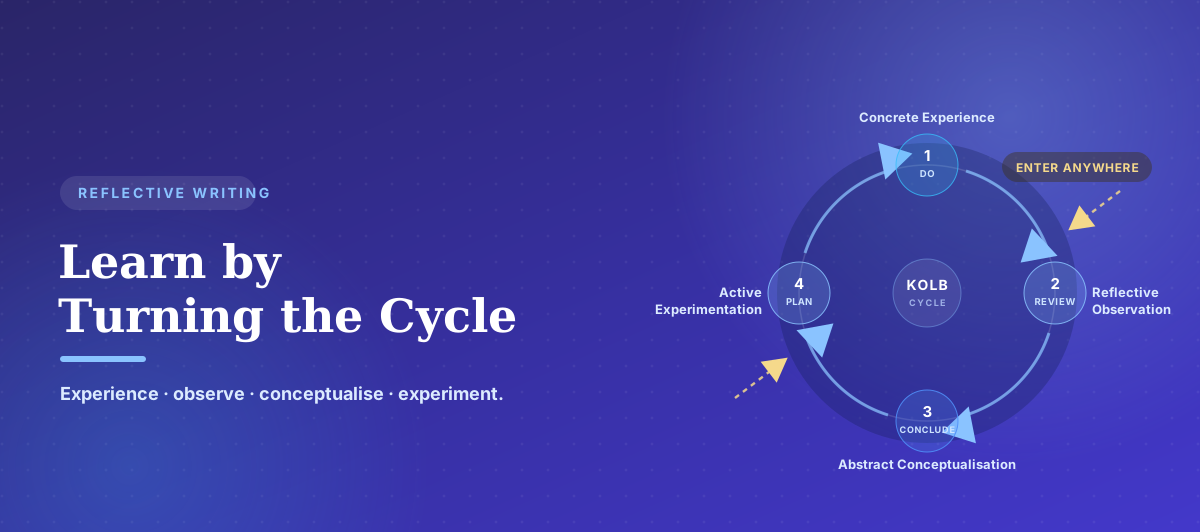
Kolb’s Experiential Learning Cycle has four stages: Concrete Experience (you do or experience something), Reflective Observation (you review it), Abstract Conceptualisation (you draw conclusions and link theory), and Active Experimentation (you plan what to do differently). Learning happens by moving through all four — and you can enter the cycle at any stage, not only at the experience.
On this page
Start here
Kolb’s Experiential Learning Cycle, set out by David Kolb in 1984, describes learning as a continuous loop: you have an experience, reflect on it, make sense of it, and then try out what you have learned — which creates a new experience, and the cycle turns again. It is one of the most widely set reflective models in UK higher education, especially in nursing, education and management, where you are often asked to learn from practice, not just read about it. If you are writing a reflective account for a nursing module, My Perfect Writing’s nursing assignment help can show you what depth UK markers expect from a reflection.
Kolb is not the only model — if you have a choice, it is worth comparing it with Gibbs’ Reflective Cycle and the Driscoll model, which this guide sets side by side later on. This one focuses on doing Kolb well.
Integrity first A reflection is your own honest account of a real experience and what you learned from it. A model gives you structure; the thinking and the words must be yours.
The framework
Kolb’s cycle has four stages, each answering a different question:
The power of the model is in the movement: a reflection that stops at stage one or two stays descriptive. The marks live in stages three and four, where you connect the experience to ideas and to future action.
A key feature
Unlike a strict step-by-step model, Kolb’s cycle is genuinely a cycle — you can join it at any point. A placement student usually starts at Concrete Experience. But you might start at Abstract Conceptualisation (you learn a theory in a lecture, then look for it in practice), or at Active Experimentation (you try a new technique deliberately to see what happens). The University of Edinburgh’s Reflection Toolkit is a good reference point on how the models differ in practice.
For a written assignment, though, present the stages in order even if you did not experience them that way — it gives the reader a clear thread. Just make sure every stage is genuinely there, not skipped to reach the conclusion faster.
See it applied
Take a nursing student who freezes during a patient handover:
Notice how the account only becomes analytical at stage three, where the experience meets evidence. That is the shift markers are looking for — and the regulator expects it too: the Nursing and Midwifery Council requires reflection as part of revalidation precisely because it turns experience into safer practice.
Choosing a model
| Model | Shape | Best when… |
|---|---|---|
| Kolb | 4 stages, a continuous cycle | You are reflecting on learning from practice and want to link experience to theory and to a next attempt |
| Gibbs | 6 stages, includes feelings | You want a detailed, guided structure and space to explore how you felt |
| Driscoll | 3 questions: What? So what? Now what? | You want a short, simple frame for a briefer reflection |
All three reward the same thing — moving from description to analysis. Follow your brief if it names a model; see the linked Gibbs and Driscoll guides for those in depth.
Check your own reflection
Marker’s Eye reviews your own reflective draft against UK marking criteria — whether you move beyond describing the experience into genuine analysis, whether you link theory, and whether your action plan is specific. You make the changes; every word stays yours.
The most important shift
The cycle is a thinking tool; your assignment is a piece of writing. The commonest way to lose marks is to narrate the experience in detail and then rush the analysis — a long stage one, a thin stage three. Aim for the opposite: keep the description brief, and spend your words on what the experience means and what you will change. That is the description-to-analysis move explained in what markers actually want, and it is where reflective writing earns its grade.
Write in the first person, but keep it academic: link to evidence, be honest about what did not go well, and make the action plan specific. Reflective writing appears across many disciplines beyond nursing — if you are working on an education or professional-practice reflection, My Perfect Writing’s education assignment help focuses on the same standards UK markers assess.
Before you submit
Run this on your own reflection before you hand it in.
Questions
Before you submit
Use this guide to work through all four stages of Kolb, then let Marker’s Eye review your own reflective draft against UK marking criteria — depth, analysis and theory — before you submit.
Guidance should support learning, not replace authorship.