
Decode an assignment brief
Read the full task before interpreting its rubric.
Not sure where to start? Talk to our support team live.

Study Skills
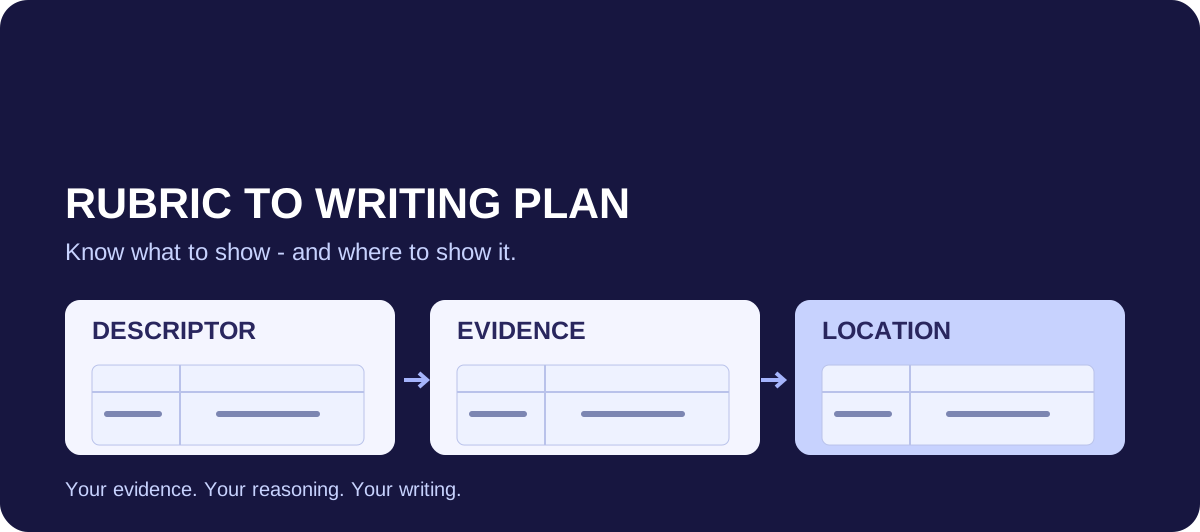
Read the rubric as a guide to demonstrable work: translate its descriptors, plan the evidence and check where each requirement appears across the assignment.
The short version
To use assessment criteria in a writing plan, retain each criterion’s exact wording, explain what it means for your task, identify the evidence needed and map where that evidence will appear. Add a self-check for the required quality. Use the actual rubric and learning outcomes; one criterion can apply across several sections, and weightings are not automatic word-count instructions.
On this page
Practical guidance
A marking rubric can look like a set of abstract qualities: “critical engagement”, “coherent argument” or “effective use of evidence”. The planning task is to work out what those qualities would look like in this assignment. Keep the original wording visible and translate it into something you can locate in the writing.
The task tells you what to produce. Learning outcomes indicate the knowledge or skills being assessed. Criteria identify dimensions of quality. Performance descriptors explain how achievement is characterised at particular levels or bands. Their exact organisation varies, so check the current module materials rather than relying on an older exemplar.
UCL’s assessment-requirements guidance encourages students to check criteria before writing. Start with the complete brief; our brief-decoding guide covers task, topic and scope. This article develops the next step: mapping rubric language to planned evidence.
| Term | Role in planning | What to record |
|---|---|---|
| Task or brief | Defines the product, question and constraints. | The required action and scope. |
| Learning outcome | Identifies a skill or understanding to demonstrate. | Which part of the task demonstrates it. |
| Criterion | Names a dimension on which work is judged. | The exact wording and relevant evidence. |
| Descriptor | Characterises a quality or level of achievement. | How that quality would become visible. |
| Weighting, if provided | Shows the stated contribution to assessment. | The official allocation and any clarification needed. |
Use your institution’s terminology. This table is a planning explanation, not a replacement assessment policy.
Practical guidance
Underline the noun and the qualifier. In “sustained critical engagement”, engagement concerns how you work with ideas and evidence; sustained asks whether that work continues through the relevant argument. A single evaluative sentence near the end may therefore leave the main body underdeveloped.
Translate a descriptor using three questions: what will the writer do; what evidence will the reader see; and what would show the requirement is not yet demonstrated? For “coherent argument”, you might check whether claims follow a clear sequence, sections contribute to the answer and the conclusion follows from the body.
Avoid replacing every descriptor with “add more detail”. Detail can help demonstrate knowledge, but it can also bury the argument. For “critical use of evidence”, the action may be comparing findings and assessing their applicability rather than increasing the number of references.
UCL’s bridge-document example illustrates the value of explaining how criteria relate to assessment sections. Your own mapper serves a similar planning purpose, while preserving the lecturer’s actual requirements.
| Illustrative criterion | Meaning for this example | Evidence and location | Self-check |
|---|---|---|---|
| Knowledge and understanding | Explain relevant concepts accurately. | Definitions used within the introduction and analysis. | Have I distinguished the concepts and applied them correctly? |
| Critical engagement | Compare interpretations and assess their basis. | Source comparisons within each analytical section. | Have I explained which interpretation is stronger and why? |
| Coherent argument | Build an answer that develops through the work. | Section claims, transitions and a justified conclusion. | Can I state how every section contributes to the answer? |
| Use of evidence | Support claims with relevant, accurately represented material. | Evidence attached to claims throughout the body. | Does each source support the specific claim I make? |
Entirely fictional university essay example. It does not reproduce a real rubric or predict a mark.
Practical guidance
Many criteria are assessed across the whole piece. A “critical analysis” section heading does not prove that analysis exists, and a references list does not prove that evidence has been used well. Record the particular claim, comparison or reasoning move that demonstrates the criterion.
For each planned section, write a one-sentence purpose and list the criteria it contributes to. Then reverse the check: for each criterion, identify the sections that demonstrate it. This two-way check helps reveal a criterion that has no evidence and a section that does not serve the task.
One paragraph may demonstrate understanding, evidence use and argument together. Do not force an artificial one-criterion-per-paragraph structure unless your brief specifically requires a separated response. Where a report has prescribed headings, work within them and show how the relevant criteria apply inside each.
Apply the guide
Use your own task and evidence. Check tool feedback against your module guidance and choose your revisions.
Practical guidance
A location note such as “main body” is only a start. Add what the evidence must do: support a comparison, establish a definition, test an explanation or justify a recommendation. Then record the actual source or data you need and what remains to verify.
Keep two columns distinct: evidence required and evidence found. Writing “recent research” in the first column does not mean that suitable research is already available. If a source is relevant only to another population or context, record that limitation rather than treating it as interchangeable evidence.
The Sussex Business School guide explains its own descriptor framework and encourages clarification with tutors. Use it as an example of institution-specific guidance, not a list every university follows. Your map should preserve the requirements of your programme.
Practical guidance
Where explicit weightings are supplied, they tell you how the assessment is allocated. They can help identify important gaps, but they do not automatically prescribe a proportional word count. A criterion such as argument or presentation may apply throughout the assignment.
First follow any stated section allocations or word limits. Then plan enough space for the reasoning each part needs. A heavily weighted criterion with no planned evidence deserves attention; adding words to a section already meeting it may be less useful than addressing a missing requirement elsewhere.
Do not invent weightings when none are published or assume equal weighting. Some rubrics are used holistically rather than as a simple sum of separate cells. If the relationship between the rubric and the final judgement is unclear, ask for clarification.
Practical guidance
A useful tutor question identifies the uncertainty and your provisional interpretation. For example: “The rubric asks for application to practice. I plan to compare the two approaches in the specified case and justify a recommendation. Does that demonstrate application, or is a separate worked scenario required?”
Similarly, ask what “wide reading” means in relation to the task if the guidance is unclear. Do not assume it means a fixed number of citations. Ask whether there are required source types, course readings or limits on the scope of the evidence.
Record the answer and its source with the planning notes. If official guidance changes, update the map. An informal interpretation from another student should not silently override published instructions.
Practical guidance
After drafting, replace proposed locations with actual sections or paragraphs. For each criterion, identify the strongest evidence and note what remains weak. “Mentioned” and “demonstrated” are different: a paragraph can mention two perspectives without comparing them.
Use simple statuses such as evidenced, partly evidenced and not yet evidenced. These are revision categories, not grade bands. Add a next action: test a claim, explain a comparison, verify a source or connect the conclusion to the body. Prioritise actions that repair the argument before cosmetic changes.
If you have an authorised exemplar, use it to identify how a quality is demonstrated, rather than copying its structure indiscriminately. Different questions can require different arrangements. Your final map must still answer your own brief.
Practical guidance
The free Assessment Criteria to Evidence Mapper includes a labelled fictional example and a blank five-part map: criterion, meaning, required evidence, planned section and self-check. Use the blank version with your actual rubric. Leave an uncertain cell marked for clarification instead of filling it with an invented rule.
Brief Decoder can help interpret the task with the supplied rubric. Its existing interface expects the actual task statement, with the rubric added separately; a rubric alone does not establish the assignment. Once you have a draft, use Marker’s Eye for review prompts and the pre-submission guide for final checks.
MPW editing and formatting support can help you review your own organisation and clarity. Students working on Pearson vocational assignments should use the separate BTEC criteria guide; its Pass/Merit/Distinction framework should not be applied automatically to a university rubric.
Questions
Your next step
Use the free planner and relevant support to improve your process. You remain responsible for the interpretation and final writing.
Follow your brief and academic-integrity requirements.