
Description vs analysis
The command-verb shift that moves BTEC work from Pass to Distinction.
Not sure where to start? Talk to our support team live.

BTEC & Vocational
A BTEC assignment is not marked like an essay out of 100. It is judged against fixed criteria—Pass, Merit and Distinction—and you either meet each one or you do not. That is why hard work can still come back as “not yet achieved”.
The short version
BTEC assignments are criteria-referenced: each Pearson unit sets Pass, Merit and Distinction criteria, and your assessor decides whether your evidence meets each one. To succeed, decode the assignment brief and its command verbs (describe, explain, analyse, evaluate, justify), produce evidence for every criterion in order, and use assessor feedback on any referral to close the specific gaps.
On this page
The real problem
Many BTEC learners write a lot, work hard and still receive a “refer” or “not yet achieved”. If you are unsure how to structure and present your work so each criterion is clearly evidenced, our editing and formatting assignment guidance can help you organise your own evidence while the research, thinking and writing stay yours.
BTEC is a Pearson vocational qualification that is criteria-referenced: instead of a mark out of 100, each unit lists Pass, Merit and Distinction criteria, and your assessor judges whether your evidence meets each one. You cannot “average out” a missed criterion—so a strong-looking assignment that skips one command verb can still fall short of the grade.
At a glance
| Grade | What the evidence must show | Typical command verbs |
|---|---|---|
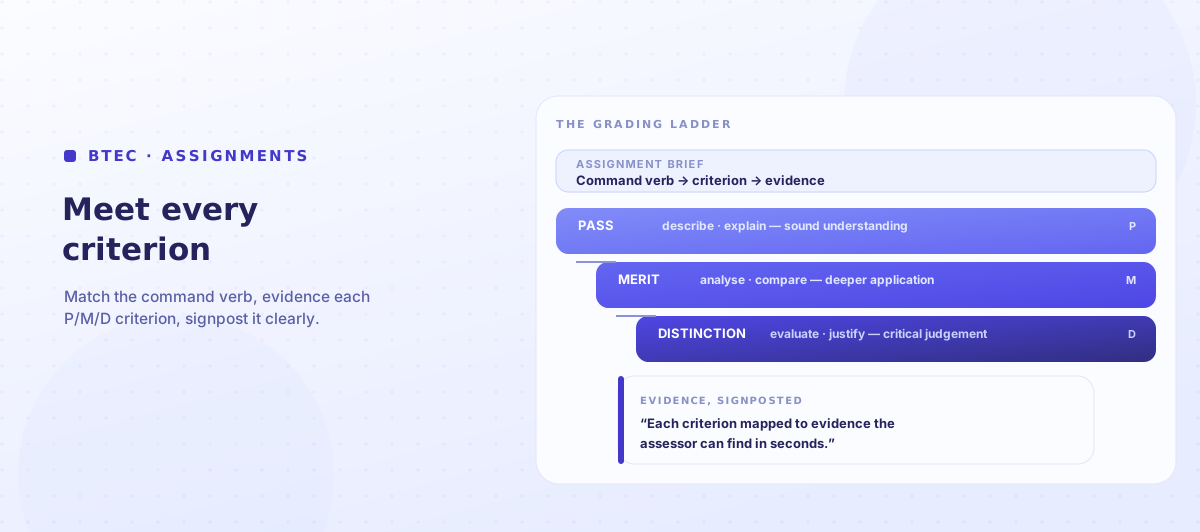
| Pass (P) | Sound understanding; the task is done correctly | describe, identify, explain, produce |
| Merit (M) | Deeper application and analysis | analyse, compare, assess |
| Distinction (D) | Critical judgement and justified conclusions | evaluate, justify, recommend |
Merit and Distinction usually build on the Pass task—you extend the same work, you do not start again.
Why students struggle
BTEC success is less about writing more and more about matching the exact evidence each criterion asks for—and making that evidence easy to find.
Before you write
Start with the assignment brief and the unit’s grading criteria side by side. For every criterion, underline the command verb and note exactly what evidence it demands. “Describe” wants an accurate account; “analyse” wants you to break something down and show relationships; “evaluate” wants a weighed judgement. When a brief is long or bundles several criteria into one task, Brief Decoder can turn it into a clear, criterion-by-criterion action list without doing the work for you.
Then plan your evidence: Which criterion does each section satisfy? What command verb does it use? Where will the assessor see it is met?
Practical framework
| Move | Purpose | Prompt |
|---|---|---|
| Target | List each P/M/D criterion in order | What exactly must I evidence? |
| Read the verb | Match the command verb to the depth needed | Describe, analyse or evaluate? |
| Assemble evidence | Gather the material that proves it | What shows this criterion is met? |
| Cite | Reference sources and keep it authentic | Is this my own, properly attributed work? |
| Evidence-check | Signpost each criterion clearly | Can the assessor find it fast? |
TRACE is a planning aid, not a template—your assignment should still read as coherent, natural work.
Reaching Merit and Distinction
Higher grades are usually the same task taken deeper, not extra tasks. If the Pass criterion asked you to describe two approaches, the Merit may ask you to analyse them (how and why they differ, with evidence) and the Distinction to evaluate them (which is better for this context, justified with a conclusion).
Signpost the step up explicitly—an assessor should be able to see where your analysis and judgement begin. For the underlying writing move, our guide to description versus analysis shows exactly how to shift from reporting to evaluating.
Worked teaching example
Pass (describe): “Two methods of promotion are social media and print advertising. Social media reaches younger audiences; print reaches local customers.”
Merit (analyse): “For this small business, social media is likely more cost-effective because it targets the 18–30 audience the product data identifies, whereas print spreads spend across readers who are mostly outside the target market.”
Distinction (evaluate): “Weighing reach, cost and targeting, social media is the stronger primary channel for this business, though a small local print run could support launch awareness. On balance, I would recommend a social-first budget with limited print, because the evidence points to better return per pound for the defined audience.”
Each level uses the same material but meets a higher command verb—which is exactly what the criteria reward.
Handling referrals
A “refer” is not a fail—BTEC usually allows one resubmission within a set window, and the assessor feedback tells you precisely which criteria are “not yet achieved”. Read that feedback as a to-do list: address the exact criterion named, not the whole assignment. If comments like “develop your analysis for M2” feel vague, Feedback Decoder can translate them into concrete revision actions—so you fix the right gap—without rewriting the work for you.
Keep your original evidence for authenticity, note what you changed, and resubmit only the improved criteria your assessor identified.
Understand the brief
Brief Decoder breaks the assignment brief into a clear, criterion-by-criterion action list—matching every command verb to the evidence you need—so you can plan the work yourself. It never writes the assignment for you.
Avoidable pitfalls
Before you submit
Check this against your own unit specification and centre guidance.
Why us
Our tools help you understand the brief and your feedback. They do not research, decide or write the assignment for you.
Brief Decoder turns the assignment brief and criteria into a clear, criterion-by-criterion plan.
Feedback Decoder converts “refer” comments into concrete revision actions.
The free tracker maps each criterion to the evidence that meets it.
You remain responsible for the evidence, analysis and final wording.
Ethical support improves your process while the assessed work remains yours.
Questions
Before you submit
Use the criteria evidence tracker to check each Pass, Merit and Distinction criterion is met and easy to find, then submit with confidence.
Your evidence, analysis and final writing remain your responsibility.