
Assignment command words explained
Continue exploring this topic with a related practical guide.
Not sure where to start? Talk to our support team live.

Study Skills
Turn a dense brief into a clear requirement map: what to do, what to cover, what evidence to use and what the assessor needs to see.
The short version
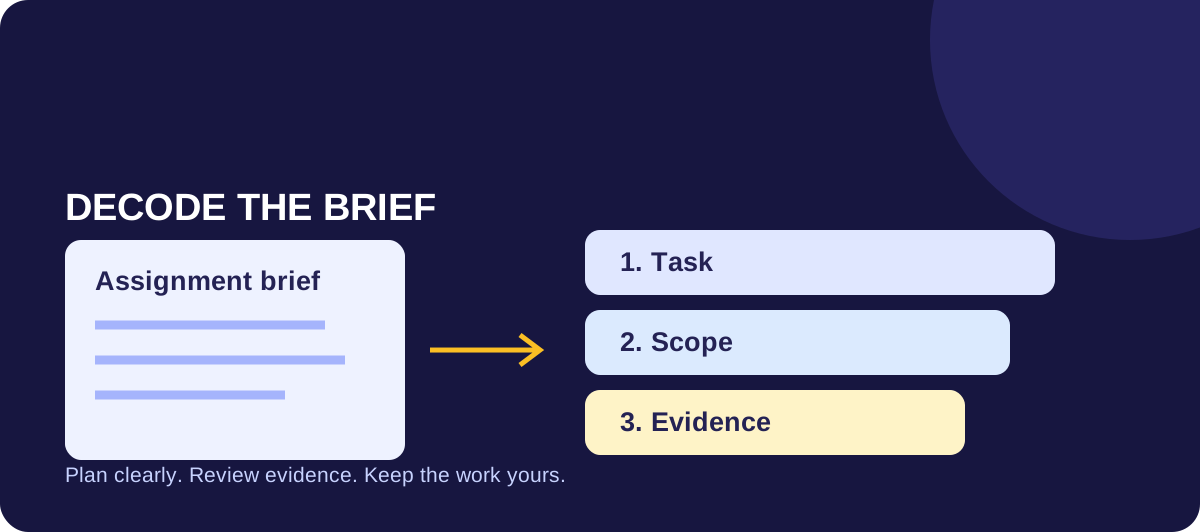
To decode an assignment brief, identify the required output, command words, topic and scope. Record constraints such as word count, evidence and referencing, then map each task to the learning outcomes and marking criteria. Turn the requirements into a provisional plan and ask your tutor about ambiguities before writing.
On this page
Practical guidance
Decoding a brief turns instructions into planning decisions. Reading only the topic can leave you answering the wrong question. My Perfect Writing’s editing and formatting support helps review your own draft, but first establish what the task requires.
Gather the brief, rubric, learning outcomes and official submission updates. Mark every required action and keep the original wording beside your interpretation. An exemplar does not override the current task.
At a glance
| Part | Question | Record |
|---|---|---|
| Output | What am I submitting? | Essay, report, reflection, presentation or another format. |
| Task | What must I do? | Analyse, evaluate, compare, justify or another command. |
| Topic | What ideas must I address? | Named concepts, problems, texts or cases. |
| Scope | What limits the answer? | Place, period, population, context or specified case. |
| Evidence | What must support my reasoning? | Required sources, data, methods or course material. |
| Assessment | How will the work be judged? | Learning outcomes, criteria and stated weightings. |
Also record deadline, word limit, referencing, file type and submission rules.
Practical guidance
In “critically evaluate two approaches to reducing staff turnover in one UK hospitality organisation”, critically evaluate is the command, approaches and turnover are the content, and one organisation limits the scope. A general essay on motivation may miss the task.
Use our command words guide for verb meanings. Monash University’s guidance also separates direction, content and limiting words. Combine all three before planning.
Practical guidance
Invented brief: “In a 1,500-word report, critically evaluate two staff-turnover approaches in one UK hospitality organisation. Use academic evidence and make justified recommendations.”
Breakdown: Submit a report; judge two approaches rather than just define them; stay within one organisation; support claims with relevant evidence; derive recommendations from the evaluation.
A provisional plan is context, evaluation criteria, analysis of both approaches, comparison and recommendations. Adjust headings and word allocation to the actual rubric. This is a planning example, not a prescribed structure or answer to submit.
Apply the guide
Use the tool to identify review priorities, then check them against your brief and evidence. You remain the author.
Practical guidance
Turn each criterion into visible work. Critical evaluation might involve comparing approaches, assessing evidence, considering limits and reaching a judgement. Use of evidence means supporting specific claims, not simply reaching a citation count.
Use explicit weightings to guide attention, but do not convert each percentage mechanically into a section word count. Criteria can apply across the report. Map each requirement to its planned location, evidence and review question.
At a glance
| Requirement | Planned response | Review question |
|---|---|---|
| Evaluate two approaches | Compare strengths, limits and feasibility | Have I made and justified a judgement? |
| Use one organisation | Apply claims to its stated context | Have I drifted into a general sector essay? |
| Use academic evidence | Select sources for specific claims | Is the evidence relevant and critically assessed? |
| Make recommendations | Derive actions from the comparison | Does each recommendation follow from the analysis? |
Use only criteria present in your own brief; do not invent hidden requirements.
Practical guidance
Quote the ambiguous instruction and explain the decision it affects: “The brief asks for a report, but the submission guide says essay. Which format should we use?” Check official updates or ask the teaching team rather than guessing.
Brief Decoder can organise an interpretation; it cannot establish unstated rules or override your assessor. Remove unnecessary personal or sensitive information before using a tool.
Practical guidance
Write a provisional one-sentence answer, then outline the claims and evidence needed to support it. Work backwards from the deadline to allow reading, drafting and revision. If a section does not answer a requirement, revise the plan before writing more.
Revisit the map when evidence changes your argument. Once you have a draft, use our pre-submission review guide to check that the answer still matches the brief.
Before drafting
Use the downloadable breakdown template as a working map, and keep your module brief as the authority.
Questions
Your next step
My Perfect Writing supports understanding, planning and draft review. Keep your decisions, evidence and final wording your own.
Follow your module brief and academic-integrity requirements.