
Writing first-class nursing assignments
Once you are on the course: structure, evidence and academic writing for UK nursing students.
Not sure where to start? Talk to our support team live.

Nursing & University Costs
Choosing a “cheap” nursing university is rarely about the headline fee — for home UK students tuition is broadly capped and similar everywhere. This guide shows how to compare the total cost: fees, living costs, placement travel, course length and the financial support you can actually get.
The short version
For home UK nursing students, tuition is broadly capped and similar across universities — around £9,790 a year in England for 2026/27 — so the “cheapest” university is rarely decided by fees. Real affordability depends on living costs, placement travel, course length, and the financial support you can actually get.
On this page
Look past the headline fee
If you are choosing where to study nursing, it helps to know the academic support that exists once you start — our nursing assignment support is one example — but the money question comes first, and it is more nuanced than a single fee. For home students in England, undergraduate tuition is capped and broadly the same everywhere: the standard limit is £9,790 for 2026/27 (it was £9,535 in 2025/26). So one university's nursing degree is rarely “cheaper” than another on tuition alone.
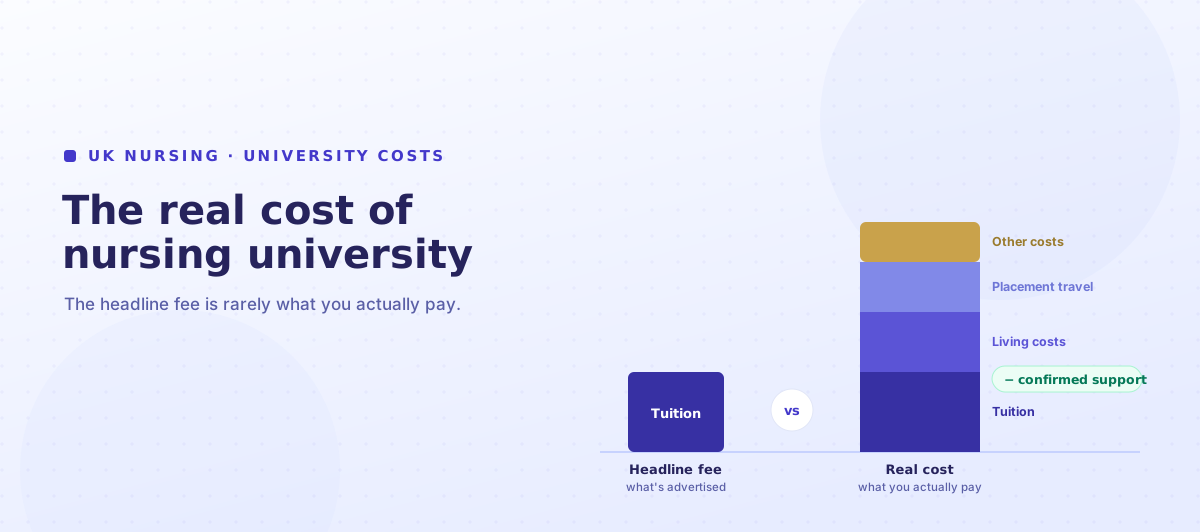
The real difference is total cost, and most of it is not tuition:
Headline fee vs real student cost
A quick note on who pays what: this fee cap applies to home students. International students pay much higher, university-set fees. And the picture differs across the UK — Wales, Scotland and Northern Ireland run their own tuition and funding systems (more on that below). Always confirm the current fee on the official university page before applying.
Where to look
Because home tuition is broadly the same, no honest list can crown an absolute “cheapest” nursing university on fees. What genuinely varies is location (which drives living costs) and the funding model where you study. The five below are established, NMC-approved nursing providers in lower-cost locations — treat them as options worth investigating, then verify the current detail on each official page.
Compare the total cost
| University | Location | Home tuition (2026/27) | Why comparatively affordable | One thing to check |
|---|---|---|---|---|
| University of Sunderland | Sunderland, North East | £9,790 (capped) | Lower average rent and living costs in the North East | Placement travel across the region |
| Teesside University | Middlesbrough, North East | £9,790 (capped) | One of the more affordable UK student cities | Which NHS trusts you would be placed with |
| University of Staffordshire | Stoke-on-Trent, Midlands | £9,790 (capped) | Low living costs and a central location | Commuting between campus and placements |
| University of Bradford | Bradford, Yorkshire | £9,790 (capped) | Among the lowest student living costs in England | Some placement partners are outside the city |
| Swansea University | Swansea, Wales | Often £0 via NHS Wales Bursary* | Lower living costs plus the Welsh funding model | The work-in-Wales commitment the bursary requires |
*Indicative for 2026/27. Wales, Scotland and Northern Ireland run their own funding schemes with different rules; always confirm the current fee and support on the official university and funding pages before applying.
Go to the source
Fees, entry requirements and placement arrangements change, so start with the primary source for each. Here are the official adult-nursing course pages for the five above:
Each also offers mental-health, child or learning-disability nursing routes — worth checking, because the funding you can claim can depend on your field (see below).
The academic side
Chosen your course? Make sense of your first assignment brief
University nursing assignments can feel very different from what you expected. Brief Decoder helps you break down the task, learning outcomes and requirements before you start planning your own work.
Decode My BriefBudget for these too
Nursing is a placement-heavy degree, so the extras add up in ways other courses do not. When you compare universities, factor in:
Money that lowers the real cost
This is where two universities with identical tuition can end up costing you very different amounts. In England, eligible pre-registration nursing students can claim the NHS Learning Support Fund (LSF) on top of student finance. For 2026/27 the main elements are:
Important caveats: the LSF is for students studying in England, you generally need to be eligible for student finance, and you must apply within the deadlines — see the official GOV.UK Learning Support Fund guidance for the current rules. It is not an automatic payment for every nursing student.
The other UK nations work differently. In Wales, the NHS Wales Bursary can cover tuition in full plus maintenance if you commit to working in Wales for up to two years after registering. In Scotland, Scottish-domiciled students studying in Scotland typically pay no tuition (funded via SAAS) and have separate nursing bursary arrangements, and Northern Ireland has its own scheme. Check your own nation's official funding pages — where you are “domiciled” matters as much as where you study.
A simple method
You do not need a spreadsheet with false precision — you need the same honest sum for each option. For any two universities, work it through the same way:
The comparison Tuition + living costs + placement/commuting travel − confirmed support = a more realistic cost picture. Do it for each university on the same assumptions, and the true difference becomes obvious.
The words that matter are “confirmed support.” Only subtract funding you have checked you are genuinely eligible for — not the maximum figure a prospectus mentions. Two universities with the same £9,790 tuition can differ by thousands once you add a high-rent city, a long placement commute, or subtract a bursary you can actually claim. The free planner below walks you through this comparison for several universities at once.
Value, not just price
Affordability matters, but a nursing degree is three years and leads to a professional registration, so weigh cost against fit:
The cheapest option is the one that is affordable and right for you — not simply the one with the lowest number on a page.
Before you write
Starting nursing study? Understand the task before you write
Before you begin an assignment, use Brief Decoder to turn a long or confusing brief into clear requirements you can work through yourself.
Try Brief DecoderBefore you accept
Use this on each offer before you decide — the answers, not the headline fee, tell you the real cost.
Questions