
Critical analysis in business essays
The same description-to-evaluation move, applied to strategy frameworks.
Not sure where to start? Talk to our support team live.

Human Resource Management
You can explain the Ulrich model, the AMO framework and hard versus soft HRM, yet still be told your essay is “too descriptive”. The missing step is not another model—it is applying HR theory to a real organisational problem and judging how well it holds.
The short version
Analytical writing in an HRM essay means applying an HR theory to a specific organisational context, supporting the point with credible evidence, weighing alternative explanations and limitations, and reaching a qualified judgement. Do not simply describe a model such as Ulrich, Guest or AMO. Show what it explains in this situation, what it misses, and why that matters for the question.
On this page
The real problem
Many HRM students revise every model on the module and still read “where is the analysis?” in the margin. If you are unsure how the command word changes what the essay must actually do, our HRM assignment guidance can help you interpret the expectations while the research, decisions and writing stay entirely yours.
The difficulty is the gap between knowing an HR framework and using it to answer a question. Description reports what a theory says. Analysis applies it to a context, explains relationships and tests what the evidence allows you to conclude. Critical analysis adds competing perspectives, limitations and organisational realities before reaching a reasoned judgement.
At a glance
| Level | What the writer does | Typical question |
|---|---|---|
| Description | States what a model (e.g. AMO, Ulrich) claims | What does the theory say? |
| Analysis | Applies the model to an organisation and explains effects | How and why does it work here? |
| Critical evaluation | Weighs evidence, alternatives, context and limits | How useful is this model for this problem? |
A strong HRM paragraph may describe a model briefly as set-up, but it spends most of its words applying and evaluating it.
Why students struggle
Critical does not mean negative. It means appropriately sceptical, evidence-led and willing to say what a model explains well in context—and what it cannot.
Reading your feedback
“Too descriptive”, “needs more critical depth” and “apply the theory” all point at the same missing move: you named a model but did not use it. When tutor comments feel vague, Feedback Decoder can translate them into concrete revision actions—so you know whether the fix is more evidence, more application, or a clearer judgement—without rewriting the essay for you.
Turn each comment into a working question for the paragraph it targets: Which organisational problem is this model helping me explain? What evidence supports it? What would an HR practitioner say against it?
Practical framework
| Move | Purpose | Prompt |
|---|---|---|
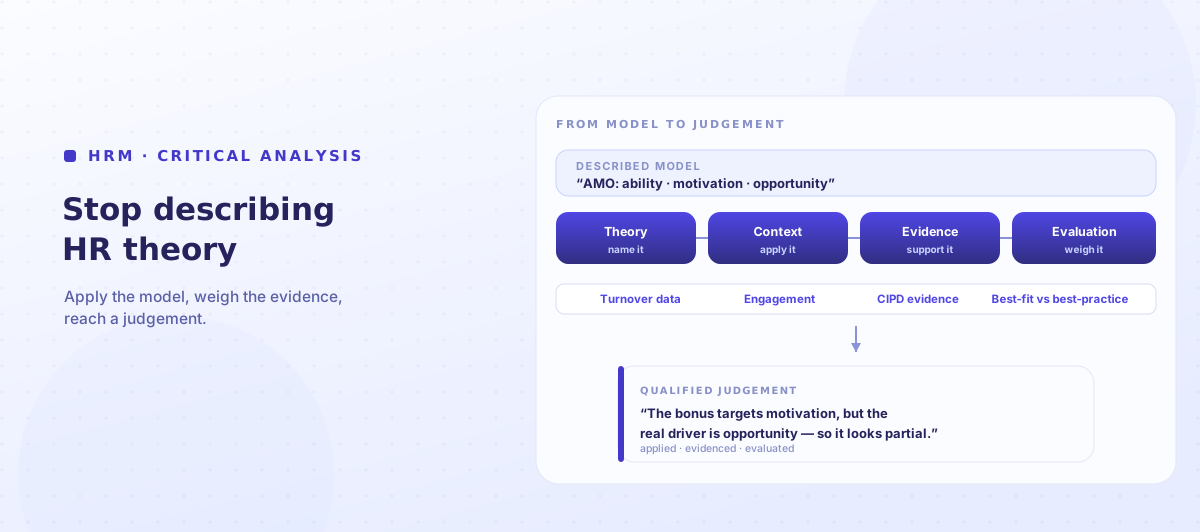
| Theory | Name the model or concept in one line | Which HR idea am I using? |
| Context | Apply it to the specific organisation or problem | How does it play out here? |
| Evidence | Support with HR data or credible research | What evidence justifies this? |
| Evaluation | Weigh limits, alternatives and significance | How well does it hold, and so what? |
TCEE is a planning aid, not a sentence formula. Paragraphs should still read naturally.
Theory into practice
A model organises attention; it does not generate a conclusion. Select the parts that help answer the question, apply them to the organisation, support the point with evidence, and identify what the model leaves out. The AMO framework (ability, motivation, opportunity) becomes analytical when you test whether a real reward change improved motivation and whether employees had the opportunity to use it—not when you merely define the three letters.
Choose deliberately between best-practice and best-fit arguments, or between hard and soft HRM, based on the case. Do not stack Ulrich, Guest, Storey and the resource-based view just to display reading; each one consumes words and must earn its place in the argument.
Worked teaching example
Descriptive: “The AMO model states that performance depends on ability, motivation and opportunity. The company introduced a bonus scheme.”
Analytical: “Framed through AMO, the new bonus targets motivation, but the retention problem appears to sit with opportunity: exit data show staff left citing limited progression, not low pay. The scheme may therefore raise short-term effort while leaving the underlying driver of turnover unaddressed. Its value depends on whether it is paired with clearer career pathways—so the intervention looks partial rather than sufficient.”
The stronger passage applies the model to real evidence, challenges the assumed cause, considers an alternative and qualifies the judgement instead of asserting success.
Evidence quality
HRM evidence comes from different places and serves different purposes: peer-reviewed studies, professional bodies such as the CIPD or SHRM, organisational metrics (turnover, absence, engagement scores), and company reports. A staff-survey statistic is useful, but an internally produced “engagement up 12%” claim should be checked against method, sample and timing before you rely on it.
Link every figure to an analytical purpose. A turnover number without a benchmark, trend or interpretation is still description. Explain the baseline, the comparison and the limitation, and never claim a practice “caused” an outcome from correlation alone. For a fuller treatment of this move, see critical analysis in business essays.
Review your analysis
Marker’s Eye reviews your own HRM essay for theory application, evidence, counter-perspective and qualified judgement against the question and rubric. You choose and make every revision.
Avoidable pitfalls
Before you submit
Check this against your own rubric and module conventions.
Why us
Our tools help you understand feedback and review your own reasoning. They do not research, decide or write the essay for you.
Feedback Decoder turns comments like “too descriptive” into concrete revision actions.
Marker’s Eye checks your own draft for theory application, evidence, evaluation and judgement.
The free planner helps you connect theory, context, evidence and evaluation.
You remain responsible for the sources, interpretation and final wording.
Ethical support improves your process while the assessed thinking remains yours.
Questions
Before you submit
Use the theory-application planner to plan each section, then review your own draft against the question and marking criteria before submission.
Your evidence, reasoning and final writing remain your responsibility.