
How to write a lab report full structure section by section
Continue exploring this topic with a related practical guide.
Not sure where to start? Talk to our support team live.

Lab Report Writing
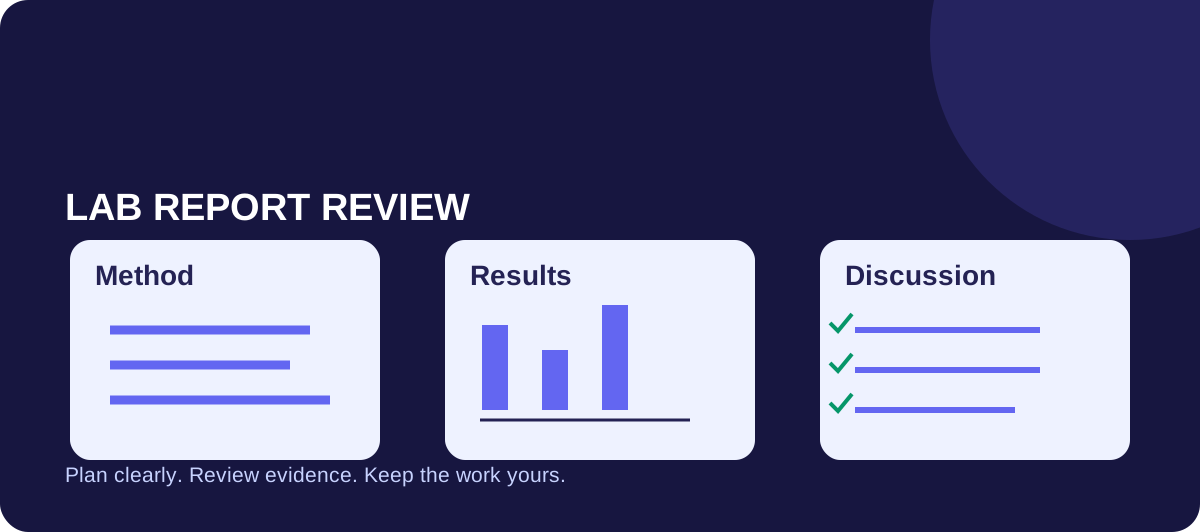
Use the function of each section to find mistakes before submission, from missing method details to conclusions that outrun the data.
The short version
Common lab report mistakes include an unclear aim, incomplete methods, missing units, poorly labelled figures, unsupported interpretations and conclusions that overstate the data. Review each section against its purpose, check that every reported value is traceable and distinguish observations from explanations. Your module instructions and rubric determine the final format.
On this page
Practical guidance
Review each section against its job: methods explain what you did, results present observations, and discussion interprets them. My Perfect Writing’s engineering assignment support helps you structure and review your own work without generating experimental findings.
Keep the brief, rubric, lab notes and source data beside your draft. If you are still planning, use our lab-report structure guide. This checklist focuses on finding and correcting errors.
At a glance
| Section | Common mistake | Check |
|---|---|---|
| Title and abstract | A vague topic or a summary missing the result | State the investigation and summarise actual findings if an abstract is required. |
| Introduction | Background without a focused aim | Connect relevant theory to the question or hypothesis. |
| Methods | Copying instructions instead of reporting work | Record what was done and relevant deviations. |
| Results | Unlabelled graphs or values without units | Make the evidence understandable and traceable. |
| Discussion | Repeating results or inventing an explanation | Interpret with evidence and assess uncertainty. |
| Conclusion | New claims or a broader claim than the study supports | Answer the aim within the evidence limits. |
Required headings and conventions vary between modules.
Practical guidance
Make the introduction lead from relevant background to the actual aim and, where appropriate, a testable hypothesis. Do not invent a hypothesis retrospectively to match an unexpected finding.
If an abstract is required, write it last. Check that its method, main result and implication agree with the body. Replace vague descriptions with findings supported by the data, and follow your module’s word limit.
Practical guidance
Report what you actually did rather than copying protocol instructions. Include relevant equipment, materials, conditions, sampling, analysis and deviations. Could a reader identify a critical setting or reproduce the procedure?
Monash University’s lab-report guidance explains the sections’ different functions. Use your department’s required voice and tense, and include details because they matter to the experiment.
Apply the guide
Use the tool to identify review priorities, then check them against your brief and evidence. You remain the author.
Practical guidance
Check table and figure labels, captions, axes, units, legends, sample sizes and text references. State what error bars represent: standard deviation and confidence intervals are different. Report only analyses you conducted and justify any exclusions transparently.
Weak: “The rate increased from 2 to 4.” Add the rate unit, conditions and relevant figure reference so the comparison is traceable. For dimensionless quantities, explain their meaning rather than inventing a unit.
Match precision to your measurements. For a closer review, see our results-section guide.
Practical guidance
Explain what the findings suggest about the aim, theory and other evidence. Consider plausible alternatives. An unexpected result is not automatically a failed experiment, and a non-significant result does not prove there is no effect.
Replace “human error” with a specific source, mechanism and implication. A calibration offset might bias readings; variability between repeats might indicate imprecision. Do not claim a direction or size without evidence. Propose an improvement that addresses the limitation.
Use our discussion versus conclusion guide to keep interpretation separate from the final answer to the aim.
Practical guidance
Fix errors in this order: data accuracy, method transparency, interpretation, then formatting. Record the location, problem and correction: “Figure 2 lacks concentration units; verify the notes and update the axis and caption.”
Keep original notes and data. If a measurement is missing, ask your supervisor about the permitted response; do not fabricate it. Check referencing and distinguish your findings from published claims before the final spelling review.
Before submission
Use the matching PDF to record your correction priorities.
Questions
Your next step
My Perfect Writing supports understanding, planning and draft review. Keep your decisions, evidence and final wording your own.
Follow your module brief and academic-integrity requirements.