
Writing the discussion section
The deep-dive companion to this guide: how to interpret your results, compare with the literature, and handle limitations.
Not sure where to start? Talk to our support team live.

Science & Lab Reports
A lab report follows a fixed structure, and marks are lost when sections blur into each other. This guide walks through every part in order — from title to references — clears up the results/discussion/conclusion confusion, and shows what markers expect from each.
The short version
A lab report follows the IMRaD structure: title, abstract, introduction, methods, results and discussion, followed by a conclusion and references. The introduction sets out the aim and hypothesis, the methods explain what you did so it can be replicated, the results present data in figures and tables, and the discussion interprets what those findings mean.
On this page
Start here
A lab report is a scientific report of an experiment you carried out: what you set out to test, how you tested it, what you found, and what it means. It is not an essay and not a diary of your afternoon in the lab — it is a structured account that another student could read and, in principle, repeat.
That word — repeat — is the key to what markers want. A strong report is clear enough that someone else could follow your method and get comparable results. Markers are really checking four things: that each section does its job, that your method is described precisely enough to be replicable, that your data is presented cleanly, and that your discussion turns those results into analysis rather than just repeating them.
None of this has to be worked out alone. If a science or engineering write-up is hard to structure, My Perfect Writing’s environmental science assignment help and engineering assignment support can help you understand what a strong report looks like in your subject — the aim is always to help you write your own, not to write it for you.
Integrity first A lab report describes work you actually did and data you actually recorded. Plan it, structure it and review it — but the experiment, the results and the writing must be genuinely yours.
The full picture
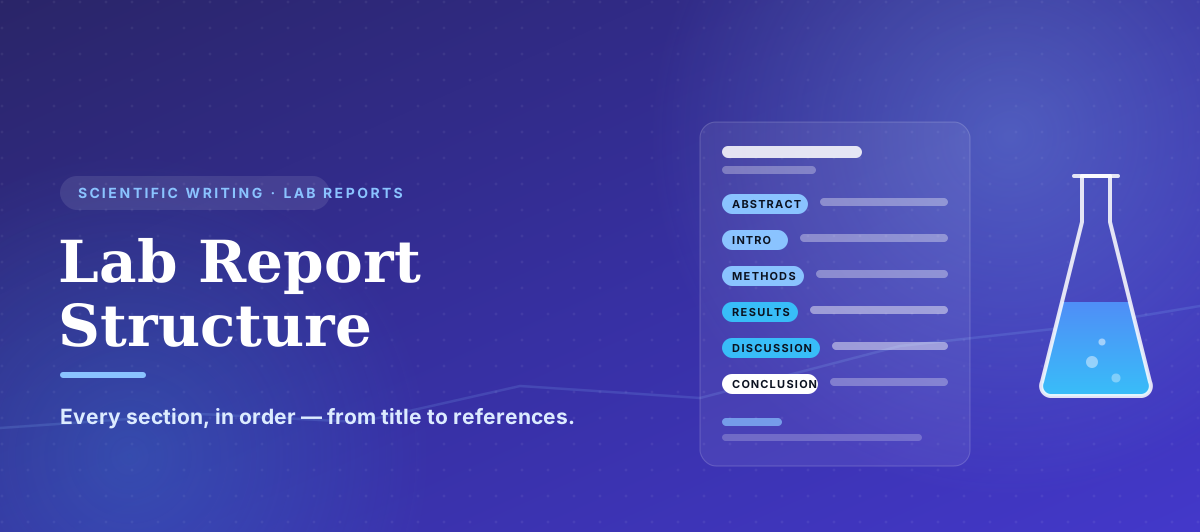
Most lab reports follow the IMRaD structure — Introduction, Methods, Results and Discussion — a standard scientific reporting format wrapped with a title, abstract, conclusion and references. Always check your module brief, but the standard order is:
The rest of this guide takes each section in turn. If you only remember one rule, make it this: every section has a job, and marks are lost when one section starts doing another section’s work.
Sections 1–2
The title should say what was investigated, specifically. “Enzyme experiment” tells a marker nothing; “The effect of temperature on the rate of an enzyme-controlled reaction” names the variables and the relationship you tested.
The abstract is a short summary of the entire report — usually 150–250 words — covering the aim, method, main result and main conclusion in a few sentences each. Even though it appears first, it is easiest to write last, once you know what the report actually says. A common mistake is treating the abstract as an introduction; it is a miniature of the whole report, results included.
Section 3
The introduction sets up the experiment. It gives just enough background theory to make the study make sense, states the aim (what you were trying to find out), and sets out your hypothesis — your testable prediction about how the variables relate.
Keep the background focused: you are framing this experiment, not writing a full literature review. A good introduction usually ends with a clear aim or hypothesis so the reader knows exactly what the rest of the report is testing. Where you draw on theory or prior studies, cite them — the details go in your references section.
Section 4
The methods section explains what you did, in enough detail that someone else could repeat the experiment and expect similar results — this is what replicability means in practice. Include the materials, the procedure, and how you controlled and measured your variables (independent, dependent and controlled).
Write it in the past tense, because the work is already done, and usually in the passive voice (“the solution was heated to 40 °C”) unless your brief says otherwise. Describe what you did — not a list of instructions to the reader. The classic failure here is a method so vague (“we heated it for a bit”) that no one could reproduce it.
Section 5
The results section presents your data — and only presents it. Use figures and tables to show your findings clearly, label each one and give it a number, and refer to them in the text (“as shown in Figure 1”). A short sentence pointing out the main trend is fine; a full explanation of why it happened is not — that belongs in the discussion.
Any calculations or basic data analysis (means, ranges, simple statistics) sit here too, presented cleanly. Like the methods, results are written in the past tense. The single most common error is interpreting your data in this section — keep “what happened” here and save “what it means” for later. If you are not sure which side of that line a sentence sits on, Marker’s Eye can review your own draft against UK marking criteria and flag where reporting should become interpretation.
Section 6
The discussion is where the marks are won or lost, because it is where you stop reporting and start interpreting: what your results mean, whether they support your hypothesis, how they compare with existing research, and what their limitations are.
It is a big topic, so we have given it its own guide rather than repeat it here. For the full breakdown — the six moves of a strong discussion, an annotated example, and how to handle unexpected or negative results — read how to write the discussion section of a lab report. If you find your discussion keeps slipping back into description, our guide on description vs analysis: what markers want shows exactly where the line sits.
Clearing up the confusion
These three sections trip students up more than any other, because they all deal with “the findings” — but each handles them differently. The results report the data, the discussion interprets it, and the conclusion answers the aim in a sentence or two. The table below shows what belongs where, and what markers are looking for.
At a glance
| Section | What belongs here | Commonly confused with | What markers look for |
|---|---|---|---|
| Results | The data itself — figures, tables, values, observed trends. No interpretation. | Discussion (students explain the data too early) | Clear, labelled figures/tables and accurate reporting of what happened. |
| Discussion | Interpretation: why results occurred, comparison with research, limitations and implications. | Results (repeating data) and Conclusion (over-summarising) | Genuine analysis linked to the hypothesis, not a re-list of the results. |
| Conclusion | A short, direct answer to your aim — the key takeaway in one or two sentences. | Discussion (turning it into a second, longer analysis) | A concise, evidence-based answer that introduces no new data. |
Rule of thumb: results = what happened · discussion = what it means · conclusion = the short answer to your aim.
The finishing details
References. Any theory, background or prior study you mention must be cited in your required academic referencing style — Harvard, APA, Vancouver or IEEE are all common, so follow your department’s guide and stay consistent throughout. If you are weighing up two systems, our guide to Oxford vs Harvard referencing explains how each one works in practice.
Formatting. Number every figure and table and refer to them by number; keep tense consistent (past tense for what you did and found, present tense for established facts); and use clear section headings so a marker can navigate at a glance.
Length. There is no universal word count — a lab report is as long as it needs to be to report the experiment clearly, and your brief or rubric is the real authority. As a rough guide, undergraduate reports often run 1,000–3,000 words, with the abstract kept to 150–250. Precision beats padding: markers reward a tight, complete report over a long, repetitive one.
Avoid these
Free resource
Not sure what belongs in each lab report section? Our Lab Report Structure & Discussion Workbook maps every section for you, gives prompts to turn your results into analysis, and lists what markers expect — so you can check your structure before you submit rather than after you get the grade back.
Grab the workbook Use the free resource card on this page to get the Lab Report Structure & Discussion Workbook sent to you — it’s built to sit next to your draft as you write.
Apply it to your own report
Marker’s Eye reviews your own lab report against UK marking criteria — structure, clarity, and whether your results turn into genuine analysis — and flags where description should become interpretation. You make the changes; every word stays yours.
Before you submit
Run this on your own draft before submission — or let Marker’s Eye check it against UK marking criteria first.
Why us
My Perfect Writing helps UK students understand their brief, review their own drafts and identify clear next steps without taking control of their work away from them.
We provide structured guidance and feedback on your own work. We do not write submission-ready assignments or replace student authorship.
Our tools focus on the areas UK markers assess, including task relevance, critical analysis, evidence, structure and academic integrity.
Instead of vague comments, students receive focused guidance showing what needs attention and what they can improve themselves.
Students can use focused tools such as Marker’s Eye and can also contact a human representative when they need additional guidance.
Students can explore the relevant report or tool before deciding whether they need further support.
You stay responsible for your own work — Marker’s Eye guides and reviews your draft, it does not write it for you.
Questions
Before you submit
Use this guide to plan each section, then let Marker’s Eye review your own lab report against UK marking criteria before you submit — so weak analysis and blurred sections get caught early.
Guidance should support learning, not replace authorship.