
Full lab report structure
See how every section fits together.
Not sure where to start? Talk to our support team live.

Lab Report Writing
The discussion explains what your findings mean; the conclusion leaves the reader with the answer. Keeping them distinct makes both sections clearer and more useful.
The short version
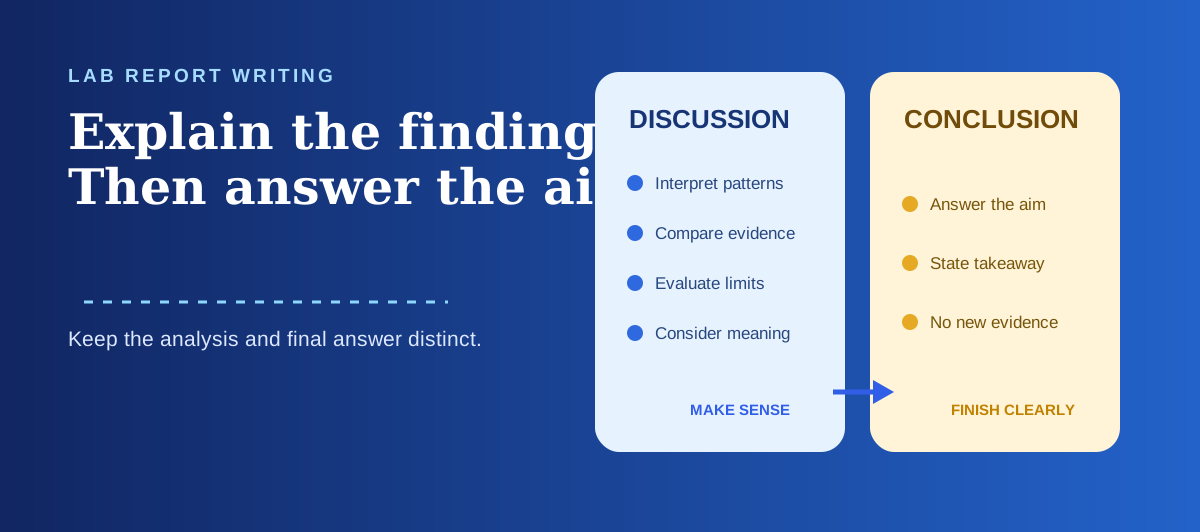
In a lab report, the discussion interprets the findings: it explains patterns, compares them with expectations or literature, evaluates limitations and considers implications. The conclusion is much shorter: it directly answers the aim or research question and states the main takeaway without introducing new evidence or extended analysis.
On this page
The key distinction
Students often merge these sections because both appear after the results. Their jobs are different. The discussion is where you interpret the results, explain whether they support the aim or hypothesis, connect them to relevant evidence and evaluate limitations. The conclusion is the final, concise answer to the aim. For guidance on the expectations of science writing, My Perfect Writing’s environmental science assignment help supports understanding and reviewing your own work, not writing it for you.
For the full report sequence, see how to write a lab report, and keep results separate using our guide to the results section.
Sort the content
| Put this in the discussion | Put this in the conclusion |
|---|---|
| Interpret the key pattern or result | State the direct answer to the aim or research question |
| Compare findings with expectations, theory or literature | Give the most important takeaway in a few sentences |
| Evaluate limitations, error and their likely effect | Mention the central qualification only if necessary |
| Explain implications or sensible next steps | Do not introduce new data, citations or detailed analysis |
Always follow the structure your module specifies; some disciplines combine both sections.
Do the analytical work
Open with the most important finding, then explain what it suggests in relation to the aim. Compare it carefully with expected results or credible sources, being precise about agreement and difference. Next, evaluate limitations: not as a list of excuses, but as factors that may have influenced the evidence. End the discussion by considering what the finding means and what a justified next investigation might examine.
Useful scientific discussion needs cautious language. The University of California San Diego’s scientific-writing guidance is a helpful independent starting point; your module brief remains the authority on length and format.
Review the boundary
Marker’s Eye can help you review your own lab report for clarity, structure and the boundary between reporting, interpreting and concluding. You decide every revision and remain the author.
Finish cleanly
A conclusion should be short because the analysis has already happened. Return to the aim or research question, give the answer the results support and state the main significance. Do not paste in the discussion’s limitations paragraph, add a new result or make a claim stronger than the evidence allows.
For wording that stays measured and formal, the University of Manchester Academic Phrasebank can help you find patterns, but adapt them to your own evidence and discipline.
Final edit
Some lab-report formats combine a discussion and conclusion, so check your brief before separating them.
Why us
My Perfect Writing helps you understand report conventions, plan a clearer structure and review a draft you have written. We do not fabricate data, interpret results for you or write assessed lab reports on your behalf.
Guidance helps you separate results, discussion and conclusion before your structure becomes repetitive.
Prompts help you relate your own findings to the aim, evidence and limitations using appropriately cautious language.
Marker’s Eye can flag unclear structure or explanation in your own writing so you can decide what to improve.
You remain responsible for accurate data, honest limitations, source use and claims that match the evidence.
The planning approach can be reused for future practical reports rather than solving only one assignment.
Use feedback to strengthen your own scientific communication, accurately and with integrity.
Questions
Before submission
Use your module brief and marking criteria to review your own lab report. Marker’s Eye supports draft review; it does not write conclusions or guarantee a grade.
Your findings, judgement and writing stay your own.