
Business & management research topics
Where B100 can lead — how to choose a strong business or management research focus as you progress.
Not sure where to start? Talk to our support team live.
Business & Study Skills
B100 is broad rather than deep, so the real challenge is its scope and the step up to academic writing and referencing. This UK guide explains what B100 covers, why students struggle, and how to plan your study and prepare strong TMAs.
The short version
B100, the Open University’s An Introduction to Business and Management, is a Level 1 module that is broad rather than advanced. It feels hard mainly because of its scope across every business function and because it is many students’ first experience of academic writing and referencing. With steady study and clear, well-referenced TMAs it is very manageable — follow your own module materials for specifics.
On this page
The basics
B100 is the Open University module An Introduction to Business and Management. It is a broad Level 1 module that introduces how organisations work and gives you the academic and professional skills to study business at university level — often as the first step of a business or management degree.
Its themes span the whole organisation: what business and management are, different types of organisation, the functional areas of marketing, people and human resources, operations and finance and accounting, the external environment businesses operate in, and an introduction to strategy and working with data. Running alongside the subject content are the study skills that matter most in your first year: academic writing, referencing, reflective writing and using evidence. For the exact units, assessment structure and study calendar, always rely on your official module website and materials.
The honest answer
B100 is an introduction, but plenty of students still find it demanding — and the reasons are consistent:
Reassurance “Challenging” is not “impossible”. B100 is designed to build these skills from scratch. The breadth becomes manageable with a steady weekly plan, and the writing gets easier fast once you understand what markers actually want.
Making sense of the scope
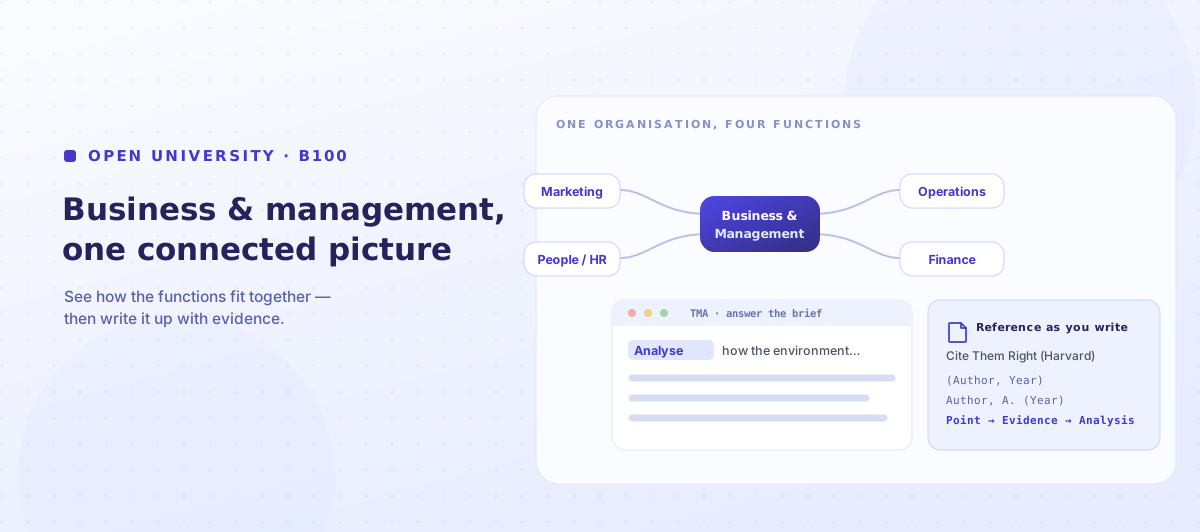
The scope of B100 is what surprises most students, so it helps to see the module as a map of one organisation rather than a list of unrelated subjects. Marketing, people, operations and finance are all different views of the same business trying to create value — which is why the module keeps returning to how the functions connect.
Practically, that means two things. First, keep a one-page summary per topic — the core idea, a key term or two, and a real example — so the breadth stays organised. Second, look for the links: when you learn about operations, ask how it affects finance; when you learn about marketing, ask who in the organisation delivers it. Seeing the connections turns a long list into a coherent picture you can actually use in a TMA.
Topic map
| Area | What it covers | Why it feels hard | How to build the skill |
|---|---|---|---|
| Marketing | Understanding and reaching customers | Lots of models and jargon | Apply one model to a brand you know |
| People & HR | Managing and motivating people | Theory feels abstract | Link a theory to a real workplace |
| Operations | Turning inputs into outputs | Processes seem invisible | Map how one product is made or served |
| Finance & accounting | The numbers behind decisions | Numbers intimidate non-maths students | Read one simple statement slowly |
| External environment | Economic, social, tech forces | Wide and always changing | Use a PESTLE-style checklist |
| Academic writing | Structured, evidenced writing | A step up from everyday writing | Write to a clear point + evidence |
| Referencing | Citing sources correctly | Fiddly and easy to slip | Follow one referencing guide closely |
A study aid only — always follow your official B100 materials for the definitive scope, referencing style and assessment.
The core skill
For many students, the biggest step up in B100 is not the business content — it is academic writing. Academic writing is structured, formal and built on evidence: you make a clear point, support it with a source or example, and explain how it answers the question. It is a skill, and B100 is where you build it.
Two habits help most. First, answer the question that is actually asked — many marks are lost by describing a topic instead of addressing the specific task. Second, reference consistently using the style your module specifies (the OU widely uses Cite Them Right Harvard). Keep a running list of your sources as you read, so citing them later is quick and accurate. If you want a clearer sense of what UK markers reward in business writing, our business assignment support explains what they look for.
A simple example
Here is a short, generic teaching example — not a live assessed task — showing the difference between describing and analysing, which is where many B100 marks are won or lost. Imagine a TMA asks you to discuss how the external environment affects a named business.
The lesson is that B100 rewards analysis, not just description: always push a point on to “so what does this mean for the organisation?” This example is deliberately generic — never copy or reproduce a live TMA question, and keep your submitted work your own.
Study planning
Because B100 is broad and reading-heavy, consistency beats intensity. Protect a regular study slot and work through the material steadily rather than cramming before a TMA. A workable weekly rhythm:
The free planner below turns this into a reusable tracker with a topic map, a TMA template and a feedback log. For official study-skills and assessment guidance, the Open University Help Centre is the place to check, and the free OpenLearn business resources offer extra background reading.
Assessment prep
For a Tutor-Marked Assignment, the hardest part is often simply working out what it wants. Read the brief slowly and note the command word (describe, explain, analyse, evaluate), because it tells you the depth expected — a structured way to start is to understand your TMA requirements so nothing is missed. Then plan your structure before you write, support each point with evidence, and reference consistently.
Once you have a draft, use tutor feedback deliberately: note the recurring comments on a returned TMA and apply them to the next one. Between submissions you can review your own writing against UK marking expectations for clarity, structure and analysis, then make the changes yourself. Keep every submission your own; guidance helps you improve your work, it never replaces it.
Revision & pitfalls
Revise B100 by practising short, structured answers to past-style prompts rather than only re-reading the units. Build a one-page summary per topic and rehearse turning a concept into an applied, evidenced point — that is the skill the TMAs test.
The most common mistakes are avoidable:
Before you start writing
Brief Decoder helps you unpack a B100 TMA — the command word, the requirements and what earns the marks — so you answer the real question instead of describing the topic. The ideas and the writing stay yours.
Before your next TMA
Use this on your own study and drafts — always defer to your official B100 materials for the definitive requirements.
Why us
My Perfect Writing helps OU business students understand their brief and review their own written work — while they stay responsible for their own study, ideas and submissions. We do not complete assessments or write TMAs.
Brief Decoder helps you read a TMA brief — the task, command word and requirements — so you answer exactly what B100 asks.
Marker’s Eye reviews your own written TMA against UK marking expectations for clarity, structure and analysis — you make the changes.
Guidance reflects how UK and Open University study works, including tutors, TMAs and self-directed learning.
The study, ideas and writing remain yours. We do not complete assessments or write TMAs for you.
Use the free Study & TMA Planner to map the module and plan your assignments before you need any further guidance.
You stay responsible for your own B100 work — our tools help you plan and review it, they do not do it for you.
Questions
Before your next TMA
Use this guide and the free planner to plan steady B100 study, then let Brief Decoder help you unpack exactly what your TMA is asking before you write.
Guidance should support your learning, not replace your own work.