
Choosing accounting research topics
Turn a broad accounting interest into a focused, feasible research question.
Not sure where to start? Talk to our support team live.

Accounting & Finance
You can recite relevance, faithful representation and the definition of an asset, and still freeze when a question asks whether an item should be recognised. The Framework is not a list to memorise—it is a reasoning tool you apply to real transactions.
The short version
The IASB Conceptual Framework for Financial Reporting sets out the objective of general purpose financial reporting, the qualitative characteristics of useful information, and the definitions of assets, liabilities, equity, income and expenses, plus recognition, derecognition and measurement guidance. It is not a standard. In assignments you apply it: test an item against the element definitions and recognition criteria, choose a measurement basis, and justify a conclusion.
On this page
The real problem
Most accounting students can list the two fundamental qualitative characteristics and the definition of an asset, yet still lose marks when a question asks them to use the Framework on a transaction. If you are unsure what a Framework question is actually asking for, our accounting and finance assignment guidance can help you interpret the requirement while the analysis, judgement and writing stay yours.
The IASB (International Accounting Standards Board), through the IFRS Foundation, issues the Conceptual Framework for Financial Reporting to underpin IFRS Standards and to guide judgement where no standard applies. The exam or coursework rarely asks you to repeat it; it asks you to apply it—which is a different skill.
Clear up the confusion first
| The Conceptual Framework | An IFRS Standard |
|---|---|
| Sets the objective and concepts of reporting | Sets specific accounting rules for a topic |
| Guides the IASB when writing standards | Applies directly to transactions |
| Assists judgement where no standard applies | Takes precedence where it does apply |
| Defines assets, liabilities, income, expenses | Prescribes recognition, measurement, disclosure |
A standard wins where it addresses a transaction; the Framework fills gaps and explains the reasoning behind the rules.
Why students struggle
Applying the Framework well is judgement, not memory. You are showing why information would be useful to investors and lenders, and building an argument that another accountant could follow.
Before you write
Underline the command word and the object of judgement. “Explain the objective” wants concepts; “apply the Framework to determine whether X is an asset” wants the definition and recognition test worked through; “critically discuss faithful representation” wants a weighed argument. When the wording is dense or the requirement bundles several tasks, Brief Decoder can turn it into a practical plan without writing the answer for you.
Then convert the marking criteria into a working question per section: Which element definition applies? Are the recognition criteria met? Which measurement basis best serves relevance and faithful representation?
Reference map
| Component | What it establishes | How you use it in an answer |
|---|---|---|
| Objective of reporting | Useful information for investors, lenders, creditors; stewardship | Justify why a treatment aids decision-usefulness |
| Qualitative characteristics | Relevance and faithful representation; enhancing characteristics | Test whether the information is useful and well-represented |
| Elements | Asset, liability, equity, income, expense definitions | Check the item against the definition first |
| Recognition & derecognition | When to include or remove an element | Decide if and when it enters the statements |
| Measurement | Historical cost and current value bases | Select and justify how the item is measured |
Enhancing characteristics—comparability, verifiability, timeliness, understandability—improve useful information but cannot make irrelevant or unfaithful information useful.
Concepts as tests
The two fundamental characteristics are relevance (capable of making a difference to decisions, including confirmatory and predictive value, subject to materiality) and faithful representation (complete, neutral and free from error). Apply them as questions about a specific number: Would this affect an investor’s decision? Does the figure faithfully depict the economic substance?
Note that the Framework frames neutrality as supported by prudence—caution under uncertainty—which is not the same as deliberate understatement. Substance over form is captured within faithful representation. Using these ideas as tests, rather than reciting definitions, is what turns a pass into a strong answer.
Worked teaching example
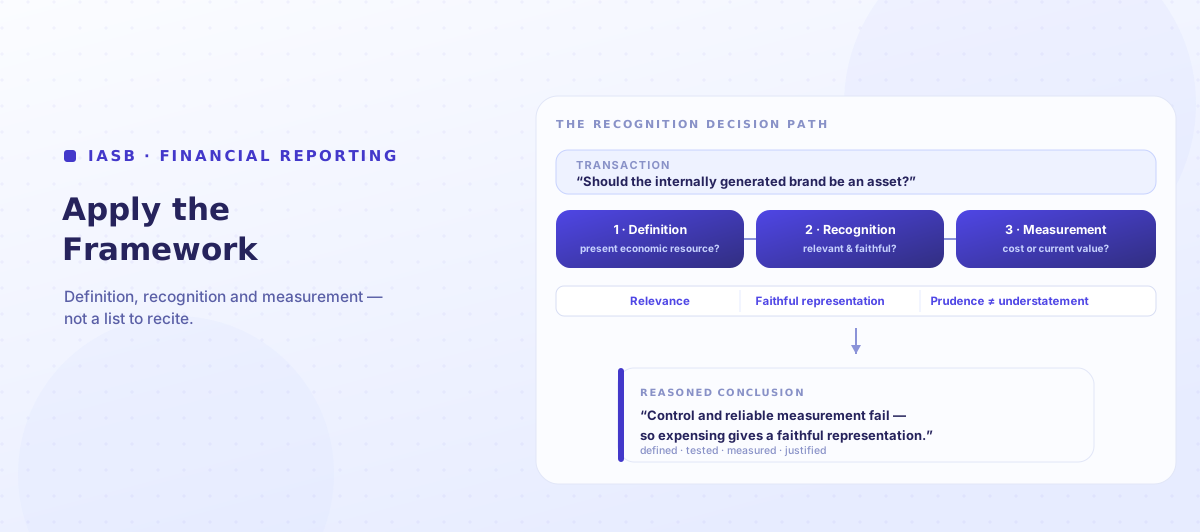
Question: a company spends heavily building an internal brand and wants to recognise it as an asset. Should it?
Applied answer: “First, the element definition: an asset is a present economic resource controlled as a result of past events. The brand may create expected economic benefits, but control and reliable identification are questionable for an internally generated brand. Second, recognition: information must be relevant and provide a faithful representation; if the amount cannot be measured with sufficient reliability, recognition may not give useful information. On balance, the internally generated brand appears to fail the recognition test even if it has value—so expensing the expenditure gives a more faithful representation.”
The strong answer moves definition → recognition → measurement → judgement, and explains why at each step rather than asserting a rule.
Authority and integrity
Refer to the IFRS Foundation and IASB materials your module sets, and distinguish the Framework from the specific IFRS Standard when both are relevant. Where a comparison helps, you can contrast the IASB approach with the FASB conceptual framework, but only if the question invites it.
Avoid essay-mill “model answers” that assert conclusions without the reasoning; markers reward the judgement path, not the verdict. Keep your interpretation and wording your own. For choosing a strong dissertation angle later, see our accounting research topic handbook.
Understand the requirement
Brief Decoder converts a dense accounting requirement into a step-by-step plan—what to define, test and measure—so you can apply the Framework yourself instead of guessing. It never writes the answer.
Avoidable pitfalls
Before you submit
Check this against your own rubric, module materials and the specific standards in scope.
Why us
Our tools help you understand the requirement and review your own reasoning. They do not solve the problem, choose the treatment or write the answer for you.
Brief Decoder turns dense accounting task wording into a clear, actionable plan.
Marker’s Eye checks your own draft for definition, recognition, measurement and justification.
The free worksheet helps you test a transaction against the Framework step by step.
You remain responsible for the judgement, citations and final wording.
Ethical support improves your process while the assessed reasoning remains yours.
Questions
Before you submit
Use the application worksheet to work a transaction through definition, recognition and measurement, then review your own draft against the requirement and rubric.
Your analysis, judgement and final writing remain your responsibility.