
100+ accounting dissertation topics
A large bank of UK-focused accounting dissertation ideas to spark and shortlist your own topic.
Not sure where to start? Talk to our support team live.

Accounting & Study Skills
The wrong accounting topic can cost you months; the right one makes everything after it easier. This UK handbook explains why choosing is so hard, the criteria that separate a strong topic from a weak one, and how to narrow a broad area into a researchable question.
The short version
A high-impact accounting research topic is relevant, feasible, backed by available data and genuinely adds something new — and it fits your assignment brief and marking criteria. The best approach is to start from a current area such as audit reform, ESG reporting, AI in accounting or tax policy, then narrow it into one focused research question you can realistically answer with the data and time you have.
On this page
The basics
Choosing a research topic is the highest-leverage decision you make in an accounting project — a strong topic makes the reading, analysis and writing flow, while a weak one fights you for months. If you want help judging whether an idea is realistic and aligned with what markers reward, our accounting and finance support can help you think it through, while the research and the writing stay entirely your own.
“High-impact” does not mean the biggest or most ambitious topic; it means one that is relevant, feasible and genuinely useful — and that you can actually answer within your word count, timeframe and access to data. This handbook walks through the criteria that separate a strong topic from a weak one, the areas worth exploring right now, and how to narrow a broad theme into a single research question. For scope and requirements, always follow your own assignment brief and marking rubric.
The honest answer
Most students get stuck for the same handful of reasons:
Reassurance A good topic is engineered, not stumbled upon. Score your ideas against clear criteria, check the data exists, and narrow ruthlessly — and a strong, feasible question emerges.
The framework
| Criterion | Ask yourself | Red flag |
|---|---|---|
| Relevance | Does it matter to the field or practice now? | Answers a question nobody is asking |
| Feasibility | Can I answer this in my word count and time? | Needs a PhD-sized study |
| Data availability | Can I actually access the data or sources? | Relies on confidential or missing data |
| Novelty | Does it add a new angle or context? | Already answered many times over |
| Alignment | Does it fit the brief and marking criteria? | Ignores the assignment’s requirements |
A study aid only — always follow your assignment brief and marking rubric for the definitive requirements.
Where to look
| Area | Example angle | Why it matters |
|---|---|---|
| Audit quality & reform | Has UK audit reform improved audit quality since recent corporate collapses? | Live regulatory debate |
| ESG & sustainability reporting | How comparable is ESG disclosure across a sector? | Fast-growing, data-rich |
| AI & automation in accounting | How is automation reshaping the bookkeeper’s role? | Reshaping the profession |
| Tax policy | Effects of a specific tax change on small businesses | Concrete, measurable impact |
| Forensic accounting & fraud | What warning signs preceded a known fraud case? | Case-study friendly |
| Management accounting | Activity-based costing in a service setting such as the NHS | Applied and practical |
Illustrative angles only — refine any of these into a single, answerable question suited to your brief and available data.
The core skill
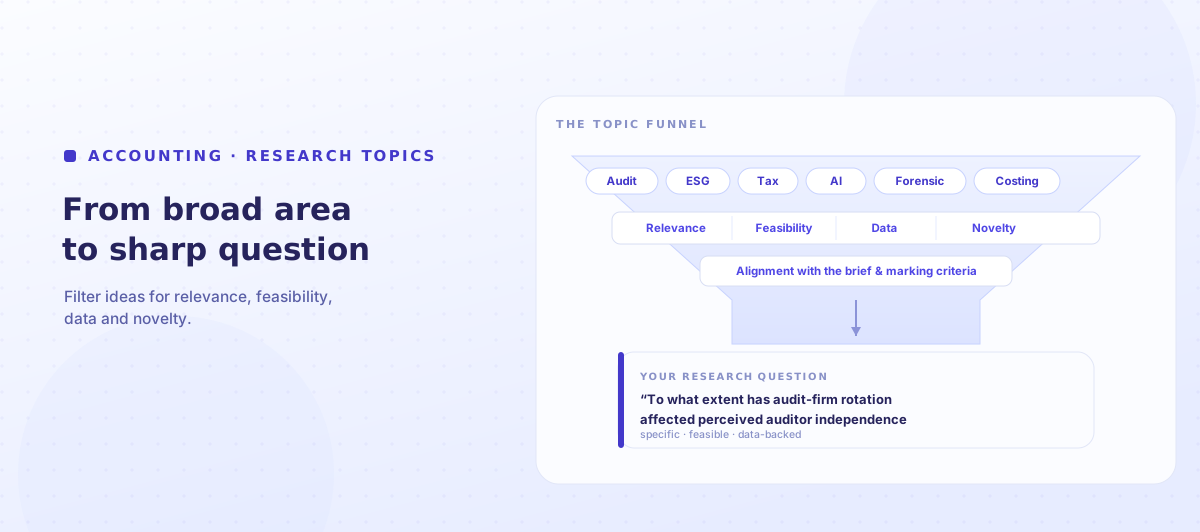
The move that unsticks most students is narrowing: turning a broad area into one specific, answerable question. Add scope on three axes — who/what (a sector, company type or standard), where/when (a country and time period), and what relationship you are examining.
Here is a short, generic example of the funnel:
That final version is specific, time-bound and answerable with public data. Once you have a question at this level, choosing methods and structure becomes far easier — and you can move on to structuring the project around it.
Reality check
Before you commit, pressure-test the topic. Can you actually get the data — company reports, databases, survey participants — within your timeframe? Is the scope realistic for your word count? And, crucially, does the topic answer what the assignment is actually asking for? Marks are lost when a strong topic quietly drifts from the brief.
It is worth taking a moment to understand exactly what your assignment requires — the task, the weighting and the marking criteria — so your chosen topic is aimed at the marks from the start. For authoritative background on live regulatory debates such as audit reform, the Financial Reporting Council is a reliable source.
Before you commit
Brief Decoder helps you read your assignment brief and marking criteria — the task, the weighting and what earns the marks — so you can choose a topic aimed at the assessment from the start. The topic and the research stay yours.
Pitfalls
Avoid the errors that cost students most:
Before you commit
Use this on your own topic ideas — always defer to your assignment brief and marking rubric for the definitive requirements.
Why us
My Perfect Writing helps accounting students choose a feasible topic and understand exactly what their assignment requires — while they stay responsible for their own research, analysis and writing. We do not choose topics for you or complete assignments.
Brief Decoder helps you read the assignment brief and marking criteria so your chosen topic is aimed at the marks from the start.
The free Topic Selection Planner scores your ideas on relevance, feasibility, data and novelty so you commit with confidence.
Guidance reflects UK accounting study, assessment and current regulatory debates.
The topic, research and writing remain yours. We do not choose topics or complete assignments for you.
Use the planner to shortlist and narrow your topic before you need any further guidance.
You stay responsible for your own accounting work — our planner and tools help you choose and scope it, they do not do it for you.
Questions
Before you start researching
Use this handbook and the free planner to narrow a high-impact topic, then let Brief Decoder help you check it against exactly what your assignment is asking for.
Guidance should support your learning, not replace your own work.