
Dissertation structure
Place the discussion within the complete project.
Not sure where to start? Talk to our support team live.

Dissertation Writing
Build a discussion that explains what the findings mean, how they relate to prior research and how far the evidence supports the answer to your research question.
The short version
A dissertation discussion interprets findings in relation to the research question and relevant literature. Organise it around questions, themes or key findings; explain agreement, disagreement and unexpected results; test alternative explanations; and show how limitations affect the claims. Derive implications from that reasoning. Follow your handbook on separate or combined results and discussion chapters.
On this page
Practical guidance
Your findings show what the research produced. The discussion explains the meaning and significance of those findings in relation to the question you set out to answer. It is where you examine how your results fit with prior work, which interpretations remain plausible and what the study can reasonably claim.
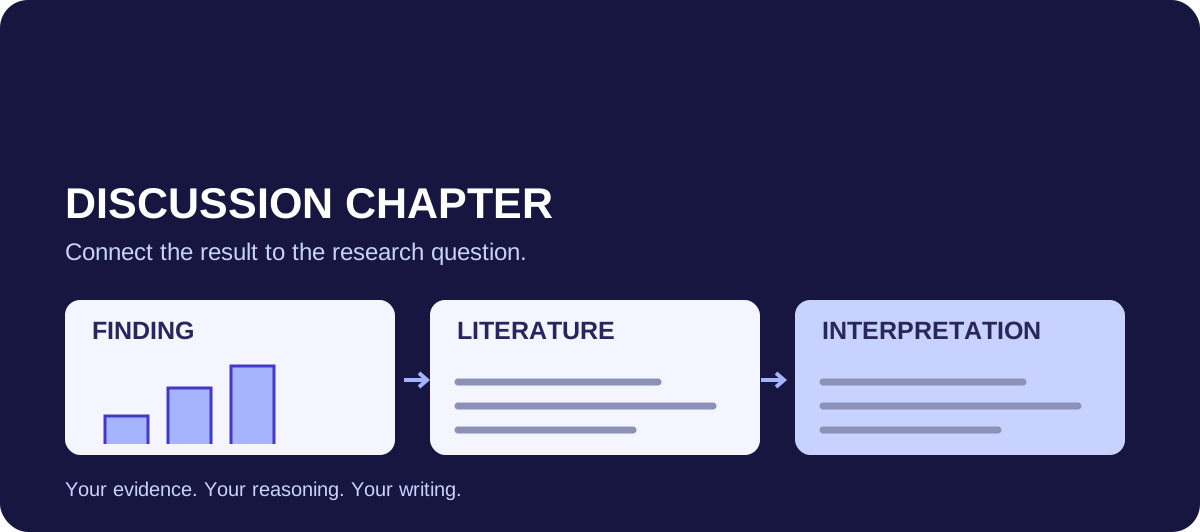
A chapter that only restates tables or themes leaves this work unfinished. Conversely, a discussion that drifts into general opinion loses its connection with the evidence. Keep a traceable chain from finding to interpretation, literature, research question and the boundaries of the claim.
The University of Leeds dissertation guidance shows that findings and discussion can be combined or presented separately. Use your handbook and disciplinary conventions rather than assuming a universal chapter number or format. Our dissertation-structure guide covers the wider project; this article develops the interpretation within the discussion.
| Part | Main job | Useful check |
|---|---|---|
| Results or findings | Present the relevant outputs of the research. | What does the evidence show? |
| Discussion | Interpret, compare and qualify those outputs. | What does this mean for the question and literature? |
| Conclusion | Draw together the answer and contribution of the project. | What can the whole study reasonably conclude? |
The functions may appear in combined chapters. Follow the structure agreed for your dissertation.
Practical guidance
List the findings that are necessary to answer each research question. For each one, record where it appears in the results and what interpretation it might support. This prevents an interesting but peripheral result taking over the chapter.
Next, identify relevant literature from the review and any additional reading legitimately needed to interpret the finding. Note whether it agrees, disagrees or examines a different context. A disagreement is not automatically a research error; methods, population, setting or concepts may differ.
Keep an uncertainty column. If the evidence does not discriminate between two explanations, say so. If a research question is only partly answered, record which part is supported and which remains unresolved. The map is an argument planning tool, not a device for making every finding fit the expected answer.
| Step | Planning question | What to record |
|---|---|---|
| Finding | What did the study actually show? | A precise result or theme and its location. |
| Interpretation | What might it mean? | A reasoned explanation and plausible alternatives. |
| Literature | How does it relate to prior work? | A verified comparison, including contextual differences. |
| Research question | Which part of the question does it answer? | The specific contribution to the answer. |
| Limitation | What restricts this interpretation? | The effect on the claim, not a generic apology. |
| Implication | What follows within those limits? | A proportionate theoretical, practical or research implication. |
Repeat this map for the findings that matter. Not every finding needs equal discussion space.
Practical guidance
Fictional planning example: imagine a small qualitative study exploring how first-year students use peer feedback. A reported theme concerns feedback becoming more useful when students discuss its meaning. No actual participants, quotations or empirical findings are being claimed here.
The interpretation could be that discussion helps students clarify an actionable next step. An alternative is that students already confident about revision are more likely to seek discussion. The map should record both possibilities before choosing the explanation best supported by the actual data.
The literature comparison would examine verified research on interpreting and using feedback, noting differences in setting and design. The research-question link concerns how students use feedback, rather than whether discussion causes higher marks. A small self-selected qualitative sample would limit claims about how common the pattern is and would not establish a causal grade effect.
A proportionate implication might be to investigate opportunities for feedback dialogue, not to assert that every university should adopt one intervention. In a real dissertation, replace this imagined pattern with your analysed finding and accurately represented literature.
Apply the guide
Use your own task and evidence. Check tool feedback against your module guidance and choose your revisions.
Practical guidance
“This agrees with previous research” is a starting note, not a developed comparison. Identify what agrees: the pattern, proposed mechanism, theoretical interpretation or practical context. Then explain why the comparison matters for your question.
Where findings differ, compare the studies before deciding what the difference means. Different samples, definitions or methods may account for it. A study examining reported preferences is not directly interchangeable with one measuring behaviour. Avoid claiming that your work disproves a theory when it has tested only a narrow part of its application.
Sheffield Hallam’s dissertation guidance recommends connecting the discussion to research questions and the literature review. Use those earlier chapters as the foundation, but do not repeat the review source by source. Bring literature into the discussion because it helps interpret a particular finding.
Practical guidance
An unexpected finding deserves a careful explanation, not concealment. Return to the research design, data and assumptions. Could the result reflect the context, a measurement issue, an alternative mechanism or the limits of the sample? Identify which explanations are supported and which remain speculative.
For quantitative work, avoid treating a non-significant result as proof that no effect exists. Interpretation depends on the estimate, uncertainty and design. For qualitative work, a contradictory account can complicate a theme and reveal conditions under which an interpretation changes. Follow the analytical approach used in your project.
Distinguish what was planned from what emerged during analysis. Do not silently rewrite a hypothesis after seeing the results. If you develop a new interpretation, label it accurately and explain how it arose. Where further analysis would be needed, acknowledge that boundary instead of presenting the explanation as settled.
Practical guidance
A limitations paragraph should do more than list time, sample size and access. Connect each relevant limitation to a particular inference. For example, a narrow setting may restrict transfer to other contexts; self-reported data may limit conclusions about actual behaviour; a design without an appropriate comparison may limit causal claims.
Separate limitations that matter to interpretation from minor imperfections that do not materially affect the argument. Do not say that the whole study is worthless because it has boundaries. Explain what remains supported and what would require a different design or further evidence.
Place qualifications near the claims they affect, then synthesise major limitations where the chapter structure requires it. Readers should not have to reach the final page to discover that a central interpretation is uncertain.
Practical guidance
A theoretical implication concerns how the finding informs a concept, explanation or relationship. A practical implication concerns what a relevant audience might consider. A future-research implication identifies an unresolved question and an appropriate way to investigate it. Select those supported by your project rather than filling all categories mechanically.
For the fictional feedback example, a practical implication could concern examining opportunities for dialogue in the setting studied. A research implication might compare different forms of discussion or examine students who did not engage. Neither permits a claim that dialogue improves grades without evidence designed to test that outcome.
Use conditional language when the evidence requires it and specify the context. A recommendation should have a visible route back to a finding and its interpretation. If that route cannot be drawn, reconsider whether the recommendation belongs in this dissertation.
Practical guidance
A workable separate-chapter outline is: a short orientation to the research questions and major findings; themed sections interpreting the most relevant findings; a synthesis across those sections; major limitations and their effects; and proportionate implications. Adapt the order to the handbook, discipline and evidence.
Organising by research question can make coverage clear. Organising by theme can work when findings interact across questions. Avoid reproducing the entire results order merely because it is available: choose an order that builds the explanation.
Within each section, begin with the relevant finding, develop its interpretation, compare literature and qualify the claim. Use transitions to explain how the next section contributes to the overall answer. In a combined findings-and-discussion chapter, make the shifts between reporting and interpretation easy to follow.
Practical guidance
Students familiar with a lab report discussion example may recognise the movement from result to explanation. The dissertation often requires a more sustained account across research questions, themes and an established literature review. Do not copy a short lab-report template without checking whether it fits the project.
Our lab report discussion guide serves that narrower scientific-report task. The transferable idea is the link between evidence and interpretation, not a universal chapter length, heading list or writing formula.
Qualitative, quantitative and literature-based dissertations also differ. A literature-based project may synthesise arguments rather than report newly collected participant data. State what counts as a finding in your design and build the discussion around that material.
Practical guidance
Complete the free Dissertation Discussion Chapter Planner for one major finding first. Its six-part map follows the article’s sequence and includes an outline and revision checklist. An empty literature link suggests further comparison is needed; an implication with no finding behind it suggests overreach.
Marker’s Eye provides rubric-led feedback on your own draft alongside the brief and criteria. Check any review comment against your methods and evidence; tool feedback cannot verify results you have not supplied. MPW thesis support focuses on connecting chapters, methodology and supervisor feedback, while editing support can help with clarity and presentation.
Keep the research, interpretation and final wording your own. Your next step is to trace one discussion claim back to its finding, source comparison and limitation. Once that chain is secure, build the next section around the same discipline of reasoning.
Questions
Your next step
Use the free planner and relevant support to improve your process. You remain responsible for the interpretation and final writing.
Follow your brief and academic-integrity requirements.