
Description vs analysis
Make your writing more your own by turning generic summary into specific, critical analysis.
Not sure where to start? Talk to our support team live.
AI Authenticity
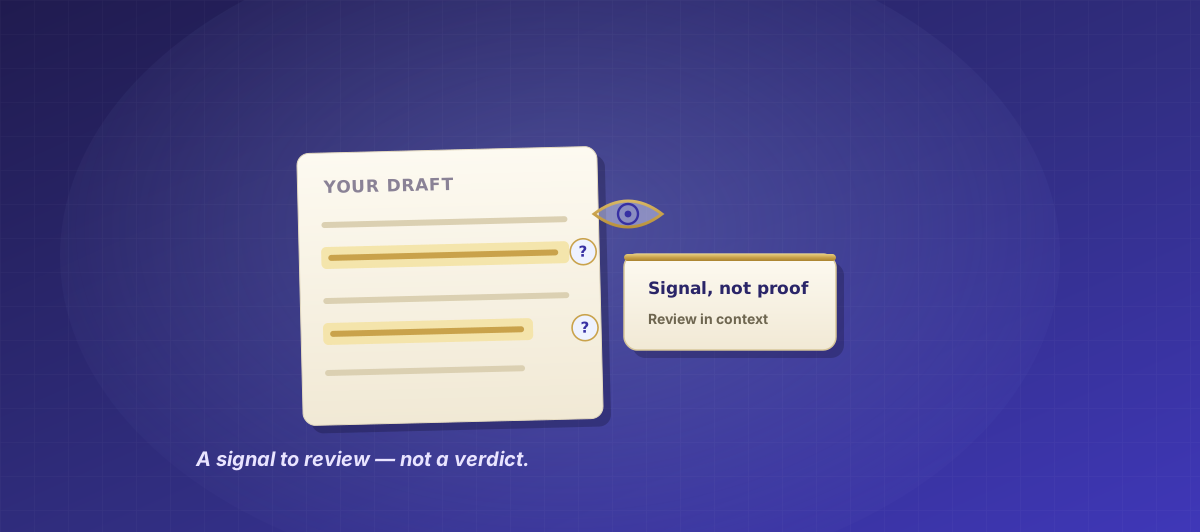
AI-writing and authenticity tools produce signals, not verdicts. This UK guide explains what those signals may indicate, why they are not proof of misconduct, how to review flagged sections in context, and how to respond honestly — by improving clarity and following your university’s AI-use policy, never by trying to “beat” detection.
The short version
Authenticity or AI-writing signals flag text that resembles patterns a tool associates with AI or with other sources. They are indicators, not proof of misconduct: detectors are imperfect and can produce false positives. Review any flag in context, check your own drafts and notes, and follow your university’s AI-use and academic-integrity policy.
On this page
The basics
An authenticity or AI-writing signal is a tool’s estimate that a passage resembles patterns it associates with AI-generated text, or that it matches other sources. It is a probability or a highlight, not a factual record of how the text was written. The tool has not watched you work; it is pattern-matching against a model.
That matters because a signal answers “does this look statistically similar to X?”, not “did a person write this?”. Treat a flag as a prompt to look more closely — an invitation to review — rather than a conclusion. This is general guidance; your university’s own definitions and policy always take precedence.
Read it carefully
No detector is fully accurate, and none should be treated as proof of misconduct. Detectors produce false positives — flagging genuine, human-written work — particularly for writing that is clear, formulaic, or by students writing in an additional language. They also carry inherent uncertainty: results are estimates, not measurements.
Different tools can return different results on the same text because they use different models, training data and thresholds. A high score from one tool and a low score from another does not mean one is “right” — it shows how tentative these signals are. Responsible institutions treat a signal as one input to a human judgement, alongside context and academic-integrity processes.
Keep it in proportion
| A signal is | A signal is not |
|---|---|
| An estimate of similarity to a pattern | A record of how the text was written |
| A prompt to review in context | A verdict or an accusation |
| Sometimes wrong (false positives) | Reliable or fully accurate |
| One input among many | Standalone evidence of misconduct |
| Tool- and threshold-dependent | Consistent across every detector |
A study aid only — always defer to your university’s academic-integrity policy and process.
The method
If a section is flagged, review it calmly and in context. Read the passage within the whole document, and check your own drafts, notes, outline and version history — these show your writing process and are your best record of authorship. Compare the style of the flagged lines with the rest of your work: is it consistent with how you write elsewhere?
A short example. A student’s introduction is flagged. Instead of panicking, they reread it in context, and confirm they wrote it — they have earlier drafts and notes. They notice the flagged lines are generic, formulaic phrasing, so they rewrite them in their own clearer voice with specific detail. If anything is genuinely unclear, the responsible next step is to ask the tutor for clarification rather than guess. A flag is a reason to look again, not to hide anything.
Know the rules
Universities set their own rules on whether and how AI tools may be used, and those rules vary by institution, course and even assignment. Read your AI-use policy and academic-integrity guidance before you use any tool, and follow any declaration or disclosure requirement — some courses ask you to state what AI use was permitted and how you used it. When in doubt, ask; disclosing permitted use is always safer than assuming.
You can read how we think about responsible AI in study on our AI usage policy and academic integrity pages, and the QAA publishes sector guidance on academic integrity for UK higher education — but your own institution’s policy is the one that governs your work.
The right response
The goal is never to disguise writing so a detector stays quiet; that solves nothing and risks your integrity. If your own writing was flagged, the constructive response is to make it clearer and more your own: add specific detail, examples and your own reasoning, and replace generic, formulaic sentences with precise ones in your voice. Writing that reflects your genuine understanding is both stronger academically and less likely to read as generic.
That is a normal editing skill — the same work as turning description into analysis. Reviewing your own draft for clarity and argument is where our Marker’s Eye can help; you make the changes, and every word stays yours.
Avoid these
These responses make things worse:
Apply it to your own work
Marker’s Eye reviews your own draft against UK marking expectations — clarity, argument and where generic writing could be more precise and more your own — so you can improve it honestly. You make the changes; every word stays your own.
A responsible final review
Use this on your own work — your university’s policy and process are the authority on any concern.
Why us
My Perfect Writing helps you understand your task and review your own writing for clarity — while you stay responsible for your own words and for following your university’s policy. We do not write your work.
Marker’s Eye reviews your own draft for clarity and argument, so you can strengthen your writing honestly.
Brief Decoder helps you read the brief so your work answers it in your own words.
Our guidance supports learning and disclosure, never detection evasion or misconduct.
The thinking and writing remain yours. We do not complete assessments.
Use the free review guide to respond to a signal responsibly before deciding whether you need more help.
You stay responsible for your own work and for following your university’s policy — our tools help you review it, they do not do it for you.
Questions
Before you submit
Use this guide to review authenticity signals responsibly and follow your university’s policy, then let Marker’s Eye review your own draft for clarity before you submit.
Guidance should support your learning and integrity, not replace your own work.